Showing posts with label starters. Show all posts

Saturday, 14 September 2013

Chrono des Nations 2013

20.10.2013 Official Site
France, ITT, 20.87km
UCI 1.1

Race report here

After several months in which there's been a race every weekend (sometimes, two for each weekend) the Chrono Champenois marked the beginning of a five-week period with no Elite Women's races at all, a sign that the end of another cycling season is almost over.

The Chrono des Nations isn't quite the last event of 2013 because the African Championships will take place in November, but it's the last non-championship race until 2014.

History
The Chrono started life as the Chrono des Herbiers in 1982, when it was open to men only (a British rider, Gary Dowdell, won that year; another one called David Akam won a year later - and thanks to two victories by Chris Boardman in 1993 and 1996 and one for David Millar in 2010, Britain is the second most successful nation in race history after the French, who have seven wins). The women's race, which was added in 1987, is especially interesting in that it reflects the long career of Jeannie Longo which, whether one considers her an inspiration or a (probably doping) dinosaur, is remarkable: she won the first edition, then won again in 1992, 1995, 2000, 2009 and 2010 and is still racing to this day. She will turn 55 years old eleven days after this race.

In 2006, organisers joined forces with the organisers of the now-defunct Grand Prix des Nations, which had been in existence since 1932 and was widely regarded as a Classic (the only time trial to be given that honour) and as an unofficial World Championship in the days before the time trial was added to the official UCI Championships - it was at the GP des Nations that Beryl Burton, the most successful British athlete of all time, surprised the men in the race when she achieved a time not too far off that of winner Felice Gimondi in 1968. With the introduction of an official World Time Trial Championship in 1994, the GP began to decline in importance and when the ProTour series was inaugurated in 2005 it was omitted from the UCI calendar. When the two races merged, the Chrono des Herbiers became the Chrono des Nations.

2011/2012 winner Amber Neben
Previous Winners
1987 Jeannie Longo, 1988 Maria Canins, 1989 Maria Canins, 1990 Astrid Schop, 1991 Nathalie Gendron, 1992 Jeannie Longo, 1993 Roselyne Riou-Chalon, 1994 Marion Clignet, 1995 Jeannie Longo, 1996 Chrystèle Richard, 1997 Zulfiya Zabirova, 1998 Zulfiya Zabirova, 1999 Zulfiya Zabirova, 2000 Jeannie Longo, 2001 Edwige Pitel, 2002 Zulfiya Zabirova, 2003 Margaret Hemsley, 2004 Edwige Pitel, 2005 Edwige Pitel, 2006 Priska Doppmann, 2007 Susanne Ljungskog, 2008 Susanne Ljungskog, 2009 Jeannie Longo, 2010 Jeannie Longo, 2011 Amber Neben, 2012 Amber Neben

The Parcours
The name Les Herbiers comes from the lush and abundant plant life in the area, made possible by the rain - the Vendée department averages around 75mm in October, slightly more than London or Paris (which are famously rainy in Autumn). Since the Chrono takes place in late October, rain often affects the race: even if it doesn't rain during the race, slippery conditions can create problems - and there are a number of points along the route that are absolutely ideal places for treacherously slippery wet leaves to accumulate.


View Chrono des Nations 2013 in a larger map

Though much of the parcours is characterised by the long, fast straights that permit riders to crank up their cadences in search of high speeds and fast times, the five turns need to be treated with some caution. The first, leading from the Rue du Onze Novembre 1918 onto the Rue Nationale, can be hazardous due to the large number of trucks that use the route - spilled diesel is almost impossible to see but is highly slippery, especially during and after rain. The second turn, on the D755 leading onto the D79 at Le Croix Barat, has a traffic island placed slightly off-centre just around the apex of the turn; it was presumably put there to slow down traffic and considerably reduces space. The third turn, on the D79 at La Bonneliere, looks tight on the map but has plenty of room for a cyclist to negotiate it at speed; however, the road surface here is poor and there may be patches of loose gravel (it may also have been repaired recently). The fourth turn, on the D23 at St-Paul-en-Pareds, comes at the bottom of a short descent; it may be very slippery in wet conditions and there may be patches of loose gravel - fortunately, there is plenty of space. The fifth and final turn is in Les Herbiers at a roundabout between the Rue d'Ardelay and the Av. de la Gare; it's a very tight turn (almost 180 degrees) and wet leaves tend to collect on the road, forming a skidding hazard. The road in the short tunnel on the D755 may be slippery, but it's straight and shouldn't cause problems.


As revealed by the altitude profile, this is quite a rolling parcours though the gradient becomes challenging at only one point. There is a short descent immediately after the start, then the road climbs from the first turn and gains around 40m in 2km at an average gradient of 2%. This is followed by a fast descent along the D755 to a point just under 5km from the start where the road climbs again, this time gaining 64m in 2km - the average gradient is, therefore, 3.2%, but there's a much steeper section at 5km which surpasses 6% for around 0.15km, the steepest gradient on the parcours. Another descent with sections at -3.8% leads to the second turn, then flatter terrain leads to the third turn which is followed by the steepest downhill section with one short stretch at -7.1% - a chance for some riders to shave a few seconds off their times in the dry, potentially a dangerous road in the wet. From 15km the road climbs again for 2km, becoming no steeper than 3%; the remainder of the route is relatively flat with the exception of a 0.15km section which nears 3% along the Av. de la Gare leading to the finish.

Starters
1 (38) Bravard Charlotte Vélophile naintréenne Poitou-Charentes
2 (37) Artaud Audrey CSM Epinay-sur-Seine Ile-de-France
3 (36) Genee Laudine VC St-Malo Bretagne
4 (35) Fenart Ophélie CSM Villeneuve-la-Garenne Ile-de-France
5 (34) Sero Coralie Comité du Morbihan Bretagne
6 (33) Rochedy Emilie VS Romans-Péage Rhône-Alpes
7 (32) Vekemans Anisha Topsport-Vlaanderen Belgique
8 (31) Strappazzon Marine VC St-Julien Rhône-Alpes
9 (30) Longo Borghini Elisa Hitec Italie
10 (29) Favre Mathilde Lointek France
11 (28) Solovey Hanna équipe d'Ukraine Ukraine
12 (27) Rival Lucile US Pontchâteau Pays de la Loire
13 (26) Burgess Jay Ecosse Grande-Bretagne
14 (25) Leleu Fanny ASPTT Amiens Picardie
15 (24) Caetano Isabel CSM Epinay-sur-Seine Portugal
16 (23) Duval Joanne US Guérande Pays de la Loire
17 (22) Islas-Garcia Roxana Bourgogne Pro Dialog Mexique
18 (21) Parot Danièle Indre Vélo Passion Centre
19 (20) Drysdale Larissa Cycle Sport Groningue Pays-Bas
20 (19) Gambier Kelly CSM Villeneuve-la-Garenne Ile-de-France
21 (18) Simmonds Hayley GBCycles.co.uk Grande-Bretagne
22 (17) Rival Elodie US Pontchâteau Pays de la Loire
23 (16) Turvey Anna Ecosse Grande-Bretagne
24 (15) De Saint Jean Magdalena VC La Pomme-Marseille Provence
25 (14) Shaw Julia Grande-Bretagne
26 (13) Stienen Jutta équipe de Suisse Suisse
27 (12) Van Houweling Molly Metromint Cycling Team Etats-Unis
28 (11) O'Donnell Bridie Total Rush Hyster Australie
29 (10) Valsecchi Silvia BePink Italie
30 (9) Brulee Latoya CyclelivePlus-Zannata Belgique
31 (8) Lesueur Mélodie CM Aubervilliers Ile-de-France
32 (7) De Vocht Liesbeth Rabobank Liv/Giant Belgique
33 (6) Pitel Edwige SC Michela Fanini France
34 (5) Schwager Patricia équipe de Suisse Suisse
35 (4) Longo Jeannie ASPSA Rhône-Alpes
36 (3) Tetrick Alison Exergy Twenty 16 Etats-Unis
37 (2) Zabelinskaia Olga RusVelo Russie
38 (1) Neben Amber équipe des Etats-Unis Etats-Unis

Getting There
As already discussed, Vendée typically experiences rainy weather during October and, by the time the race takes place, temperatures will have fallen (and may even drop below freezing at night). However, Les Herbiers can be reached easily by road and, as a result, going to see the race could be an ideal short holiday for hardier cyclists looking for one last adventure on the bike before the weather turns too cold - in addition to the women's race, there are races for Elite Men, Male and Female Espoirs, Male and Female Juniors and for Cadets (mixed) taking place between the 15th and 21st, a cyclosportive and other sports in addition to various events going on around town including music (the jazz band is promising; the rest - including Veronique Cadanse and her accordion - might not be that tempting to foreign visitors), a Mexican evening (and why not?), a bike fair and, because this is France, more local food and drink than you could ever hope to consume and still ride home.

The most practical route to make the journey by bicycle would be to start at St-Malo in Brittany, to which ferries sail from Portsmouth. St-Malo to Les Herbiers is approximately 260km avoiding motorways, a distance that a very fit cyclist could cover in a day and most serious cyclists could easily manage in two days. The route suggested by Google is here. The journey by car is roughly the same distance and would take around three hours in light traffic; the route suggested by Google is here. Les Herbiers is not connected to the train network; however, Cholet is and lies just 25km away, making it possible to get most of the way there before cycling the remainder. Do check before buying tickets, though, as traveling on SNCF trains with a bike is not as simple a process as might be expected. Nantes Atlantique international airport is 70km away, a distance that can be covered easily by bicycle in an afternoon; the route suggested by Google is here.

Following the Race
The Chrono has its own radio station which is broadcast over the Internet as well as locally on 89.7fm. The official Twitter account is @ChronoNations; hashtags #LeChrono2013 and #chronodesnations return various results - use them to share any news you come across, too.

Are you going to the race? Could you provide reasonably regular and accurate coverage via Twitter? Let me know and I'll list you as a way to follow the race here!

Tuesday, 10 September 2013

Premondiale Giro Toscana Int. Femminile-Memorial Michela Fanini 2013

11-15.09.2013 Official Site
Italy, 4-stage (+ prologue) Road Race, 461.22km
UCI 2.HC

Michela Fanini, born in Lucca on the 23rd of March in 1973, became National Road Race Champion of Italy in 1992 and won the Giro Donne in 1994. She was a rider with enormous potential, one who gave all the signs of becoming one of cycling's greatest stars had she not have been tragically killed when her Peugeot 205 hit a wall and rolled over on the 16th of October 1994. Her memory lives on, in the team S.C. Michela Fanini-Rox and in the name of this race.

The race consists of a prologue and four stages. In the case if Stages 2 and 4 the organisers have, for some reason, decided not to employ the standard technique of naming stages after the towns in which they start and end, using the names of the : Stage 1, Bottegone - Massa e Cozzile, actually ends in Montecatini Terme; Stage 3, Segromigno in Piano - Capannori, starts and finishes in Capannori. It's their race, I suppose.

The 2.HC classification designates this as being one of three Hors Categorie races, intended by the UCI to promote races awarded the status as being especially prestigious (the organisers of the Thuringen Rundfahrt declined the designation in favour of the standard 2.1, while the other 2.HC race, the Exergy Tour, is no longer held following sponsorship problems). As such, the points awarded to the winning riders are greater than in other races - first place in the General Classification receives 80 points, equal to two standard 2.2 events, second place receives 60 points, third place 45 points.

Please note: the official road book for the race appears to have several inaccuracies, both in the text and the diagrams. Routes and other features may therefore be different to those included here; please refer to the official site if in doubt.

Finally, whatever you do, make the most of and try to enjoy this race - it's the last Elite Women's stage race of 2013.

The Parcours
Prologue (11.09.2013; Campi Bisenzio, 2.22km)
With a short and flat parcours that, apart from the two turning points, is largely straight, the Prologue Individual Time Trial ought to see some blisteringly fast times. Look out for the TT specialists, who are going to be the ones to beat; but keep an eye on some of the climbers and sprinters too - there have been many climbers who were also good against the clock, and on a parcours like this a strong sprinter with good endurance could create surprise.

The climb on the Via Roma looks considerably bigger on the altitude profile supplied by the organisers than it actually is - if the profile was accurate, the climb would gain 25m in 0.15km at an average gradient of 16%. In fact, it gains only 5m in 1km; the average gradient is therefore 0.5% and the maximum, at the point where riders arrive at the bridge on the return journey, is only 3.2%.

Campi Bisenzio was the birthplace of Franco Ballerini, winner of the 1995 and 1998 editions of Paris-Roubaix.


Stage 1 (12.09.2013; Bottegone - Massa e Cozzile, 126.15km)
After yesterday's flat time trial, the Giro heads through rolling terrain for 33km to the hilly landscape around Montecatini Terme, where the riders face four laps of a local circuit featuring an ascent of the Piazza della Chiesa leading into the beautiful medieval village Massa e Cozzile, birthplace of Bruni Pasquini who won the Giro's brother race, the Giro di Toscana, in 1947.

While the climb is far from alpine with a maximum altitude of 223m, it gains the majority of that altitude in 3km; its average gradient of around 7.4% is sufficiently steep to earn it Category 2 status. The hill is climbed at 33.1km, 58.15km, 83.2km and 108.25km with GPM points being awarded each time. While there is plenty of opportunity for non-climbers to catch up in the last 14km from the final ascent to the finish, four ascents will have taken their toll and those riders that suffer on the climbs will be at a serious disadvantage to the climbers, making this a good stage for a small group of climbers - perhaps neo-pros and domestiques at this early point, before the GC contenders stamp their authority on the race - to form a break and go after a stage victory. Nevertheless, unless the climbers have managed to build up a big lead, they might find the sprinters get the last laugh after all - the final 3km are very flat and feature a couple of corners leading into a straight 500m to the finish.

In addition to GPM points, intermediate sprint points will be awarded at two points - the first is at the Palazzo Comunale in Montecatini Terme, 26.2km from the start; the second is at the second passage of the finish line on Centro Commerciale also in Montecatini Terme, 75.45km from the start. There is also a sprint prime named the Traguardo Volante Michela, located on the first passage of the finish line 50.4km from the start.


Stage 2 (13.09.2013, Porcari - Pontedera, 110.5km)
The first half of Stage 2 takes place on a parcours best described as rolling rather than hilly (though a couple of short ramps at 18km and 43km look steep enough to get knees aching, if only for a short time) while the second half, consisting of five laps of a 10.6km circuit at Pontedera is flat. There are no GPM points on offer for that reason, and so the climbers will probably sit back and conserve energy for Stage 3 (which has four Category 2 and two Category 1 ascents with GPM points aplenty) while the sprinters do their stuff and battle it out among themselves in the final 3km which, being flat with a corner  to mark the start of the last 200m, might have been laid out for no reason other than to encourage tactical bunch sprint finishes.

Once again, there are two intermediate sprints. The first, on the Via delle Colline in Cenaia, is 46.15km from the start; the second, at the fourth passage of the finish line on the Via Veneto in Pontedera, is 100.65km from the start. There is another Traguardo Volante Michela sprint prime, located at the second passage of the finish line 81.85km from the start.

Pontedera is the birthplace of several professional cyclists including Fabiana Luperini, born there on the 14th of January 1974. Luperini, who turned professional in 1997, would become one of the most successful female cyclists of all time with victories in the Giro Donne and the now-defunct women's Tour de France - she won both in 1995, 1996 and 1997 - and is still racing, with the Faren-Kuota team, to this day.


Stage 3 (14.09.2013; Segromigno in Piano - Capannori, 124km)
Yesterday's stage was one for the sprinters, today brings a route made for the climbers with no fewer than six categorised climbs - four rated Cat. 2 and two rated Cat. 1, making this an essential stage for any riders hoping to do well in the Mountains competition and a very important one for anyone hoping to win the General Classification.

The first 9km are flat (apart from a small climb 2km in), then the riders arrive at the first climb, Cat. 2 Segromigno in Monte. It's not a big climb, topping out at 100m above sea level, but the fact that it gains almost all of its height in a kilometre reveals why it's been given a high classification. What's more, the riders are going to climb it four times (11.3km, 28.2km, 45.1km, 62km) before turning off onto the second part of the parcours, where they face two ascents (84.2km, 112.4km) of the much higher and tougher Cat. 1 Valgiano climb - which rises to almost 400m in 9km with a very steep 2km section along the way.

The last 3km are flat with two corners in the last 1000m, making it ideal ground for a bunch sprint - though unless any one rider manages a solo break on Valgiano and stays away over the last 11.6km (which is exactly the sort of thing Marianne Vos does),  it's likely to be one fought by climbers and GC contenders rather than pure sprinters.

The two intermediate sprints and the Traguardo Volante Michela sprint prime take place in Lunata at the premises of Mercatino Fanini, the company owned by Michela's family. The sprints are at 38km and 71.8km, the prime is at 54.9km. Capannori is the birthplace of Mario Cipollini, who was often listed as the most successful sprinter in cycling history until the rise of Mark Cavendish.


Stage 4 (15.09.2013; Lucca - Firenza, 98.8km)
With two Cat. 3 climbs offering the only GPM points today, we'll see either a hotly-contested battle for the Mountains classification or a total lack of interest among the classification contenders - if there are only a few points between the riders at the top of the classification it'll be the former, if one rider led over the bigger climbs on yesterday's parcours then she'll have found an insurmountable lead and it'll be the latter.

The competition between the General Classification leaders is almost certain to be far stiffer - those categorised climbs, along with the uncategorised ones around 30km from the start, are just enough to give a breakaway plenty of scope to steal victory from right under the noses of the race leaders, or for the race leader (or someone near to her in the GC) to get into a break and turn a victory into a definitive, glorious one. There's still plenty of room for the climbers and sprinters to duke it out, too: while the climbs will give the climbers an advantage up until the summit of the second Cat. 2, the long and steep descent on the other side, with only 5.1km left to the finish line, puts them at a disadvantage and favours the bigger, heavier riders who can retain more effective control over their bikes at high speed. Then there's the finish itself: flat throughout the last 3km with a corner approximately 100m from the line, there'll be a fast and furious sprint if nobody's stayed away and the riders approach in a bunch.

Lucca was the birthplace of Michela Fanini, in whose memory this race and the S.C. Michela Fanini-Rox team are both named. Firenze was the birthplace of 2000 Giro d'Italia King of the Mountains Franco Casagrande (and of the Renaissance, which even cycling fans will admit is an even greater claim to fame).


Jerseys
The Memorial Michela Fanini has an unusually high number of classification leader jerseys, including two - awarded to the "most generous" rider (usually the most hard-working domestique) and the "most elegant" rider (awarded to the rider judged to have the best bike-handling skills) - that are unique to this race and were presumably invented to make more places to put sponsor's names, which is a practical enough reason.


Starters
A definitive starters and team roster list has not yet been published and it's probably safe to assume that this one is very provisional. Check Women Cycling Fever for regular updates.

S.C. MICHELA FANINI-ROX

CHIRIO FORNO D'ASOLO

COLOMBIA NT

FAREN-KUOTA

LOTTO-BELISOL

OPTUM P/B KELLY BENEFIT STRATEGIES

PASTA ZARA-COGEAS

SERVETTO-FOOTON

SLOVENIA NT

MAXX SOLAR

TOP GIRLS-FASSA BORTOLO

VAIANO-FONDRIEST

WIGGLE-HONDA

BEPINK
ARZUFFI Alice Maria
CANTELE Noemi
FRAPPORTI Simona
MUCCIOLI Dahlia
VALSECCHI Silvia
ZRIMSEK Petra

BOELS-DOLMANS
DAAMS Jessie
KESSLER Nina

HITEC PRODUCTS-UCK
BJORNSRUD Miriam
FAHLIN Emilia
HOSKING Chloe
LONGO BORGHINI Elisa
NEYLAN Rachel
RATTO Rossella

MCIPOLLINI-GIORDANA
ANTOSHINA Tatiana
CARRETTA Valentina
GUDERZO Tatiana
JASINSKA Malgorzta
SCANDOLARA Valentina
TAGLIAFERRO Marta

ORICA-AIS
CROMWELL Tiffany
CURE Amy
EDMONDSON Annette
JOHANSSON Emma
SUNG EUN Gu

RABOBANK-LIV/GIANT
BRAND Lucinda
VAN VLEUTEN Annemiek
VOS Marianne

SENGERS
VAN DER BREGGEN Anna

ARGOS-SHIMANO
GARNER Lucy
WILD Kirsten

SPECIALIZED-LULULEMON
WORRACK Trixi Germany

TIBCO-TO THE TOP
BLAAK Chantal

FRANCE NT

GERMANY NT

ITALY NT

USA NT

Following the race
It has to be said that the Giro's organisers haven't got the greatest website ever seen on the Internet. That's not entirely their fault - few women's races have the budget to employ hotshot web developers, as seen with races like the Tour de France - but in this case it really wouldn't be a bad idea to try to improve matters (how about offering a VIP, access-all-areas pass for next year's race to anyone willing to tidy things up for free? There must be a few fans out there capable of doing it), because while the determined fact-hound will eventually get the information they're after, more casual visitors will quickly give up.

Hitec Products-UCK and Boels-Dolmans are both racing, which means one of the best ways to follow the race is by following Karl Lima and Richie Steege on Twitter. Lima is the manager of Hitec, Steege is the mechanic of Boels-Dolmans; both of them know the sport inside-out and provide regular updates on the progress of their own teams and their rivals in all the races they attend.

Monday, 19 August 2013

GP de Plouay Bretagne 2013

31.08.2013 Official Site
France, One-day Road Race,
UCI CDM

With the Women's World Cup consisting of only eight rounds this year (a loss of one third when compared to 2006, when there were twelve, but no different to 2012 and still an improvement on 1998, the first year the competition was held, when there were six), we've been left with a rather peculiar situation in which three rounds were held within a three week period in March, then there was another one in April and another in May before a three-month wait until the Vargarda team time trial and road race rounds, which take place on the same weekend. Two weeks after Vargarda it's the GP de Plouay-Bretagne and then, once that's over, so is the World Cup - and so we begin to approach the end of another cycling season.

Cup standings before the race
1 Marianne VOS (Rabobank-Liv/Giant) 354pts
2 Emma JOHANSSON (Orica-AIS) 252pts
3 Ellen VAN DIJK (Specialized-Lululemon) 224pts

With 75 points on offer to the winner, we're in a similar situation to 2012 when Marianne Vos started the race with an unassailable advantage of 84 points. This year, her advantage is even greater at 102 points; she is, therefore, guaranteed a fifth Cup victory (others: 2007, 2009, 2010, 2012). However, Ellen van Dijk trails Emma Johansson by only 28 points, meaning that she could still take second place - their Lululemon and Orica teams have proven many times that they are evenly-matched rivals, setting the scene for an epic battle. Fourth place Elisa Longo Borghini trails van Dijk by 68 points, meaning that she could take third place if she wins (for a breakdown of points awarded to each position, see the bottom of this article) and van Dijk does poorly, but cannot challenge for a higher place than that. Anna van der Breggen, in fifth, trails van Dijk by 101 points and thus cannot challenge for a podium position.

Don't take your eyes off Vos, though: she could stop off halfway round the parcours for a couple of beers if she felt like it, but that's not her style - she'll fight every bit as hard for a final first place over the finish line as she has at every other race she's taken part in. After all, she didn't need to win this race last year - but she still did, and by 35".

Previous Winners
2002 Regina Schleicher
2003 Nicole Cooke
2004 Edita Pucinskaite
2005 Noemi Cantele
2006 Nicole Brändli
2007 Noemi Cantele
2008 Fabiana Luperini
2009 Emma Pooley
2010 Emma Pooley
2011 Annemiek van Vleuten
2012 Marianne Vos

Since its inauguration, Plouay has earned a reputation as one of the most well-organised and fun events on the Elite Women's calendar and the committe makes sure there's plenty enough going on to keep the huge crowds that show up to watch happy even when no racing is taking place - with a selection of music, food, drink and all sorts of other entertainments also on offer, it attracts people with no interest in cycling and are simply looking for a good day out, which also makes it the ideal event to visit with your family if you've not yet persuaded them that cycling is something they ought to show some interest in. It all comes together to form a superb showcase for cycling, so who knows - it might be this race that finally gets them to see the light.

The Parcours
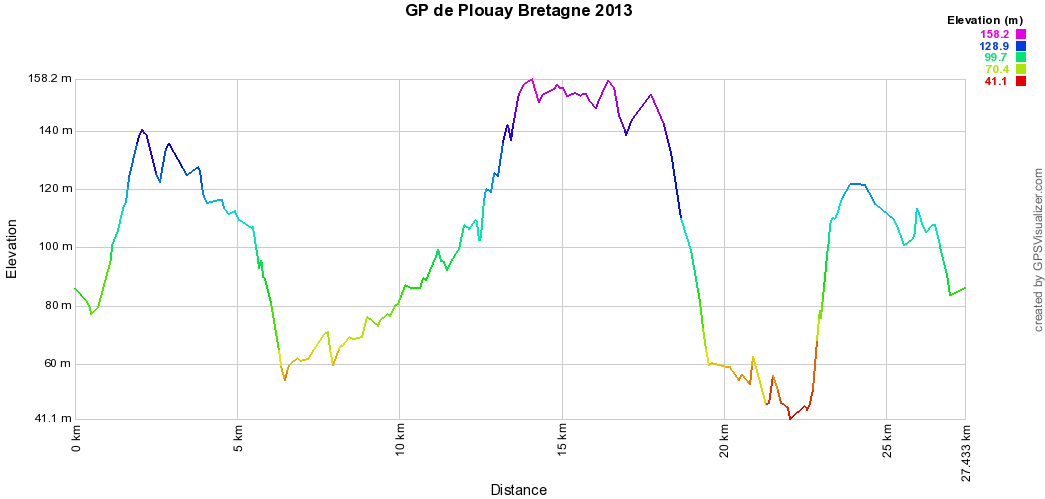
The race takes an almost identical route to the 2012 edition with only a few minor changes to the parcours leading through Plouay shortly after the start line. These changes do not alter the length of the circuit, which remains 27km; as was the case last year the riders will complete five laps (in red on the official maps, blue on the Les Déesses map; the shorter, blue circuit depicted on the official map is the parcours used by some of the other events taking place).

Back in 2000, Plouay hosted the World Championships and, just north of the velodrome on a road named the Boulevard des Championnats du Monde in honour of the event, a hard-surfaced area was created to host the event "village" with plenty of space for the team vehicles and race infrastructure. This area was preserved and is now used for the GP village; opposite it is a raised grassy area that, for those spectators who can find space among the vast crowds that pack onto it, offers excellent views of the spectacularly fast starts along the straight and slightly downhill initial 0.5km as the riders head into the first corner.


View GP de Plouay Bretagne 2013 in a larger map

Once past the unspeakably ugly Carrefour and Netto supermarkets just past the start line the riders head into the first corner, a tight left with a drain cover placed in the middle of the left-hand carriageway (potentially a hazard in the wet). Moments later, they pass a fuel station and then turn left again to join the D178 leading through the outskirts of Plouay to the first climb, Cote du Lezot. The summit is marked by a footbridge; just past it is another raised area alongside the road which forms another good point from which to watch the race. The route begins to climb again shortly afterwards and looks reasonably steep around the next bend, a non-technical left leading towards the village of Kerscoulic; beyond the village at Questenen Plaine is an easy right turn onto the D110.


The race follows the D110 for several kilometres through the Foret Domaniale de Pont-Calleck, an area of stunning natural beauty but one where the roads, as with all forests, can be treacherously slippery due to wet leaves after wind and rain. Soon they cross a bridge over the Le Scorff river and come to a roundabout, heading right to follow the course of the river north to Chateau de Pont-Calleck. The road rises and falls, but the route is primarily uphill. After bending left, the road starts to climb more steeply on the approach to Chapelle Ste Anne de Bois, a tiny church that looks like a miniaturised Baroque cathedral. Anne is the patron saint of lost objects; if hope is an object perhaps riders who suffered on the climb to reach her chapel will refind it on the fast, flat 5.1km that now takes them to the same roundabout they visited earlier. At the end of the road, the right turn to join the D204 is very tight and leads immediately into a fast descent.

The D204 ends at another roundabout, where the race turns left and then left again onto the D769, a wide and fast road with none of the charm of those running through the forest. Very soon, they leave the road by turning right and then immediately left, taking a road that is little more than a track running alongside the D769. It's not the more pleasant of the two routes, however, because it takes in the Minojenn du Calvaire climb which is as steep as 13% at points. Once over it, they rejoin the D769 and continue to the Cote de Ty-Marrec, the final climb of the circuit, and then enter the last 5km. A sharp left turn with a traffic island leads from the D769 to the D760BIS, which the riders will follow around a right-hand bend (and past more trees, hence more hazards if the weather is bad) and back toward Plouay. A road joining from the right marks 1km to go; the remainder is flat and straight all the way to the finish line and, if no rider manages to get away earlier on as Vos did in 2012, makes a fast bunch finish likely.

Start List
Click to enlarge. List is provisional.
How to follow the race
Regular updates are posted on the official website, with images at Plouay TV (turn the sound down if you're at work). Unfortunately, the organisers do not seem to have set up a Twitter account; however, Hitec-UCK manager Karl Lima, Boels-Dolmans mechanic Richie Steege and journalists Bart Hazen and Anton Vos all Tweet live from the races they attend.

Points awarded according to position: 1: 75 - 2: 50 - 3: 35 - 4: 30 - 5: 27 - 6: 24 - 7: 21 - 8: 18 - 9: 15 - 10: 11 - 11: 10 - 12: 9 - 13: 8 - 14: 7 - 15: 6 - 16: 5 - 17: 4 - 18: 3 - 19: 2 - 20: 1 

Monday, 12 August 2013

Trophée d'Or 2013

24-28.08.2013 Official Site
France, 6-stage Road Race, 496.3km
UCI 2.2

First held in 1997, when it was won by Jeannie Longo (who was then 39 and, famously, is still racing today at the age of 54), the Trophée d'Or is now in its 17th edition. Although it has fluctuated between five and six stages, it is unusual among women's cycling races in that it has been held every year since its inauguration - a tribute to the excellent organisational skills of the race committee.

One (possibly unique) feature of the Trophee d'Or is the 18km de l'arrivée prime, awarded to the first rider to reach a point 18km from the finish line. It provides an incentive for riders who might not be in a position to challenge for a stage win to fight for a place near the front of the peloton as the race nears its end, ensuring that competition remains high in the last part of each stage.

Like their Route de France counterparts, organisers of the Trophee d'Or want to keep their race interesting by trying to make sure that the overall outcome remains undecided for as long as possible. The Trophee does this in completely the opposite way to the Route - whereas the Route consisted of a series of flat, straight, relatively featureless stages that kept the peloton rolling along at high speed day after day and prevented anyone getting away (and might well have become ironically boring as a result, had it not been for Giorgia Bronzini's record six consecutive stage wins), the Trophee tries to prevent anyone building up an insurmountable lead by including a wide selection of fast straights, tough climbs, technical sections, steep descents and as many different variations on the final 3km as can be squeezed into six stages. This means that there is plenty of incentive and scope for breakaways, either solo or in groups, but that any rider who gains a big advantage in a break can very easily lose it again; the race therefore stands a good chance of remaining undecided right up until the end, possibly even into the final few kilometres, yet features plenty of interest and action along the way.

Previous Winners
The Lithuanian Edita Pučinskaitė and the Swede Emma Johansson (riding this year with Orica-AIS) are the only riders to have won twice, in 2001 and 2004 and in 2008 and 2010 respectively. Longo remains the only French winner; no British rider has ever made it to the podium, but there are some very good British women on the start list this year: Lizzie Armitstead (Boels-Dolmans) and Sharon Laws (Lotto-Belisol) have the potential to challenge overall and Emma Trott (Boels-Dolmans) could aim for a stage win.

2012 winner Elena Cecchini, pictured
at the Thuringen Rundfahrt
1997 Jeannie Longo
1998 Jolanta Polikevičiūtė
1999 Tracey Gaudry
2000 Leontien van Moorsel
2001 Edita Pučinskaitė
2002 Tatiana Stiajkina
2003 Olivia Gollan
2004 Edita Pučinskaitė
2005 Joane Somarriba
2006 Zulfiya Zabirova
2007 Noemi Cantele
2008 Emma Johansson
2009 Diana Žiliūtė
2010 Emma Johansson
2011 Tatiana Antoshina
2012 Elena Cecchini

Parcours

Stage 1 (24.08.2013; St Amand Montrond-Graçay, 107.1 km)

View Trophee d'Or Feminin 2013 Stage 1 in a larger map

With numerous small hills and twisty lanes along its 107.1km, Stage 1 looks on paper to encourage breakaways more than any other in this edition. That makes the race interesting right from the very start because, with the big name General Classification contenders wanting to save some energy for the battles to come, it would be entirely possible for a small group of domestiques and riders who usually couldn't challenge for an overall win to grab an advantage that, provided they can keep up a decent pace and avoid accidents over the next few days, could see them achieve a very good final placing - and, perhaps, even stand on the podium after Stage 6.


GPM points are on offer four times during the stage. The first are at the Category 3 Cote des Billons, 19.3km into the parcours; it ascends (asc.) 38m in 0.75km (len.) to give an average gradient (ave.) of 5%. The second is the Cote de Diou, 57.2km in and also rated as Category 3 (asc. 30m, len. 0.62km, ave. 4.8%); the third and fourth are at the Cote de Prinçay, climbed at 90km and then again at 103.7km (asc. 36m, len. 0.62km, ave. 5.8%). Although Prinçay sounds little more difficult that Diou, it reaches a maximum gradient for a short stretch of 12% and as such is rated at Category 2, making it a difficult obstacle even if it were climbed only once - with the second ascent coming just 6.7km before the end of the race it may, therefore, prove to have a decisive effect on the outcome of the stage. The final 3km descends gradually (though there's a very brief and small rise at 1.1km to go); if riders approach the finish as a group, this should encourage a fast sprint to the line.

Stage 2 (25.08.2013; Mehun sur Yèvre ITT, 17.7km)

View Trophee d'Or Feminin 2013 Stage 2 in a larger map

Throughout cycling history, there have been several climbers who could also time trial. Stage 1 wasn't even remotely mountainous, but the combined effect of all those little hills and the four GPM climbs served to give the climbers and more grimpeur-orientated all-rounders an advantage that they could then have preserved (if not extended) on Stage 2 - if, that is, it wasn't as long as it is: no other type of rider can keep up sufficient wattage over 17.7km to be able to rival the time trial specialists, meaning that nobody who gained a lead yesterday is guaranteed to keep it today.


Stage 3 (25.08.2013; La Chapelle St Ursin-La Chapelle St Ursin, 78.3km)

View Trophee d'Or Feminin 2013 Stage 3 in a larger map

Taking place after the Stage 2 Time Trial, Stage 3 consists of three laps around a fast 26.1km circuit - which makes this an ideal parcours for spectators as it offers an opportunity to see the peloton go by three times, or even to move around and see it from different places.

Long, exposed stretches make breakaways difficult, especially if it's windy - but with three lots of GPM points on the Cote de la Madeleine and bonification seconds at the intermediate sprint two-thirds of the way to the end, any break that does manage to get away could reap handsome rewards. Whether that can happen has to remain to be seen, as does whether or not such a break could remain out in front over the final lap and avoid being swept up by the pack once the General Classification riders building up to the bunch sprint that seems the inevitable conclusion.


Cote de la Madeleine is climbed at 12.1km, 38.2km and 64.3km. It gains 25m in 0.55km, giving an average gradient of 4.5%, and is rated as Category 3. The intermediate sprint is contested at the second passage of the finish line, 52.2km from the start. There is a small descent between 3km and 2km before the finish line, then a gradual climb of around 20m over the last 2km, an average gradient of only 1%.

Stage 4 (26.08.2013; Cosne Cours Sur Loire-Cosne Cours Sur Loire, 99.4km)

View Trophee d'Or 2013 Stage 4 in a larger map

With the first circuit (depicted in blue on the map) and the first 15km or so of the second running through open countryside with few hedgerows, riders may again experience strong crosswinds during this stage. There are also a number of difficult corners along all the circuits, putting bike-handling skills to the test. That makes the first 35km ideal ground for the rouleurs, big, strong riders who can fight their way to the front and then get out in front. However, tthe organisers say this stage has been named Montagne and although the highest point (Cote de Bue) topping out at a little under 400m means it's not exactly alpine, but five categorised climbs (including three Category 1 ascents, once of them with a maximum gradient of 20%) and a good selection of smaller, uncategorised hills suggests that once the race gets into the hilly section, the heavier riders will start to suffer. So the best tactics would seem to be to get your team's best climber surrounded by a posse of bigger, tougher rouleurs who can then make sure she gets to the categorised climbs in good shape and at the front of the pack. Then, you let her go and do her stuff and with a bit of luck the GPM points - and maybe even a stage victory, if she finds a sufficiently large enough advantage for it not to be chipped away in the local circuit that finishes the stage - come pouring in.

Failing that, you want to get your sprinters and their lead-outs into a break shortly before or soon after the beginning of the local circuit, once they've had chance to recover a bit from the climbs (hmm - can anyone else see why this could be an excellent stage for a rider like Lotto-Belisol's Ashleigh Moolman?) That way, they're well away from the pack and avoiding the congested corners and any crashes that might take place and are in the right place to launch themselves into that last, nearly straight 150m blast to the finish.

Cosne-Cours-sur-Loire looks exactly what it is - a once grand town that has fallen on hard times, in this case due to the demise of its metal-working industry that it had depended on since the 16th Century. However, having been inhabited since prehistoric times, there is much to see and the town forms an ideal base for visitors to the race. The medieval town Sancerre, sitting on an isolated hill 310m above sea level and packed full of centuries-old buildings, is also worth a visit.


The first GPM climb is the Cote du Petit Graveron, located 36.1km from the start; with a total ascent of 96m in 1.6km it has an average gradient of 6.8% but is steeper in parts with a maximum of 8%, being rated at Category 2 as a result. The second is the Cote de Bue at 53km, ascending 105m in 1.6km at an average gradient of 6.9% and a maximum of 8%; it is rated Category 2. Third is the 1st Category Cote du Graveron at 59.1km, rising 150m in 2.3km with an average gradient of 6.5% and one section reaching a harsh 15%. Fourth is the even more brutal Category 1 Cote des Perrieres 63.2km into the parcours; ascending 64m in 0.6km gives a difficult average gradient of 10.7% - but it's much worse than that, because the maximum is 20%. The fifth and final GPM climb is Category 1 Cote des Remparts, 69.6km from the start; it gains 112m in 1.6km at an average gradient of 7%. Note also a small hill that rises around 30m between the three and two kilometres to go points - possibly just enough to give a rider able to climb and sprint (such as Moolman again, or Giorgia Bronzini from Wiggle-Honda) an advantage.

Stage 5 (27.08.2013; Baugy-Baugy, 105.7km)

View Trophee d'Or 2013 Stage 4 in a larger map

There is plenty of open countryside again on this stage but, if the riders have been battling the wind over the last couple of days, the forested sections and the shelter they offer will come as a relief - though they may also permit breakaways.

The local circuit may only be 5.5km in length, but with some sharp corners followed by long, fast straights that's plenty enough for breaks to be caught, then for the lead-outs and sprinters to get themselves into position before the final bend and the non-technical 1.1km running along the Rues de la Croix-St-Abdon, du Huit Mai, du Chancelier and Sully, ending at the finish line back where the race began on the Place de Verdun.


The three climbs are far less troublesome than those ridden yesterday, each of them being rated Category 3. Cote de Vizy, located at 71.8km, ascends 40m in 2km at an unchallenging average gradient of 2%. The latter two have steep sections, but overall are of sufficiently low average gradient to be given their low categorisation. The Cote de Villequiers, 84km from the start, rises 34m in 0.95km; the average gradient is 3.6% but it reaches 7% at one point. The final GPM climb of the stage is the Cote de Solerieux, 91.6km from the start; it ascends 30m in 0.5km at an average gradient of 6% while the steepest section is 11%. The terrain rises slightly over the course of the final 3km but so gradually that, with the exception of a small low gradient ramp just after 1km to go, the increase is too minor to have any effect.

Stage 6 (28.08.2013; Orval-St Amand Montrond)

View Trophee d'Or 2013 Stage 6 in a larger map

Another stage designed to let spectators see the race go by more than once (and thus a good option if you have the chance to go to see it but can only remain for one day), Stage 6 is roughly in the form of a figure of eight that begins at Orval, heads west and then swings east to take a long route back to Saint-Amand-Montrond, Orval's neighbour on the opposite side of the Loubiere and Cher rivers. It then comes within half a kilometre of the finish line but turns away, traveling north and climbing into forest; soon after emerging it joins the same route taken east earlier with the riders contesting the intermediate sprint, then continues back to Saint-Amand-Montrond again. This time it passes over the finish line to enter a local circuit 6.5km, which will be completed three times.


Today's GPM climbs begin with the Category 2 Cote de Nozieres which, located just 3.6km from the start line and rising 40m in 0.4km (average gradient 10%), gives the climbers a chance to get out in front early on in the race. Doing so might not stand them in good stead, though, because there are more than 30km to the next climb - ample time for any advantage to be taken away again. The second is the Cote de la Tour, also Category 2, which will be climbed at 35km and then again at 63.1km when it'll be the fourth GPM ascent. It rises just 21m but does so in 0.23km, giving it a difficult average gradient of 9%. The third and fifth GPM climbs are the Cote du Fer Cheval which, ascending 70m in 1.6km, has an average gradient of 4.4% (maximum 7.5%) and is rated as a Category 3. 

Once GPM points have been awarded for the final time on the second ascent of Cote du Fer a Cheval, it will be climbed three more times, once on each of the three laps around the local circuit; those three ascents going to take their toll and, by the time they near the last 3km, all but the pure climbers are going to be hurting. However, the organisers have cleverly seen to it that the climbers can't rely on the parcours to win them the race: there's a fast descent between 2.5km and 2km to go - something that climbers, who lack the body weight to keep control of their bikes on a steep downhill, tend to dislike. Heavier riders, like sprinters and rouleurs, are less affected; deciding the General Classification may be a formality by this point, but the final stage victory will in all likelihood still be up for grabs.

Starters
Provisional and subject to change; Women Cycling Fever is regularly updated.

Australia NT

BePink

Bigla

France NT

Germany NT

Boels-Dolmans
Lizzie Armitstead
Jessie Daams
Romy Kasper
Emma Trott
Marieke Wanroij
Adrie Visser

Lotto-Belisol
Marijn de Vries
Kaat Hannes
Sharon Laws
Ashleigh Moolman
Marion Rousse
Carlee Taylor

MCipollini-Giordana
Valentina Carretta
Tatiana Guderzo
Malgorzata Jasinska
Valentina Scandolara
Anna Zita Maria Stricker
Marta Tagliaferro

Orica-AIS
Tiffany Cromwell
Nettie Edmondson
Gracie Elvin
Melissa Hoskins
Emma Johansson
Gu Sung Eun

Pasta Zara-Cogeas
Inga Cilvinaite
Véronique Fortin
Amber Pierce
Martina Ruzickova
Lorena Maria Vargas Villamil

Rabobank-Liv/Giant
Lucinda Brand
Liesbet de Vocht
Pauline Ferrand Prevot
Roxane Knetemann
Iris Slappendel
Sabrina Stultiens
Annemiek van Vleuten
Marianne Vos

RusVelo
Yulia Blingyuk
Alexandra Burchenkova
Oxana Kozonchuk
Elena Kuchinskaya
Hanka Kupfernagel
Aizhan Zhaparova

Sengers
Evelin Arys
Sofie de Vuyst
Vera Koedooder
Christine Majerus
Maaike Polspoel
Anna van der Breggen

Argos-Shimano
Janneke Busser-Kanis
Elke Gebhardt
Willeke Knol
Amy Pieters
Esra Tromp
Kirsten Wild

USA NT
Kaitlyn Antonneau
Jacquelyn Crowell
Andrea Dvorak
Janel Holcomb
Kristin McGrath
Brianna Walle

Vienne-Futuroscope
Jessica Allen
Sandrine Bideau
Karol-Ann Canuel
Audrey Cordon
Pascale Jeuland
Emmanuelle Merlot

Wiggle-Honda
Charlotte Becker
Giorgia Bronzini
Emily Collins
Danielle King
Lauren Kitchen
Linda Villumsen

Riders to Watch
Marianne Vos ("meilleure cycliste mondiale depuis 2007," says the official race website - something with which few people would argue) isn't having the best year of her career, but what counts as a bad year for Marianne would be the greatest season of most riders' careers - she is, just as she always is, a favourite for overall victory and very much a rider to watch.

Emma Johansson seems to get stronger and stronger with every year that comes and has emerged as a very powerful rival to Vos, beating her on a number of occasions - with her Orica-AIS squad also able to stand up to the might of Vos' Rabobank-Liv/Giant, she'll be making sure the Dutch star doesn't have an easy time of it as she goes after an unprecedented third victory.

Wiggle-Honda exploded onto the scene at the start of this season and enjoyed a spectacular victory at the Route de France a few weeks before this race, with Linda Villumsen winning overall and Giorgia Bronzini setting a new world record of six consecutive stages (the previous record of five was set, coincidentally, by Jeannie Longo, who won the first edition of this race). Bronzini won three in a row at last year's Trophée (she won four in a row back in 2008, too) and may well be a force with which to be reckoned this year - although Stage 4 suits Lotto-Belisol's Ashleigh Moolman, the last three kilometres suit Bronzini very well indeed.

Finally, we'll probably see a lot of MCipollini-Giordana: the Valentinas Scandolara and Carretta are on excellent form at the moment and have been grabbing GPMs, sprints and podium steps all over the place this season, and Marta Tagliaferro can cut it with the best in a bunch sprint.

How to Follow the Race
Boels-Dolmans mechanic Richie Steege Tweets live from all the races the team enter, providing expert and up-to-the-minute information on the action. Karl Lima's Hitec Products-UCK are not on the start list at the time of writing but, if present at the race, he also provides excellent coverage via Twitter. Journalists Bart Hazen and Anton Vos (Marianne's brother) also Tweet from races. Once the race is over, check Marijn de Vries' blog - Marijn, in addition to racing for Lotto-Belisol, is a professional journalist and her race reviews (even when auto-translated into English) are always excellent with their warts-and-all descriptions of what it's actually like to compete in an Elite Women's race.

Wednesday, 31 July 2013

Lotto-Belisol Belgium Tour 2013

23-26.08.2013 Official Site
Belgium, 4-stage Road Race, 332.5km
UCI 2.2

If you want to be rich, women's cycling is not the place to go seeking your fortune - most of the teams operate on notoriously tiny budgets and riders can never be certain that their sponsors won't suddenly announce they're ending their links with the sport which, in all too many cases when the team is unable to find a new sponsor, means the end. Fortunately, there are a few companies out there that are willing to ignore the bean-counters and put in large amounts of money for returns that, as women's cycling doesn't receive anything like the exposure that men's cycling does, often seem not to make sound financial sense. Rabobank proved itself to be a company that genuinely cares when it elected to continue sponsoring a women's team after pulling out of men's cycling entirely; Boels, a plant machinery firm, is another example, one that sponsors a team and three races (the Boels Ronde van Drenthe, which took place in March, the Boels Hills Classic in May and Boels Ladies' Tour, previously known as the Holland Ladies' Tour and one of the most prestigious events on the Elite Women's calendar, which will take place early in September). There is also Lotto, the Belgian national lottery, and Belisol, a Belgian manufacturer of solar panels, doors and windows - together, they sponsor the Lotto-Belisol men's and women's teams and this race, the Tour of Belgium.

Unlike the Tour de France, which has stages that start in one town and end in another, the Belgium Tour is more like a rock band's tour - it visits a different town each day and the riders then compete on a circuit that starts and ends at the town. This has numerous advantages, chiefly that costs are cut by having each stage consist of several laps rather than one long parcours and fans get to see the race pass by several times, either by remaining at the same point or by moving around to see it from different places.

Parcours
Stage 1: Warquignies-Angreu (23.08.2013, 19.7km Team Time Trial)

View Tour of Belgium Stage 1 2013 in a larger map
The only non-circuit stage of the race, Stage 1 will see the teams putting their bike handling skills to the test with a series of very sharp corners in the first two kilometres, where it'd be very easy indeed to lose a couple of riders to unfortunate crashes and end up with insufficient numbers to even be awarded a time - which would mean race over. Once through, there's a forested section (which always increases the likelihood of punctures, which can be disastrous when racing against the clock) with a climb of around 70m in 2.5km, then a long and flat straight section running south-west along the Av. du Haut-Pays where the fastest squads will be able to get their heads down and find a serious time advantage against those who haven't been practicing their TTT tactics quite so much as they ought. Another very sharp bend then leads onto the remaining part of the parcours, finishing 19.7km (which is why it's a stage rather than a prologue; a prologue in an Elite Women's race cannot be longer than 4km according to UCI rule 2.6.006).
Altimetry
The route uses many open lanes running alongside flat, wide fields; although the parcours is in Wallonia, the region is subject to typically Flandrian wind and rain - with so little shelter along much of the route, the stage could become an ordeal if the weather is bad. There is also a cobbled section on the Rue des Juifs at Onnezies; however, the cobbles are flat, regularly-placed and in good condition, they will therefore not cause the riders serious problems.

Stage 2: Angreau (24.08.2013, 110.16km)

View Tour of Begium 2013 Stage 2 in a larger map
Stage 2 both begins and ends at the Place d'Angreu, where Stage 1 also finished. From the start line, the riders head into a 12.24km circuit taking them first south to Roisin; they then travel north-east to the first GPM climb of the race - the Cote du Autreppe (5.48km from the start, points awarded at 5.48km, 29.96km, 54.44km, 78.92km, 103.4km), where points will be awarded during the 1st, 3rd, 5th, 7th and final lap. There are also four intermediate sprints, each of which begins as the riders cross the finish line during the 2nd, 4th, 6th and 8th laps (24.48km, 48.96km, 73.33km, 97.92km).

A tight left-hand turn leads onto the narrow Rue d'Autreppe, at which point the parcours will be familiar to the riders as it now follows the same route via Onnezies (including the 300m Rue des Juifs cobbles), Angre, Honnelles and back to Angreau.

Riders must complete nine laps of the circuit; the Cote, though neither high nor steep, will have a considerable cumulative effect and there'll be some sore knees on the final passage.
Altimetry
Stage 3: Nijlen (25.08.2013, 115.12km)

View Lotto-Belisol Belgium Tour 2013 Stage 3 in a larger map
The place names reveal that the Tour has left Wallonia behind and is now in Flanders, perhaps the most cycling-obsessed region in the world. Many of the little towns that dot the flat landscape have produced famous riders, including Nijlen where the race begins - it was the birthplace of Victor van Schil, trusted lieutenant of Eddy Merckx and winner of the 1968 Brabantse Pijl (sadly, van Schil took his own life in 2009 at the age of 69), Bjorn Leukemans (who may have won far more had he not have crashed so often) and Nick Nuyens, winner of the 2011 Ronde van Vlaanderen and husband of Evy van Damme, Belgian Road Race Champion in 2000 and 2001.

Most of the great Flemish races have taken place in warm, dry conditions in recent years, but for many people racing in this part of the world will always be associated with cold winds and driving rain. The parcours is far enough from the coast to avoid the worst, but with the topography being as flat as it is any wind blowing in from the North Sea rips across the land and still has plenty of power by the time it reaches Nijlen - crosswinds on the section heading west between Herenthout and Kruiskenberg and headwinds on the section heading north between Heikant and Nijlen may create some problems. Riders must complete nine laps of the 14.49km circuit, making the stage

There are no GPM points on offer on this, the flattest stage of the 2013 edition; the feed zone passes through an area known as Kruiskenberg, which sounds dauntingly like one of the brutally steep climbs for which Flemish racing is infamous, but which is in fact an undemanding hillock rising no higher than 20m with an average gradient of around 1.5% (maximum 3.5%). There are, however, four intermediate sprints. Each begins at the Cafe de Max located at Bevel-Dorp 160 in Bevel and points will be awarded on the 1st, 3rd, 5th and 7th laps (10.59km, 39.57km, 68.55km, 97.53km).
Altimetry

Stage 4: Geraardsbergen (26.08.2013, 87.47km)

View Lotto-Belisol Belgium Tour 2013 Stage 4 in a larger map

Rather than several identical laps like the earlier stages, Stage 4 consists of a total of four laps around three circuits; the first is 29.16km in length with one GPM climb and will be completed once, the second is 19.17km with no GPM climbs and will be completed once and the third, which is 19.57km in length and features one GPM climb, will be completed twice. There are also intermediate sprints when the parcours crosses the finish line for the first, second and third times.

The first circuit begins at marketplace in Geraardsbergen, a town that will be familiar any riders who took part in Gooik-Geraardsbergen-Gooik back in May - it's also been a feature in many editions of the Ronde van Vlaanderen over the years. Very soon after heading out into the neutral zone they'll catch glimpses of what, to cyclists, is Geraardsbergen's most famous feature, Kapelmuur, but for the time being they can concentrate on other things. Racing gets underway 1.9km from the start on Verhaegenlaan and the parcours remains unchallenging until Parikeberg, a 0.6km climb offering GPM points, with an average gradient of 5.8 and maximum of 7%; it is 21.44km from the end of the neutral zone. The remainder of the circuit runs back into Geraardsbergen, with several tight and potentially risky corners leading into the town.  The riders will take the last (non-GPM) climb to arrive at the start line at the market place, then continue to the first T-junction where earlier they turned right; now they turn left and follow Vesten, passing the finish line and contesting the intermediate sprint for the first time.

Riders tackle the Muur van Geraardsbergen
during the 2006 Ronde van Vlaanderen voor
Vrouwen
A short while later they turn south onto Edingseweg, then west on Guilleminlaan and follow it through two sweeping curves until it joins Vesten heading south and the race then continues along the same route as earlier until reaching the T-junction at Priem. In Circuit 1, the riders turned left here to travel west; this time they turn east along Molenstraat, neatly avoiding Parikeberg. A few hundred metres ahead, they rejoin the Circuit 1 parcours and follow it back into Geraardbergen, taking the same route via the marketplace and back to the finish line where another intermediate sprint is contested.

To begin Circuit 3, the riders turn right before reaching the Oude Steenweg junction used in Circuit 2 and follow Oudebergstraat, a route that takes them directly to and over the notorious Kapelmuur - the reason that Geraardsbergen has featured in so many legendary races, Kapelmuur is, according to some, the toughest climb in East Flanders. With cobbles as large as steps and a maximum gradient of 19.8% (average is 9%), it's proved decisive many times and may well do so again today, even on the first lap of the circuit if one rider manages to get away and a crash in the peloton holds everyone else up - when that happens, many riders find it impossible to get going again on the steep slope and have to run up instead. Once over the top, the parcours takes Oudeberg and Dreipikkel for the short distance to Oude Steenweg and turns right, the remainder of the circuit following the route of Circuit 2. By the time the finish line approaches, those climbs will have taken their toll and there might not be any sprinters left in contention, in which case the race will be fought out by the climbers - unless, of course, one of them has built up a sufficient solo lead to win ahead of the pack.
Altimetry, Circuit 1 and Circuits 3/4


Starters

Specialized-Lululemon
Ellen van Dijk
Lisa Brannauer
Gillian Carleton
Trixi Worrack
Evelyn Stevens
Katie Colclough
Loren Rowney

Sengers
Kimberly Buyl
Joanne Hogan
Birgit Lavrijssen
Julia Soek
Evelyn Arys
Sofie de Vuyst
Vera Koedooder

Lotto-Belisol 
Marijn de Vries
Jolien d'Hoore
Ann Sophie Duyck
Kaat Hannes
Steffi Lodewijks
Kim Schoonbaert
Celine can Severen

CycleLive Plus-Zannata
Annelies van Doorslaer
Carla Ryan
Annelies Dom
Daisy Depoorter
Monique van der Ree
Latoya Brulee
Liz Hatch

TopSport Vlaanderen-Bioracer
Jessy Druyts
Kelly Druyts
Else Belmans
Tessa de Moyer
Gilke Croket
Nel de Crits

Tibco-To The Top
Shelley Olds
Claudia Hausler
Chantal Blaak
Melanie Spath
Jasmine Glaesser
Lauren Stevens

Boels-Dolmans
Lizzie Armitstead
Adrie Visser
Romy Kasper
Nina Kessler
Jessie Daams
Martine Bras

Orica-AIS
Emma Johansson
Loes Gunnewijk
Gracie Elvin
Jessie MacLean
Tiffany Cromwell
Melissa Hoskins

Hitec Products-UCK
Rossella Ratto
Emilie Moberg
Thea Thorsen
Elisa Longo Borghini
Siri Minge
Cecilie Gotaas Johnsen
Chloe Hosking

Futurumshop NL
Karen Elzing
Sarah Lena Hofmann
Anouska Helena Koster
Mieke Kroger
Janine van der Meer
Mascha Pijnenborg

Crano Go:Green
Madeleine Olsson
Jessica Kihlbom
Linnea Sjobom
Hanna Nilsson
Martina Thomasson
Alexandra Nessmar
Hanna Helamb

Argos-Shimano
Kirsten Wild
Fllortje Mackaij
Esra Tromp
Janneke Busser-Kanis
Willeke Knol
Kelly Markus
Amy Pieters

Wielerclub De Sprinters Malderen
Chantal Hoffmann
Sarah Ingelbrecht
Mieke Leeman
Lilianne Leenknegt
Steffy van den Haute
Laure Werner
Joyce Willems 

Mixed Team (Rabobank-Liv/Giant, Autoglass Wetteren, Group Solar, FCS)
Tamina Kate Oliver
Amy McGuire
Daniela Gass
Roxane Knetemann
Thalita de Jong
Marieke Blomme
Adeline de Vestele

Napoleon Games-St Martinus-Kerksken
Joyce Accoe
Evelien Deltombe
Nele Seghers
Helga Sibick
Janicke Gunvaldsen
Vittoria Bussi

Endura Lady Force
Ines Klok
Margriet Kloppenburg
Michelle Geoghegan
Natasja Nieuwenhuizen
iris van der Stelt
Marjolein Claessen
Elke Bolangier

Dura Vermeer
Kirsten Coppens
Rowena van de Klundert
Charlotte Peeters
Chantal Verstraten
Brigitta Roos
Natalie van Gogh
Demi de Jong

NWVG-Bike4Air
Geertje Hoeke
Olivia Koster
Mary Rose Postma
Danielle Lissenberg-Bekkering
Anne Peer
Nathalie van Katwijk
Femke van Kessel

Parkhotel Valkenburg
Aafke Eshuis
Bianca van den Hoek
Inge Klep
Riejanne Markus
Rozanne Slik
Lisanne Soemanta
Nathaly van Wesdonk

Water, Land en Dijken
Nike Beckering
Melissa Slewe
Bernadette Jeremiasse
Marleen de Kroon
Corrinne Smith
Sigird Jochem

SWABO
Sofie van Horik
Annemarie Pasveer
Domenique van Santen
Harriet Koorn
Nina van Tol
Yvonne van Dam
Stella Blom-Visser

Les Filles Racing Team
Lydia Boylan
Nicola Juniper
Alexie Shaw
Helen Ralston
Nicole Oh
Nikki Engelbach
Kate Hewett


Mixed Team (Boretti, Matrix, Vanderkitten)
Sara Olsson
Kate Chilcott
Tracy Best
Emma Grant
Christina Siggard
Gina Hofland
Jessica Smits

RC Jan van Arckel
Moniek Tenniglo
Kristen Peetoom
Silke Kogelman
Winanda Spoor
Roos Hoogeboom
Hester Wagenaar
Britt Jansen

GSD Gestion-Kallisto

Keukens Redant

Canada NT
Anika Todd
Shoshauna Laxson
Sarah Coney
Annie Foreman-Mackie
Veronique Fortin
Veronique Labonte

Australia NT
Emily McRedmond
Madeline Marshall
Alexandria Nicholls
Samantha de Riter
Miranda Griffiths

Belgium NT

Further details to be announced; check Women Cycling Fever for regular updates.

Following the race
As is the case with the majority of Belgian races, getting to the Tour is a simple process from anywhere in North-Western Europe - including from the United Kingdom: traveling by ferry from Dover to Dunkirk with a car costs as little as £74 return (check online for deals; Hull to Zeebrugge, a better choice for much of Britain's population, is for some reason far more expensive - around £200 with a bike rather than a car) and none of the Tour towns are more than 180km from the port. Better still, travel by bike - port to race is a day's ride for a fit cyclist, two at a more comfortable pace and, with the Belgians' legendary love for bicycles and cyclists, you'll be sure of a warm welcome. None of the towns are tourist traps, so accommodation will also be affordable.

If you can't get there, the choices for following the race are typically limited to Twitter feeds. Hitec Products-UCK manager Karl Lima provides regular updates on the progress of his team and the rest; Boels-Dolmans mechanic Richie Steege and photojournalists Bart Hazen and Anton Vos (who may attend regarless of whether or not his sister Marianne Vos is there with the Rabobank-Liv/Giant team) are also good choices.