Showing posts with label jerseys. Show all posts

Tuesday, 10 September 2013

Premondiale Giro Toscana Int. Femminile-Memorial Michela Fanini 2013

11-15.09.2013 Official Site
Italy, 4-stage (+ prologue) Road Race, 461.22km
UCI 2.HC

Michela Fanini, born in Lucca on the 23rd of March in 1973, became National Road Race Champion of Italy in 1992 and won the Giro Donne in 1994. She was a rider with enormous potential, one who gave all the signs of becoming one of cycling's greatest stars had she not have been tragically killed when her Peugeot 205 hit a wall and rolled over on the 16th of October 1994. Her memory lives on, in the team S.C. Michela Fanini-Rox and in the name of this race.

The race consists of a prologue and four stages. In the case if Stages 2 and 4 the organisers have, for some reason, decided not to employ the standard technique of naming stages after the towns in which they start and end, using the names of the : Stage 1, Bottegone - Massa e Cozzile, actually ends in Montecatini Terme; Stage 3, Segromigno in Piano - Capannori, starts and finishes in Capannori. It's their race, I suppose.

The 2.HC classification designates this as being one of three Hors Categorie races, intended by the UCI to promote races awarded the status as being especially prestigious (the organisers of the Thuringen Rundfahrt declined the designation in favour of the standard 2.1, while the other 2.HC race, the Exergy Tour, is no longer held following sponsorship problems). As such, the points awarded to the winning riders are greater than in other races - first place in the General Classification receives 80 points, equal to two standard 2.2 events, second place receives 60 points, third place 45 points.

Please note: the official road book for the race appears to have several inaccuracies, both in the text and the diagrams. Routes and other features may therefore be different to those included here; please refer to the official site if in doubt.

Finally, whatever you do, make the most of and try to enjoy this race - it's the last Elite Women's stage race of 2013.

The Parcours
Prologue (11.09.2013; Campi Bisenzio, 2.22km)
With a short and flat parcours that, apart from the two turning points, is largely straight, the Prologue Individual Time Trial ought to see some blisteringly fast times. Look out for the TT specialists, who are going to be the ones to beat; but keep an eye on some of the climbers and sprinters too - there have been many climbers who were also good against the clock, and on a parcours like this a strong sprinter with good endurance could create surprise.

The climb on the Via Roma looks considerably bigger on the altitude profile supplied by the organisers than it actually is - if the profile was accurate, the climb would gain 25m in 0.15km at an average gradient of 16%. In fact, it gains only 5m in 1km; the average gradient is therefore 0.5% and the maximum, at the point where riders arrive at the bridge on the return journey, is only 3.2%.

Campi Bisenzio was the birthplace of Franco Ballerini, winner of the 1995 and 1998 editions of Paris-Roubaix.


Stage 1 (12.09.2013; Bottegone - Massa e Cozzile, 126.15km)
After yesterday's flat time trial, the Giro heads through rolling terrain for 33km to the hilly landscape around Montecatini Terme, where the riders face four laps of a local circuit featuring an ascent of the Piazza della Chiesa leading into the beautiful medieval village Massa e Cozzile, birthplace of Bruni Pasquini who won the Giro's brother race, the Giro di Toscana, in 1947.

While the climb is far from alpine with a maximum altitude of 223m, it gains the majority of that altitude in 3km; its average gradient of around 7.4% is sufficiently steep to earn it Category 2 status. The hill is climbed at 33.1km, 58.15km, 83.2km and 108.25km with GPM points being awarded each time. While there is plenty of opportunity for non-climbers to catch up in the last 14km from the final ascent to the finish, four ascents will have taken their toll and those riders that suffer on the climbs will be at a serious disadvantage to the climbers, making this a good stage for a small group of climbers - perhaps neo-pros and domestiques at this early point, before the GC contenders stamp their authority on the race - to form a break and go after a stage victory. Nevertheless, unless the climbers have managed to build up a big lead, they might find the sprinters get the last laugh after all - the final 3km are very flat and feature a couple of corners leading into a straight 500m to the finish.

In addition to GPM points, intermediate sprint points will be awarded at two points - the first is at the Palazzo Comunale in Montecatini Terme, 26.2km from the start; the second is at the second passage of the finish line on Centro Commerciale also in Montecatini Terme, 75.45km from the start. There is also a sprint prime named the Traguardo Volante Michela, located on the first passage of the finish line 50.4km from the start.


Stage 2 (13.09.2013, Porcari - Pontedera, 110.5km)
The first half of Stage 2 takes place on a parcours best described as rolling rather than hilly (though a couple of short ramps at 18km and 43km look steep enough to get knees aching, if only for a short time) while the second half, consisting of five laps of a 10.6km circuit at Pontedera is flat. There are no GPM points on offer for that reason, and so the climbers will probably sit back and conserve energy for Stage 3 (which has four Category 2 and two Category 1 ascents with GPM points aplenty) while the sprinters do their stuff and battle it out among themselves in the final 3km which, being flat with a corner  to mark the start of the last 200m, might have been laid out for no reason other than to encourage tactical bunch sprint finishes.

Once again, there are two intermediate sprints. The first, on the Via delle Colline in Cenaia, is 46.15km from the start; the second, at the fourth passage of the finish line on the Via Veneto in Pontedera, is 100.65km from the start. There is another Traguardo Volante Michela sprint prime, located at the second passage of the finish line 81.85km from the start.

Pontedera is the birthplace of several professional cyclists including Fabiana Luperini, born there on the 14th of January 1974. Luperini, who turned professional in 1997, would become one of the most successful female cyclists of all time with victories in the Giro Donne and the now-defunct women's Tour de France - she won both in 1995, 1996 and 1997 - and is still racing, with the Faren-Kuota team, to this day.


Stage 3 (14.09.2013; Segromigno in Piano - Capannori, 124km)
Yesterday's stage was one for the sprinters, today brings a route made for the climbers with no fewer than six categorised climbs - four rated Cat. 2 and two rated Cat. 1, making this an essential stage for any riders hoping to do well in the Mountains competition and a very important one for anyone hoping to win the General Classification.

The first 9km are flat (apart from a small climb 2km in), then the riders arrive at the first climb, Cat. 2 Segromigno in Monte. It's not a big climb, topping out at 100m above sea level, but the fact that it gains almost all of its height in a kilometre reveals why it's been given a high classification. What's more, the riders are going to climb it four times (11.3km, 28.2km, 45.1km, 62km) before turning off onto the second part of the parcours, where they face two ascents (84.2km, 112.4km) of the much higher and tougher Cat. 1 Valgiano climb - which rises to almost 400m in 9km with a very steep 2km section along the way.

The last 3km are flat with two corners in the last 1000m, making it ideal ground for a bunch sprint - though unless any one rider manages a solo break on Valgiano and stays away over the last 11.6km (which is exactly the sort of thing Marianne Vos does),  it's likely to be one fought by climbers and GC contenders rather than pure sprinters.

The two intermediate sprints and the Traguardo Volante Michela sprint prime take place in Lunata at the premises of Mercatino Fanini, the company owned by Michela's family. The sprints are at 38km and 71.8km, the prime is at 54.9km. Capannori is the birthplace of Mario Cipollini, who was often listed as the most successful sprinter in cycling history until the rise of Mark Cavendish.


Stage 4 (15.09.2013; Lucca - Firenza, 98.8km)
With two Cat. 3 climbs offering the only GPM points today, we'll see either a hotly-contested battle for the Mountains classification or a total lack of interest among the classification contenders - if there are only a few points between the riders at the top of the classification it'll be the former, if one rider led over the bigger climbs on yesterday's parcours then she'll have found an insurmountable lead and it'll be the latter.

The competition between the General Classification leaders is almost certain to be far stiffer - those categorised climbs, along with the uncategorised ones around 30km from the start, are just enough to give a breakaway plenty of scope to steal victory from right under the noses of the race leaders, or for the race leader (or someone near to her in the GC) to get into a break and turn a victory into a definitive, glorious one. There's still plenty of room for the climbers and sprinters to duke it out, too: while the climbs will give the climbers an advantage up until the summit of the second Cat. 2, the long and steep descent on the other side, with only 5.1km left to the finish line, puts them at a disadvantage and favours the bigger, heavier riders who can retain more effective control over their bikes at high speed. Then there's the finish itself: flat throughout the last 3km with a corner approximately 100m from the line, there'll be a fast and furious sprint if nobody's stayed away and the riders approach in a bunch.

Lucca was the birthplace of Michela Fanini, in whose memory this race and the S.C. Michela Fanini-Rox team are both named. Firenze was the birthplace of 2000 Giro d'Italia King of the Mountains Franco Casagrande (and of the Renaissance, which even cycling fans will admit is an even greater claim to fame).


Jerseys
The Memorial Michela Fanini has an unusually high number of classification leader jerseys, including two - awarded to the "most generous" rider (usually the most hard-working domestique) and the "most elegant" rider (awarded to the rider judged to have the best bike-handling skills) - that are unique to this race and were presumably invented to make more places to put sponsor's names, which is a practical enough reason.


Starters
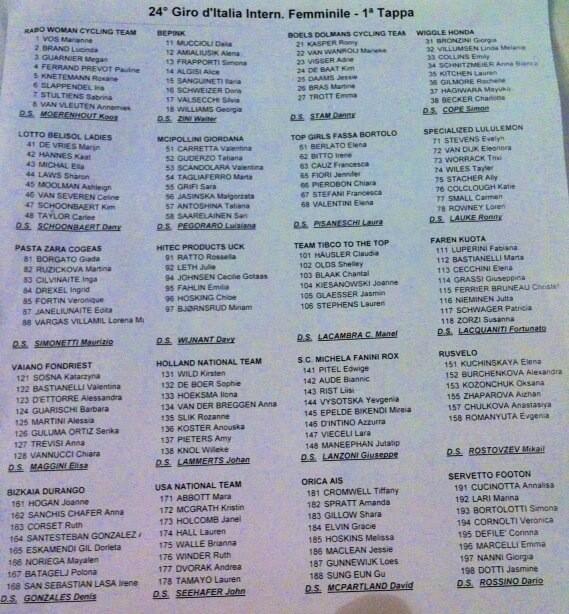
A definitive starters and team roster list has not yet been published and it's probably safe to assume that this one is very provisional. Check Women Cycling Fever for regular updates.

S.C. MICHELA FANINI-ROX

CHIRIO FORNO D'ASOLO

COLOMBIA NT

FAREN-KUOTA

LOTTO-BELISOL

OPTUM P/B KELLY BENEFIT STRATEGIES

PASTA ZARA-COGEAS

SERVETTO-FOOTON

SLOVENIA NT

MAXX SOLAR

TOP GIRLS-FASSA BORTOLO

VAIANO-FONDRIEST

WIGGLE-HONDA

BEPINK
ARZUFFI Alice Maria
CANTELE Noemi
FRAPPORTI Simona
MUCCIOLI Dahlia
VALSECCHI Silvia
ZRIMSEK Petra

BOELS-DOLMANS
DAAMS Jessie
KESSLER Nina

HITEC PRODUCTS-UCK
BJORNSRUD Miriam
FAHLIN Emilia
HOSKING Chloe
LONGO BORGHINI Elisa
NEYLAN Rachel
RATTO Rossella

MCIPOLLINI-GIORDANA
ANTOSHINA Tatiana
CARRETTA Valentina
GUDERZO Tatiana
JASINSKA Malgorzta
SCANDOLARA Valentina
TAGLIAFERRO Marta

ORICA-AIS
CROMWELL Tiffany
CURE Amy
EDMONDSON Annette
JOHANSSON Emma
SUNG EUN Gu

RABOBANK-LIV/GIANT
BRAND Lucinda
VAN VLEUTEN Annemiek
VOS Marianne

SENGERS
VAN DER BREGGEN Anna

ARGOS-SHIMANO
GARNER Lucy
WILD Kirsten

SPECIALIZED-LULULEMON
WORRACK Trixi Germany

TIBCO-TO THE TOP
BLAAK Chantal

FRANCE NT

GERMANY NT

ITALY NT

USA NT

Following the race
It has to be said that the Giro's organisers haven't got the greatest website ever seen on the Internet. That's not entirely their fault - few women's races have the budget to employ hotshot web developers, as seen with races like the Tour de France - but in this case it really wouldn't be a bad idea to try to improve matters (how about offering a VIP, access-all-areas pass for next year's race to anyone willing to tidy things up for free? There must be a few fans out there capable of doing it), because while the determined fact-hound will eventually get the information they're after, more casual visitors will quickly give up.

Hitec Products-UCK and Boels-Dolmans are both racing, which means one of the best ways to follow the race is by following Karl Lima and Richie Steege on Twitter. Lima is the manager of Hitec, Steege is the mechanic of Boels-Dolmans; both of them know the sport inside-out and provide regular updates on the progress of their own teams and their rivals in all the races they attend.

Sunday, 16 June 2013

Giro Rosa 2013

30.06-07.07.2013 Official Site
Italy, 8-stage Road Race, 803km
UCI 2.1

Stage reports and results here

The legendary Giro Donne - the last Grand Tour in women's cycling - faced an uncertain future and, for a while, looked about to vanish forever last year when organiser Epinike revealed that it wouldn't be seeking a renewal of its contract to run the race. Fortunately, Renato di Rocco kept true to his promise that he'd make saving it a priority if he was successful in his bid to be re-elected as president of the Italian national federation; once he was he wasted no time in appointing a new race director, Giuseppe Rivolta, and a new company named Erre 4 was created to take on responsibility for making sure that the Giro went ahead under its new name the Giro Rosa.

Since its inception right back in 1988, the Donne has attracted the most talented and famous athletes in the sport. Maria Canins won that year, followed by Roberta Bonanomi in 1989 and then the Frenchwoman Catherine Marsal in 1990. The race wasn't held in 1991 or 1992, but Slovakian Lenka Ilavska became the first rider from the former Eastern Bloc to win with her victory when it restarted in 1993 and the race has been held every year since. Michela Fanini began a new era of Italian domination with her 1994 victory; just a few months later, at the age of 21, she was tragically killed but her memory lives on in the name of the team named after her - S.C. Michela Fanini-ROX, taking part in the race this year. Fabiana Luperini, who still races today and is competing with the Faren-Let's Go Finland team this year, won for the first time in 1995 and then did so again in 1996, 1997 and 1998 and Joane Somarriba became the first Spanish winner in 1999 and won for a second time in 2000. Nicole Brandli was the first Swiss winner in 2001, Svetlana Bubenkova the first Russian in 2002, Brandli won again in 2003 and then the Welsh wonder Nicole Cooke took Britain's first win in 2004, after which Brandli won for a third time in 2005. Lithuanian Edita Pucinskaite won in 2006 and 2007 and then, an incredible 13 years after her first victory, Luperini won for a record fifth time in 2008. Two more firsts came in subsequent years with Claudia Hausler (back with Tibco-To The Top in 2013) the first German winner in 2009 and Mara Abbott (riding with the USA team this year) the first American in 2010, bringing the race neatly up to the reign of Marianne Vos who was the first Dutch winner when she beat Britain's Emma Pooley by more than three minutes (and third place Judith Arndt by more than eight) in 2011, then did the same in 2012. Vos will be a popular favourite for this year, but she'll have a tougher time of it than in the past - the other teams and riders have a better understanding of precisely what they're dealing with when Vos races and are thus better able to react when she makes a move. There are those who believe that, with her return to mountain biking this year, Vos is spreading herself too thinly; however, many believe that she could probably add a few more disciplines and still win more races than any rider in the history of cycling.

Parcours

Stage 1 (30.06.2013) Giovinazzo-Margherita di Savoia, 124.3km
The Giro's general classification, as tends to be the case in any Grand Tour, usually goes to a rider who can climb; for that reason, the first few stages are normally much flatter and riders who don't have much chance of winning overall are permitted a few days in the limelight while the big guns size one another up.

Not so this one. The last 94km are flat, which means that the sprinters will have ample opportunity to get to the front and battle for the stage win, but look at the climb in the first 23km - it's only rated Category 3, isn't very high and, coming so early in the stage, is unlikely to set up any stage-winning breaks, but it's long enough to provide the riders with a good indication of whether or not their rivals are going to cope well with the real knee-breakers to come later on.

Stage 2 (01.07.2013) Pontecagnano Faiano-Pontecagnano Faiano, 99.6km

Stage 2's climb, from the SP28a to the Piazza Garibaldi at Pontecagnano Faiano, ascends only 80m - but it does it in only 1.2km, making the average gradient 6.6%. 6.6%% isn't horrific by professional cyclists' standards, but with the hill being climbed on each of the four laps around the parcours it'll certainly have an effect. What's more, there are GPM points on offer at the top on the final lap; climbers therefore have a choice between going for them or saving energy in order to be able to challenge the sprinters - thus improving General Classification times ready for tomorrow, when the parcours begins to get far lumpier - over the last 21km to the finish. 

Don't forget that many climbers don't like steep descents, where the heavier sprinters are better able to control their machines: so it might be the downhill section after the Piazza that proves decisive rather than the climb to it.

Stage 3 (02.07.2013) Cerro Al Volturno-Cerro Al Volturno, 111.6km
There are no high peaks on Stage 4, but the terrain is far hillier than those that came earlier and gives a taste of the mountain action to come. The first 9km starts flat, then begins to climb gently before becoming steeper on the way to Via Mainarde where today's only GPM points (Cat. 3) will be awarded - which seems a little bit of a strange move by the organisers as the climbers may decide to take the remaining 102km at an easy pace to save energy for subsequent stages while the climbs in the second half of the stage are liable to be too big for the sprinters, potentially making for a boring day once the GPM points have been won.

On the other hand, if the big names do sit back and enjoy the scenery, they might allow domestiques a chance to fight among themselves for a stage win. That usually leads to some excellent and unpredictable racing - and sometimes reveals the young riders who are going to win races like this one in years to come; any that can hold their own on the 18% gradient cobbled climb to the finish line will have proven they've got what it takes.

Stage 4 (03.07.2013) Monte San Vito-Castelfidardo, 137.2km
The longest stage this year by almost 13km, Stage 4 is also the last chance for the sprinters to get a good result that'll see them through the next two stages, when the finish lines are located at the top of serious climbs. 

However, it's a long way to the finish line and, without mountains, this is a parcours that lends itself to breakaways. It might take some time for a successful break to form on the 45km ride to the Cat. 3 climb rough a third of the way into the route, but one made up of a selection of good rouleurs could work together, get their heads down like they're riding a long time trial and stick a big gap between themselves and the following pack - and if that happens, anybody who wants to prevent them taking the stage win will have to make sure they get their chasers on the group before it's too late. Whatever happens, look out for a rider who can climb when the race nears its end: it's not a steep ascent over the last 8km, but after 129km even a gentle gradient could prove decisive.

Stage 5 (04.07.2013) Varazze-Monte Beigua, 73.3km
Stage 5 is 64km shorter than Stage 4, but there's no way it could ever be described as easier - while yesterday's parcours was mostly flat with only a couple of little climbs along the way, today's finish line is located at the top of a Cat.1 climb 1,274m above sea level. To put that into context for British readers, it's 189m (620 feet) higher than the summit of Snowdon.

The finish line is only 74m below the summit of Monte
Beigua, within sight of RAI's TV masts
The parcours starts climbing right from the finish line, gaining 210m at an average gradient of 3.3% over the first 6.3km; no real problem for the grimpeurs, but not at all a welcome prospect for the sprinters or any rider who isn't feeling their best. It's flatter - but not flat - for the next 7.5km to Santa Giustina, then climbs 174m in 2.7km (average gradient 6.3%) on the Cat. 3 ascent to Ponte Giovo, making this the perfect spot for a small group of climbers to leave the pack behind - especially as the coming descent isn't steep enough to give even the most birdlike of climbers too many problems, permitting them to maintain any lead they gain. They'll probably seek to increase it even further on the 17.3km, gently uphill section Pontinvrea, but the descent in the next 4.5km might easily whittle down their numbers: -3% average is not a steep gradient, but the climber who fears descending the least has an obvious advantage here. The next downhill section from 55.3 to 58.5km, with its average -4.3%, will have the same effect.

From 58.5km to the end, everything changes: a rider could arrive at this point alone and with an advantage of an hour, but it won't matter in the slightest if she hasn't got the strength left in her legs to tackle Monte Beigua - over the remaining 14.8km, there are 1,152m at an average gradient of 7.8% to be climbed.

Stage 6 (05.07.2013) Terme Di Premia-San Domenico, 121km
Stage 6 begins with a long descent over the first 20km to Crevoladossola, which puts the climbers at a disadvantage but favours breaks - an escape group made up of domestiques freed to go ahead by their team leaders is a distinct possibility, but they'll probably be swept up in no time at all once the peloton arrives on the flat 81km section that makes up most of today's parcours. Roughly halfway to the finish, at 69km, the race passes through Ornavasso, a pretty town in a stunning location. It's the hometown of Elisa Longo Borghini, riding with the Hitec Products-UCK team, and the stage is dedicated to her.

Like yesterday, the outcome of the stage depends on what happens on the mountain at the end. This one, lying right on the border of Switzerland, rises to 1,410m - 136m higher than yesterday. The climb is longer at 19.5km, which combined with a gain of 1,118m, gives a gentler average gradient than Monte Beigua of 5.7%; however, there is a section at 7% between 109.8 and 115.9km and a real grind of 9% from 117.2km to the finish. 

Being almost 50km longer than Stage 5 and with another very tough climb up to the finish line, Stage 6 is very likely to be the stage that decides the eventual overall winner.

Stage 7 (06.07.2013) Corbetta-Corbetta, 120km
Stage 7 couldn't really be any different to Stages 5 and 6 (unless it was an individual time trial, of course - there's one of those tomorrow) - it consists of eight laps of a 15km circuit with only 16m of vertical gain in total on each and has been designed to suit the sprinters who will have half-killed themselves getting this far into the race. What it all comes down to is which one of them made the best recovery overnight and, as a result, can generate the most power in the bunch sprint that is almost certainly inevitable once the finish line comes within sight?

Stage 8 (07.07.2013) Cremona ITT, 16km
Bah - it's the final stage already! An individual time trial is always an exciting way to end a long stage race, however - there have been many excellent climbers who could also ride well against the clock throughout the history of cycling, but few of them were ever able to rival the true time trial specialists and as a result it's not unknown for a General Classification leader who earned a decent lead up in the mountains to see it suddenly turn into a deficit on the final day. There are some excellent climbers in this race, a few of them definitely among the greatest of all time (Stevebs and Moolman spring to mind, but there are others too); but there are also some very, very good time trial riders - the climbers will need to perform well if they want to keep their overall placings.

Classification Jerseys
General Classification


Points Classification
Mountains Classification


Italian Classification
Youth Classification


Start List
...as provided by the organisers. Women Cycling Fever maintains a regularly-updated list here; the official race website has a list here. One rider who isn't taking part, due to a knee injury, is Amber Pierce: last year, Amber hosted a series of interactive post-stage video conferences in which she chatted with fans and answered their questions, a prime example of a rider doing her bit to promote the sport.


Wednesday, 8 February 2012

Presenting... the most stylish team in professional cycling!

Modern team kits tend to be very different to those of decades ago. Think of Merckx in his Molteni Arcore kit, Anquetil in St. Raphael-Gitane, Koblet in - well, everything Koblet ever deemed worthy of covering his perfect back. In those days, teams had just one or two sponsors; allowing designers to come up with simple, beautiful designs that made use of large sections of complimentary colours. Now, a ProTour team has as many as 30 or more sponsors, each of them wanting their identity emblazoned on the kit as prominently a possible in order to get something back for the money they put in. As a result, jerseys are complicated, messy, ugly patchworks of logos, slogans and corporate names.

In 2011, Leopard Trek bucked the trend and turned out in the first genuinely tasteful professional kit seen since the early 1980s. Using just three colours, a wide expanse of black across the shoulders and upper torso, separated from the pure white midriff by a band of sky blue, it could have come straight from the drawing board of a top Italian designer - and if the team's matching Mercedes Benz cars and enormous, space-shuttle-like bus are anything to go on, they had the money for it to have done so. Logos were kept to the minimum. There was Leopard, the name of manager Bryan Nygaard's racing company, Trek who supplied the bikes, Mercedes and a few restrained placings of the team's symbol, which rapidly became as recognisable to cycling fans as the Mercedes star is to car fans. Then there were the bikes: all Trek Madones are beautiful, but when painted up to match the kit, the effect was stunning - but it lasted for just a year because, when Leopard Trek merged with Radioshack, a fourth colour was added and new logos appeared. It's still one of the better kits, but the simple beauty was gone.

The best-looking kit in professional cycling?
(image credit: On The Drops CC)
So, who has the best-looking kit in professional cycling now? Enter Britain's Matrix Fitness Racing Team, also known as On The Drops after their website (home, incidentally, to the riders' blogs which offer first-rate insights into the races they enter). Having ridden in primarily blue kits in the past, new sponsor Matrix has inspired a change to black, white and red kit designed by Prendas Ciclismo and Santini that easily outclasses anything else on the professional circuit. Black across the shoulders is separated from a white middle section bearing the Matrix logo by a thin red band, then a thin black strip separates white from the red midriff.  There are more corporate logos than Leopard Trek could display - due to the criminally low exposure women's cycling receives, teams have no choice but to give back far more for each every pound, euro and dollar the sponsors put in than the men's teams have ever done - but excellent placing keeps the overall effect simple.

Helen Wyman, winner of the 2011
Johnson Health Tech Grand Prix
(image credit: Thomas DucroquetCC BY-SA 3.0)
"The kit is second to none. We’ve been with Santini now for 12 months and once you’ve experienced the quality of their kit, change isn’t really an option," says manager Stefan Wyman, husband of seven-time British cyclo cross champion Helen who also rides for the team in road race events. "It stands out, the riders love it and we feel it gives us the edge we always look for." The team consists of Joanna Rowsell, Hannah Rich, Dani King, Penny Rowson, Jessie Walker, Hannah Walker, Annie Simpson and, new for 2012, Sarah Reynolds in addition to Helen, all highly talented riders and arguably the strongest squad in British cycling - so expect to see the new kit crossing the finish line at high speed throughout the new season.


Fans will be able to show their support with replica kits, available to buy from Prendas Cyclismo at the end of March - and there's really no reason not to do so.