Showing posts with label time trial. Show all posts

Thursday, 12 December 2013

North Norfolk 100

17.05.2014 Norfolk, UK
Individual Time Trial, 161km
Start: 52°50'32.07"N  0°48'37.15"E

Everyone knows that women's cycling hasn't been in a healthy state for several years, and has only started to show signs of recovery - thanks to the hard work of riders and fans alike, as well as the unsung believers who toiled under McQuaid and will now hopefully be able to make a real difference under the more favourable tenure of Brian Cookson - over the last couple of seasons. If you ask people what it is that needs to be done, you'll get a whole host of ideas and opinions, and one you'll hear again and again is "more effort at grassroots level, to encourage more women to get into racing in the first place."

So how do you do that? Well, the organisers of the North Norfolk 100 have a pretty good idea, and they've proved beyond reasonable doubt that they're fully committed and truly dedicated not just to the future of women's cycling, but to cycling in general - they've made it free for women and juniors to enter their event. This 100 mile (161km) individual time trial is not as widely known as it deserves to be despite having existed in some shape or form for more than decade, but with organisers that passionate about the sport it soon will be. Likewise, North Norfolk is not nearly as well-known as a cycling destination as it ought to be - a look at the parcours for this event demonstrates that the district is perfect for a short break.

2013
In 2013, the race was hit by torrential rain and only 36 riders finished. Five were female, in this order (numbers in brackets are their overall placings in the mixed result)...

1(26) Kathryn Smith (Sleaford Wheelers CC) 5h21'10"
2(28) Naomi Shinkins (Tri London) 5h27'40"
3(29) Roslyn McGinty (Tri London) 5h28'17"
4(34) Martina Geraghty (Penzance Wheelers) 6h02'56"
5(35) Maria Greaves (North Norfolk Wheelers) 6h05'16"

The race is also contested by tricycles as the Tricycle Association (East) 100, with five riders taking part last year - including one woman, Jane Swain (Willeden CC), who later in the summer became World Tricycle Criterium Champion!

The Parcours


View North Norfolk 100 in a larger map

Other than the fact that the county is home to Alan Partridge, a lot of ill-fated turkeys and Stephen Fry, the one thing that everyone knows about Norfolk is that it's very flat. This is indeed the case - the highest point in the county, Beacon Hill near West Runton, rises to just 103m above sea level and makes Norfolk the flattest British county (only the City of London, sometimes considered a county, is flatter - its highest point is High Holborne at 22m above sea level). However, cyclists who visit North Norfolk will find that it's flat in the same way that Flanders is flat: the hills are low and few and far between but some are surprisingly steep, and there are many dips (some of which drop below sea level) which have much the same effect on the legs when climbing out of them. This parcours, being a long time trial, avoids the worst of them but is still considerably more rolling than someone who has never been to the county might expect - the steepest section anywhere on the circuit is no more than 5.4%, but the total elevation gain in a complete lap is 234m. Over the course of three laps, that has an effect.

Altitude profile
The race starts at a large layby on the A148 just south of Sculthorpe and a few kilometres west of Fakenham with the riders setting out west past the operational airfield RAF Sculthorpe and the tiny villages of Coxford, Tattersett, East and West Rudham and Harpley (where there's a long barrow by the side of the road on the way to Little Massingham). This section, 18.9km in length upon arrival at Hillington, is on wide roads with several long, straight sections that permit high speed - a great opportunity to set pace and start working on a decent overall time, but also a place where early in the race an inexperienced rider could easily and unnecessarily expend energy he or she will need later.

At Hillington they'll turn left for the first time, taking the B1153 south - the corner isn't tight, but some care needs to be taken (especially if conditions are as slippery as in 2013, when the race was hit by torrential rain) due to a traffic island immediately upon entering the new road, and riders should be aware that there may be loose gravel on the road just before the church approximately 0.25km from the turn. 21.7km from the start and still on the B1153 is Congham which is probably a far more pleasant place without the oil mill that once stood in the village and processed dead whales brought from the docks at King's Lynn. There are a couple of rather awkward drain covers upon entering the village, just as the road bends slightly left and a likelihood of more loose gravel just ahead where it bends right again, then the buildings thin out before the race comes to Grimston - a tiny village today, Grimston was once an important producer of pottery and that is was once a wealthy town can be seen by its large and grand church. The road bends left and then right just past the church by a row of white cottages on the right, then left as it leaves the village behind before coming to a sharper left and right 23.1km from the start. It then enters a fast 2.45km section leading into Gayton where the section of the race heading south comes to an end at a crossroads near the windmill which no longer has its sails.

The left turn onto the B1145 heading east at Gayton is not technical, but it is essential that riders obey the rules of the road here and race organisers warn that marshalls will be in position and will disqualify any rider who does not check to the right for traffic.This is not a closed circuit; the penalty for failing to give way could be far worse than disqualification. The B1145 section is another fast road that climbs gently through the first half of its 12.7km length, with no villages or tight bends to distract riders from getting their heads down and pushing hard. The hedges along the road, however, are low in many parts; if the wind is blowing from the north (as is frequently the case) or the south, crosswinds may cause problems (if you're visiting the race with a bike, this would be a good place from which to spectate as it would be possible to ride along the pleasingly-named Drunken Drove 5.9km from Gayton, then to Great Massingham and north to the A418 at Harpley for the next lap. Presumably an old sheep drove - the economy of Norfolk was, in former times, based largely on sheep farming, rather than arable farming and tourism as it is today - Drunken Drove bears a slight resemblance to Koppenberg - but with a maximum gradient of 5.5% and asphalt rather than "children's heads" cobbles, you don't need to be a pro cyclist to get up it and will probably beat the riders who are taking a longer route in the race).

After covering 38.5km from the start, riders come to the A1065 and turn left to head north. There may be loose gravel on the road immediately before the turn due to a parking area on the right. The turn is wide, but once again it's essential to check for traffic before joining the new road. Shortly after the turn, the road passes through woodland - something that isn't seen often in Norfolk - for 2.1km; there is an increased chance of punctures here. On the other side it reaches Weasenham All Saints, where the once very convivial Ostrich Inn has stood derelict for twelve years and looks ready to collapse; locals in search of a pint now have to go to Weavenham St. Peter, which the race passes through a kilometre further north. Wandering gradually to the east, the road continues to first South Raynham and then East Raynham, location of Raynham Hall where one of the most famous photographs purported to show a ghost - the Brown Lady - was taken. The Hall is not open to the public, but can be viewed from a circular walk that passes through the estate.

13.2km from the turning onto the A1065 and 51.7km from the start, the riders pass Shereford Road on the right. Just beyond it, separated from the road by a patch of grass with a red post box, is a area in front of a row of cottages; during the first and second laps the riders will continue straight past, while on the third lap they will arrive at the finish line here. Less than half a kilometre further ahead they cross a bridge which doesn't narrow sufficiently to be a hazard, then pass Fakenham on the left after another half a kilometre, then continue for another half a kilometre to a roundabout where they'll turn left to rejoin the A148 heading west. They pass a graveyard on the left then, 1.88km from the turn, arrive back at the layby from which the race began and start a new lap.

Start List
Not yet available

Getting There and Staying There
Fakenham has an undeserved reputation as a boring town, mostly as a result of a retracted comment on the Knowhere Guide website that was misconstrued in the press as stating that the town had been voted the most boring place in Britain. It isn't; it's probably not a bad place at all to live and most certainly a pleasant place to visit, and enough people are aware of that for there to be a good selection of small hotels nearby ranging from the expensive to cheap. TripAdvisor is a good place to find them. Cheaper still is Greenwoods Campsite, located just off the A148 at Tattersett some 5km west of the start. Do be aware that stays of one night at the site must be booked and paid seven days in advance.

The largely unspoiled North Norfolk coast is perfect for bike exploration if you plan to make your visit to the race part of a short tour. Hunstanton is worth a visit, but for what must be one of the best beaches in Britain head to Brancaster - which nearly became the rocket launch site for the British space programme in the 1950s. While you're in the area, why not make the 25km trip straight down the A1065 to Swaffham where you can pay your respects at the grave of one of Britain's first female cycling heroes, Evelyn Hamilton? Hamilton lived an amazing life, setting numerous cycling records in the 1930s and acting as Gracie Fields' body double in Sing As We Go before setting up a bike shop which might have in reality been a front for the Free French Forces and possibly employed one of the Pélissiers (the brothers of 1923 Tour de France winner Henri Pélissier) during the Second World War while she was away in France where she just might have been a secret agent. She died in 2005, and her gravestone bears the name Evelyn Alice Helsen - leave a bidon or something similar, like we do when we pass Tom Simpson's memorial on Ventoux, to show that a truly remarkable woman has not been forgotten.

Saturday, 14 September 2013

Chrono des Nations 2013

20.10.2013 Official Site
France, ITT, 20.87km
UCI 1.1

Race report here

After several months in which there's been a race every weekend (sometimes, two for each weekend) the Chrono Champenois marked the beginning of a five-week period with no Elite Women's races at all, a sign that the end of another cycling season is almost over.

The Chrono des Nations isn't quite the last event of 2013 because the African Championships will take place in November, but it's the last non-championship race until 2014.

History
The Chrono started life as the Chrono des Herbiers in 1982, when it was open to men only (a British rider, Gary Dowdell, won that year; another one called David Akam won a year later - and thanks to two victories by Chris Boardman in 1993 and 1996 and one for David Millar in 2010, Britain is the second most successful nation in race history after the French, who have seven wins). The women's race, which was added in 1987, is especially interesting in that it reflects the long career of Jeannie Longo which, whether one considers her an inspiration or a (probably doping) dinosaur, is remarkable: she won the first edition, then won again in 1992, 1995, 2000, 2009 and 2010 and is still racing to this day. She will turn 55 years old eleven days after this race.

In 2006, organisers joined forces with the organisers of the now-defunct Grand Prix des Nations, which had been in existence since 1932 and was widely regarded as a Classic (the only time trial to be given that honour) and as an unofficial World Championship in the days before the time trial was added to the official UCI Championships - it was at the GP des Nations that Beryl Burton, the most successful British athlete of all time, surprised the men in the race when she achieved a time not too far off that of winner Felice Gimondi in 1968. With the introduction of an official World Time Trial Championship in 1994, the GP began to decline in importance and when the ProTour series was inaugurated in 2005 it was omitted from the UCI calendar. When the two races merged, the Chrono des Herbiers became the Chrono des Nations.

2011/2012 winner Amber Neben
Previous Winners
1987 Jeannie Longo, 1988 Maria Canins, 1989 Maria Canins, 1990 Astrid Schop, 1991 Nathalie Gendron, 1992 Jeannie Longo, 1993 Roselyne Riou-Chalon, 1994 Marion Clignet, 1995 Jeannie Longo, 1996 Chrystèle Richard, 1997 Zulfiya Zabirova, 1998 Zulfiya Zabirova, 1999 Zulfiya Zabirova, 2000 Jeannie Longo, 2001 Edwige Pitel, 2002 Zulfiya Zabirova, 2003 Margaret Hemsley, 2004 Edwige Pitel, 2005 Edwige Pitel, 2006 Priska Doppmann, 2007 Susanne Ljungskog, 2008 Susanne Ljungskog, 2009 Jeannie Longo, 2010 Jeannie Longo, 2011 Amber Neben, 2012 Amber Neben

The Parcours
The name Les Herbiers comes from the lush and abundant plant life in the area, made possible by the rain - the Vendée department averages around 75mm in October, slightly more than London or Paris (which are famously rainy in Autumn). Since the Chrono takes place in late October, rain often affects the race: even if it doesn't rain during the race, slippery conditions can create problems - and there are a number of points along the route that are absolutely ideal places for treacherously slippery wet leaves to accumulate.


View Chrono des Nations 2013 in a larger map

Though much of the parcours is characterised by the long, fast straights that permit riders to crank up their cadences in search of high speeds and fast times, the five turns need to be treated with some caution. The first, leading from the Rue du Onze Novembre 1918 onto the Rue Nationale, can be hazardous due to the large number of trucks that use the route - spilled diesel is almost impossible to see but is highly slippery, especially during and after rain. The second turn, on the D755 leading onto the D79 at Le Croix Barat, has a traffic island placed slightly off-centre just around the apex of the turn; it was presumably put there to slow down traffic and considerably reduces space. The third turn, on the D79 at La Bonneliere, looks tight on the map but has plenty of room for a cyclist to negotiate it at speed; however, the road surface here is poor and there may be patches of loose gravel (it may also have been repaired recently). The fourth turn, on the D23 at St-Paul-en-Pareds, comes at the bottom of a short descent; it may be very slippery in wet conditions and there may be patches of loose gravel - fortunately, there is plenty of space. The fifth and final turn is in Les Herbiers at a roundabout between the Rue d'Ardelay and the Av. de la Gare; it's a very tight turn (almost 180 degrees) and wet leaves tend to collect on the road, forming a skidding hazard. The road in the short tunnel on the D755 may be slippery, but it's straight and shouldn't cause problems.


As revealed by the altitude profile, this is quite a rolling parcours though the gradient becomes challenging at only one point. There is a short descent immediately after the start, then the road climbs from the first turn and gains around 40m in 2km at an average gradient of 2%. This is followed by a fast descent along the D755 to a point just under 5km from the start where the road climbs again, this time gaining 64m in 2km - the average gradient is, therefore, 3.2%, but there's a much steeper section at 5km which surpasses 6% for around 0.15km, the steepest gradient on the parcours. Another descent with sections at -3.8% leads to the second turn, then flatter terrain leads to the third turn which is followed by the steepest downhill section with one short stretch at -7.1% - a chance for some riders to shave a few seconds off their times in the dry, potentially a dangerous road in the wet. From 15km the road climbs again for 2km, becoming no steeper than 3%; the remainder of the route is relatively flat with the exception of a 0.15km section which nears 3% along the Av. de la Gare leading to the finish.

Starters
1 (38) Bravard Charlotte Vélophile naintréenne Poitou-Charentes
2 (37) Artaud Audrey CSM Epinay-sur-Seine Ile-de-France
3 (36) Genee Laudine VC St-Malo Bretagne
4 (35) Fenart Ophélie CSM Villeneuve-la-Garenne Ile-de-France
5 (34) Sero Coralie Comité du Morbihan Bretagne
6 (33) Rochedy Emilie VS Romans-Péage Rhône-Alpes
7 (32) Vekemans Anisha Topsport-Vlaanderen Belgique
8 (31) Strappazzon Marine VC St-Julien Rhône-Alpes
9 (30) Longo Borghini Elisa Hitec Italie
10 (29) Favre Mathilde Lointek France
11 (28) Solovey Hanna équipe d'Ukraine Ukraine
12 (27) Rival Lucile US Pontchâteau Pays de la Loire
13 (26) Burgess Jay Ecosse Grande-Bretagne
14 (25) Leleu Fanny ASPTT Amiens Picardie
15 (24) Caetano Isabel CSM Epinay-sur-Seine Portugal
16 (23) Duval Joanne US Guérande Pays de la Loire
17 (22) Islas-Garcia Roxana Bourgogne Pro Dialog Mexique
18 (21) Parot Danièle Indre Vélo Passion Centre
19 (20) Drysdale Larissa Cycle Sport Groningue Pays-Bas
20 (19) Gambier Kelly CSM Villeneuve-la-Garenne Ile-de-France
21 (18) Simmonds Hayley GBCycles.co.uk Grande-Bretagne
22 (17) Rival Elodie US Pontchâteau Pays de la Loire
23 (16) Turvey Anna Ecosse Grande-Bretagne
24 (15) De Saint Jean Magdalena VC La Pomme-Marseille Provence
25 (14) Shaw Julia Grande-Bretagne
26 (13) Stienen Jutta équipe de Suisse Suisse
27 (12) Van Houweling Molly Metromint Cycling Team Etats-Unis
28 (11) O'Donnell Bridie Total Rush Hyster Australie
29 (10) Valsecchi Silvia BePink Italie
30 (9) Brulee Latoya CyclelivePlus-Zannata Belgique
31 (8) Lesueur Mélodie CM Aubervilliers Ile-de-France
32 (7) De Vocht Liesbeth Rabobank Liv/Giant Belgique
33 (6) Pitel Edwige SC Michela Fanini France
34 (5) Schwager Patricia équipe de Suisse Suisse
35 (4) Longo Jeannie ASPSA Rhône-Alpes
36 (3) Tetrick Alison Exergy Twenty 16 Etats-Unis
37 (2) Zabelinskaia Olga RusVelo Russie
38 (1) Neben Amber équipe des Etats-Unis Etats-Unis

Getting There
As already discussed, Vendée typically experiences rainy weather during October and, by the time the race takes place, temperatures will have fallen (and may even drop below freezing at night). However, Les Herbiers can be reached easily by road and, as a result, going to see the race could be an ideal short holiday for hardier cyclists looking for one last adventure on the bike before the weather turns too cold - in addition to the women's race, there are races for Elite Men, Male and Female Espoirs, Male and Female Juniors and for Cadets (mixed) taking place between the 15th and 21st, a cyclosportive and other sports in addition to various events going on around town including music (the jazz band is promising; the rest - including Veronique Cadanse and her accordion - might not be that tempting to foreign visitors), a Mexican evening (and why not?), a bike fair and, because this is France, more local food and drink than you could ever hope to consume and still ride home.

The most practical route to make the journey by bicycle would be to start at St-Malo in Brittany, to which ferries sail from Portsmouth. St-Malo to Les Herbiers is approximately 260km avoiding motorways, a distance that a very fit cyclist could cover in a day and most serious cyclists could easily manage in two days. The route suggested by Google is here. The journey by car is roughly the same distance and would take around three hours in light traffic; the route suggested by Google is here. Les Herbiers is not connected to the train network; however, Cholet is and lies just 25km away, making it possible to get most of the way there before cycling the remainder. Do check before buying tickets, though, as traveling on SNCF trains with a bike is not as simple a process as might be expected. Nantes Atlantique international airport is 70km away, a distance that can be covered easily by bicycle in an afternoon; the route suggested by Google is here.

Following the Race
The Chrono has its own radio station which is broadcast over the Internet as well as locally on 89.7fm. The official Twitter account is @ChronoNations; hashtags #LeChrono2013 and #chronodesnations return various results - use them to share any news you come across, too.

Are you going to the race? Could you provide reasonably regular and accurate coverage via Twitter? Let me know and I'll list you as a way to follow the race here!

Friday, 13 September 2013

Chrono Champenois - Trophée Européen 2013

15.09.2013 Official Site
France, Individual Time Trial, 33.4km
UCI 1.1

The 2013 cycling season is almost over. The Memorial Michela Fanini, which finishes on the same day the Chrono Champenois takes place, is the last stage race of the year and all we have left is a handful of time trials, of which the Champenois is one - the other races left are the Chrono des Nations, World Championships and the African TT and road race Championships, and then that's it until Spring 2014 (fortunately, there is cyclo cross).

The Champenois is a rare example of a race that started out as a women's event, right back in 1989, and later expanded to include a men's race too.

Previous winners
Jeannie Longo of France and the Swiss Karin Thürig have enjoyed the most victories with four apiece (1992, 1995, 1996 and 1999 for Longo; 2004, 2006, 2007 and 2008 for Thürig). Several riders have won twice, including Britain's Wendy Houvenaghel who won in 2009 and then again in last year's edition.

2012 winner Wendy Houvenaghel
1989 Nathalie Six
1990 Nathalie Gendron
1991 Nathalie Gendron
1992 Jeannie Longo
1993 Svetlana Samokhvalova
1994 Svetlana Samokhvalova
1995 Jeannie Longo
1996 Jeannie Longo
1997 Alessandra Cappellotto
1998 Zoulfia Zabirova
1999 Jeannie Longo
2001 Kirsty Nicol Robb
2002 Zoulfia Zabirova
2003 Hanka Kupfernagel
2004 Karin Thürig
2005 Kathy Watt
2006 Karin Thürig
2007 Karin Thürig
2008 Karin Thürig
2009 Wendy Houvenaghel
2010 Anne Samplonius
2011 Judith Arndt
2012 Wendy Houvenaghel

The Parcours
The majority of the route is made up of long, straight sections and is as a result not highly technical; however, there are several tight corners which may become slippery after rain. An added hazard at this time of the year is the horse chestnut trees found at several points along the way - the spiky nut (conker) shells they drop can easily cause punctures. There are also a number of short tunnels passing under railways, while these are not narrow enough to cause problems for a single rider water and leaves often collect in them, causing slippery conditions.


View Chrono Champenois 2013 in a larger map


The climb, which takes up most of the third quarter of the race, looks daunting on the altitude profile but in fact gains only around 90m in 8km, making the average gradient negligible. With the highest gradient, around 24km from the start, less than 6% and lasting for only a short section, gradients won't play much of a part in deciding the outcome - what matters is being able to maintain a good rhythm around the corners and keep your momentum all the way to the finish.

Getting there
Calais to Betheny by car isn't a difficult journey, being some 270km down the A26 - though you'll have to pay tolls at a few points; the suggested Google map is here. Completing the journey by bike is probably not possible for the majority of people at this late a stage since avoiding the motorway increases the journey to 310km; however, the Google map for the suggested route is here - and you could always drive the first bit, then cycle the last 100km for one last bike adventure before the weather turns bad.

How to follow the race
As ever, we're probably going to be limited to Twitter updates from Karl Lima, Richie Steege, Anton Vos and Bart Hazen - so it's a good thing that all four of them do a fantastic job of providing information. The race doesn't seem to have an official Twitter account, but using the hashtags #womenscycling and #chronochampenois may turn up some good stuff - be sure to use them to share any information on the race or media coverage you may come across.


Tuesday, 23 April 2013

Grand Prix Cycliste de Gatineau 2013

18.05.2013 (GP) and 20.05.2013 (Time Trial) Official Site and FaceBook
Canada, One-day Road Race, 132.34km (GP) and 9.2km (TT)
UCI 1.1

Joelle Numainville won in 2010 (when she
rode for Webcor), was second in 2011
(riding for Tibco) and was best-placed
Canadian rider with fourth place in 2012
(with current team Optum)
Back in 2010, Canada found itself suddenly lacking in UCI women's cycling races when several events - faced with financial difficulties or lack of interest - fell by the wayside. Fortunately, instead of deciding that this was evidence that the sport is less interesting than men's cycling and cutting funding as some national federations might do, the Canadian Cycling Association decided to look into why those races hadn't been as successful as they might have been and to investigate ways in which a new event might be given a better start in life.

The reason, they decided, wasn't that women's cycling is boring or less competitive than men's cycling; awareness of it just isn't sufficiently widespread - there is an audience for it, but most of that audience didn't know it yet. The answer they came up with was one that many professional riders and fans have been advocating for years: combine some UCI races with an already-popular family cycling event. That way, the existing event benefits when more professional cycling fans show up and the race benefits from a ready-made audience, many of whom then go home as new fans thinking that this pro cycling thing all seems rather good fun.

What's more, they had the perfect event in mind. Since 2004, Quebec's La Grande Visite de Gatineau cycling festival had been offering a popular mix of gran fondo, bike show, bike market, children's races, fairground attractions, food and all the other things that have made similar events - like Luxembourg's Festival Luxembourgeois du Cyclisme Féminin Elsy Jacobs and the Belgian Omloop van Borsele, both of which attract enormous crowds with more coming every year - as successful and glorious as they are in cycling's Low Countries homelands. So La Grande Visite gained a UCI  time trial and a road race, and both of them (along with a couple of new men's races) were so popular that the entire shebang was renamed the Grand Prix Cycliste de Gatineau. And it's been getting bigger and better every year since.

If you're running an event designed to showcase cycling, you don't want to use the traditional point-to-point format in which riders begin in one town and then ride to another town a couple of hundred kilometres away, as is the case in stage racing; the problem being that people who haven't already fallen in love with cycling or casual fans really can't be bothered with waiting around for a few seconds of excitement when the race flashes past. Thus Gatineau, like many other races, uses the circuit format: the riders complete thirteen laps of a 10.18km route, allowing spectators to see them go by twelve times without even having to move. With each lap, the riders become more familiar with the parcours and the race becomes faster instead of slowing down due to fatigue and, often, a rider or group of riders who weren't among the favourites will make an all-or-nothing effort to get into the final lap with a big lead on the bunch, putting the favourites under pressure to respond. Watch the start, find a decent cafe and a decent beer with a view of one of the most crucial points along the parcours, then stroll to the finish line - there's no better way to watch a race.

Previous winners: 2010 Joelle Numainville, 2011 Giorgia Bronzini, 2012 Ina-Yoko Teutenberg

Grand Prix Parcours
GP map - click to enlarge
The race begins on the Boulevard des Allumettières, a wide, smooth and flat road that promises a fast start despite the roundabout, left-hand bend, right-hand bend and right corner all within the first 0.5km; the right corner leads onto the Promenade du Lac des Fées heading north for 1.48km. The first 1.1km are entirely flat, then the road climbs 20m on the approach to the non-technical left corner onto the Rue Gamelin, giving an average gradient of 5.26% - just enough for a group of climbers to make a breakaway attempt (expect the less-well-known riders to do so early on, possibly in the first lap, to get a chance to ride out in front and please sponsors by getting noticed, and the favourites to do so later on nearer to the end of the race) in an effort to leave the sprinters behind.

The Rue Gamelin continues arrow straight south-west for 0.96km; the first 0.2km is flat and followed by a 17m descent in 0.234km, the average gradient of -7.26% being potentially enough for climbers in a break to lose their advantage as, being lighter than sprinters, they tend to lack the weight to maintain efficient control on downhill sections (this isn't true of all climbers, however; some don't fear descents and could maintain or even increase their lead here). There's a small climb of around 10m between 0.5km and 0.6km from the corner, the average gradient is therefore 10% - but this isn't an accurate description of the climb because most of it is far less steep; however, for a short while it tops 14%, which over the course of thirteen laps will take its toll. After descending for the next 0.225km, it climbs again; this time gaining 13m in 0.123km - an average gradient of 10.6% with a few much steeper points before it flattens out before the next corner.

GP altimetry - click to enlarge
There is loose gravel along the roadside at the left corner onto the Promenade Gatineau Sud, but there's plenty of room for riders to avoid it even if the corner is approached by a complete peloton. The section is 1km long and the first 0.27km descends steeply, losing 22m at an average gradient of -8.1% with plenty of scope to let the sprinters catch the climbers again, then following a flat central part  riders climb 10m in 0.15km, average 6.6%. It ends at an easy right turn onto a 0.2km access road leading back onto the Boulevard des Allumettières, where the riders turn right to continue traveling west. The first 0.125km of the access road is flat, the rest descends very steeply between two rocky outcrops. If you take a closer look at the route on Google Earth, note that the mad -40% descents at the end of the access road and the first 0.15km of the Allumettières don't actually exist and appear as features on Google's elevation profiles due to the difference between the altitude of the road (which first passes through a cutting between the rocks and then over an embankment) and the surrounding landscape isn't taken into account - neither of them appear on the race organisers' profiles.

The race now continues along the westbound carriageway of the Boulevard des Allumettières for 1.7km, a flat and gently bending fast section that passes under a flyover 0.82km before a turning point where the riders switch onto the eastbound carriageway and head back the way they came, passing by the access road from earlier before coming to another one 1.82km from the turning point. Turning right onto it carries them up a small climb and onto the Promenade Gatineau heading north; they cross Allumettières on a flyover and then return to the first access road 0.34km after joining the Promenade, following it back down onto Allumettières where they travel east on the westbound carriageway for 1.31km to a roundabout, going right around it before heading west once more. 0.28km later - an ideal distance on a flat and straight road for a good bunch sprint, should the race come down to one - they arrive back at the finish line to either begin a new lap or complete the race.

Time Trial Parcours
TT map - click to enlarge
The time trial, which takes place two days after the Grand Prix, uses a parcours made up of the same roads but in a different order; this makes it 9.2km in length, slightly shorter than the GP's lap length of 10.18km. Evelyn Stevens won the first edition in 2010, Clara Hughes won in 2011 and 2012.

The start line is slightly west of that used in the GP, being located at the roundabout where the Rue Labelle crosses the Boulevard des Allumettières; instead of turning left onto the Promenade du Lac des Fées access road as they did in the GP, the riders continue west along the Allumettières for 2.59km, arriving at the same turning point between the carriageways. They then travel east for 1.82km to the Promenade Gatineau access road, turning right onto it and, rather than turning left after 0.33km on the Promenade to get back onto the Allumettières, proceed north-west for 1.41km to the Rue Gamelin - not an easy route at all due to the steep climb up to the junction. The Rue Gamelin carries the race just under a kilometre to the east, where a right turn leads onto the Promenade du Lac des Fées heading south for 1.48km - the first half-kilometre is downhill and should generate some very fast speeds - to the left turn and access road to get back onto Allumettières; once on Allumettières, the finish line is approximately 110m ahead at the roundabout where the race started.

TT altimetry - click to enlarge


Other Events
The women's Grand Prix and Chrono are just two of many events and activities that make up the GP Cycliste de Gatineau. In addition there road races for Junior, Senior and Masters men, the new-for-2013 Coupe du Québec Cuisses Or de l’Outaouais young riders' race; a 102km gran fondo promising some of the best roads and most beautiful scenery in Quebec; a Ride with the Pros event in which children aged 4-9 can ride on the circuit with some of the professional stars shortly before they race in the Grand Prix; and the 20km family nocturne that formed the very first Grande Visite de Gatineau back in 2004. Velo Village - a combination of bike show, bike market and food/music/art festival, takes place on the Rue Laramee immediately south of the Boulevard des Allumettières start lines throughout the duration of the meeting.

How to follow the race
Keep an eye on Twitter (#Gatineau?) to find riders, team officials and fans tweeting directly from the events.

Starters
No start list has yet been made available. Further details here as soon as possible.

Weather
More information closer to race day.

Thursday, 30 August 2012

8th Memorial Davide Fardelli

The 7.85km circuit - the Elite Women will complete
three laps (click for enlargement)
02.09 Official site
Italy, 23.55km Individual Time Trial, UCI 1.2

Be Pink are Tweeting from the race

↓↓↓Parcours, starters (when available), weather↓↓↓

Davide Fardelli, born on the 6th of January 1972, discovered his love of cycling aboard a mountain bike when he was 28 years old - older than most, so he made sure that he made up for lost time by riding as much as possible. "The bike, you know, is a love that often has no limits" says the official race website; in 2002 he decided to give road cycling a go. While he continued mountain biking, road cycling became his passion and, before long, he began to do well in amateur races. Then, on the 26th of August in 2004, he was badly injured in a crash. Four days later, having experienced a great deal of pain, he died. This race is a celebration of his life and of the sport he loved, now in its eighth edition and bigger than ever before.

It consists of six events in total, all of them individual time trials. The Elite Professional men and women race on an identical 23.55km parcours consisting of three laps of a 7.85km circuit with a small hill (17m in 0.86km, average gradient a little over 1.5%, maximum 4% near the top) beginning just after 1km from the start line. The rest is either slightly descending or flat, making it a parcours likely to generate very high speeds. It's very much a race for the strong time trial specialists who are able to produce a lot of power for a long time through the several straight sections, then do the same again on the next - and keep it up for all three laps. There are one or two points where riders might need to exercise caution, but overall this is not a technical parcours: it's more about power than finesse and even the predicted bad weather is unlikely to create many problems.

The Parcours
The race takes place in a glacial valley just north-east of Lago d'Iseo, Lombardy's fourth-largest lake, beginning at a car park on the SS42 road at Rondinera in Bergamo. Mountains rear up immediately to the north and the fortified village of Castelfranco, atop a rocky outcrop, can just be seen from the road. To the south, more mountains can be seen above the roof line of a building bearing the name Fardelli Ernesto & C. - the headquarters of the Global Radiators company created by Davide Fardelli's father, and where he worked before his death. Having turned right out of the car park and onto the SS42, riders will want to make use of the smooth, modern road surface to get up to a reasonable speed immediately but not risk using up too much energy that might be put to a better use later on. There has been a lot of construction work taking place on the far side of Rondinera, around 0.75km from the start; riders will need to take care on their first passage in case there is sand or mud on the road. This is especially likely with the heavy rain forecast for the end of the week and lighter rain through the weekend as the houses to the left of the road are built right up against the lower slopes of the mountains, giving ample opportunity for soil and stones to be washed down onto the road. If the rain keeps up throughout the race, there's no guarantee that because the road surface was free of mud on one passage it will be on the next, either.

Click for enlargement
After passing a field on the right, the riders arrive at Rogno - three houses (one pale green, two terracotta) on the right mark the beginning of the climb which shouldn't give anyone any problems provided they pace themselves properly through to the last lap. Rogno will never win any "most beautiful village in Italy" competitions: it's an industrialised place where people live and work rather than a tourist trap (and let's face it - it would have some very stiff competition), but it does have its charms. One of the most attractive is the old stone house on the right of the road some 1.56km from the start with a football pitch next door - it not only looks nice, it also provides a handy landmark to let the riders know they've reached the steepest part of the climb. A little further ahead, having passed by the town hall on the left, they pass into a narrower section with buildings right up against the road on both sides, then it opens up again as the riders leave Rogno and head into Bessimo - the two villages are all but contiguous, with only a field separating them.

2011 winner Judith Arndt, seen here at
the 2012 Olympics
Bessimo is more industrialised that Rondinera and Rogno, the grey factories next to road don't give a good first impression when the village is approached from this angle, though the mountains - like most mountains - are breathtaking. The road passes straight through with the riders negotiating a roundabout at 2.85km; to the right is what must be one the most intriguing provincial superstore units anywhere in Europe: an Iperfamily with an entrance that looks like a huge, glass orchid. 0.33km later, they turn right onto the Via Nazionale. It's a wide corner, but taking the fastest and tightest line around it leads straight over two drain covers that could prove perilously slippery (there's a third in the middle of the left-hand lane too, where it could catch out a rider taking a wide line). The road descends past a field to the left and industrial units to the right but is straight enough for fuel spillages left by trucks and tractors to be unlikely to cause problems and so the road can be negotiated at high speed; after rounding a sweeping right-hand bend it narrows considerably and passes under overhanging trees - a spot where some riders might experience punctures. After 0.75km from the right turn, the River Oglio comes into view on the left of the road, a short way further ahead the Lago di Rogno appears on the right before the race enters the most attractive part of the parcours with superb views over Rogno to the mountains on the right and across the river to more mountains on the left, then the road bends right, left and right again before reaching 4.95km from the start and the next corner, where the riders turn left.

It seems almost impossible that the riders were passing industrial units only minutes before at this point on the parcours - there is an old and very beautiful house right by the corner, and the narrow road they turn onto looks as though it runs over an Alpine meadow. Cows are grazed along here but, kept off the road by electric fencing, shouldn't have left any slippery surprises; if the weather forecast turns out to be completely wrong, the main issue on this stretch is likely to be wind - there's little cover and riding into a wind blowing north-east off the lake would be hard work, while riding with a tail wind blowing down through the valley from the high mountains (which top 3,100m only 40km away) would make it more like land-yachting than cycling. The road is narrow but it's flat, smooth, mostly straight and likely to be very fast indeed, any rider who feels she had the strength in her legs when she approaches the finish line for the final time, knowing her race is almost over and that she has no need to conserve energy for layer, could put it to very good use and steal a big lead over her rivals by switching up to full power and then hammering through the 1km section between the left turn at the start and the right turn at the end - and could just as easily lose it in the last 200m, where overhanging trees make punctures more likely than anywhere else on the parcours.

Final kilometre
After the right turn, riders head north along a slightly wider road, passing a cottage on the left before entering a right-left-right S-bend leading into Rondinera 0.21km from the corner and marking 1km to go. 0.3km later (this section apparently has some drainage problems, hopefully not an issue on race day), they come to a crossroads where they turn left. Vehicles are prevented from reaching the crossroads by a line of low concrete bollards just around the corner - they will have to pass between these. The road is straight and extends for 0.2km; at the end - having passed through an alleyway between the buildings at the far end - they turn left back onto the SS42, ride back past Global Radiators and return to the start line.

Results

1. Edwige PITEL 33'29"
2. Martina RITTER +15"
3. Pascale SCHNIDER +21"
4. Patricia SCHWAGER +25"
5. Katarína HRANAIOVÁ +53"
6. Oxana KOZONCHUK +54"
7. Thrude KARLSEN +57"
8. Doris SCHWEIZER +1'18"
9. Jacqueline HAHN +1'19"
10. Susanna ZORZI +1'20"
Full results


Weather
Not looking good at all. Thunderstorms and 47mm of rain are predicted for Thursday, which is more than enough to bring mud onto the roads as described above. Sporadic heavy rain is also predicted for Friday, then heavy showers on Saturday. Race day morning should be dry with the wind blowing up the valley from the south west, more showers are expected in the afternoon when the wind will reverse direction - however, it'll be no stronger than around 5kph. Maximum temperature is expected to be around 27C.

Saturday, 19 May 2012

Lululemon dominate at Gatineau

Clara Hughes
Clara Hughes' victory at the Chrono Gatineau Rona TT would have been more than enough for most teams, but Specialized-Lululemon are not like most teams - as far as they're concerned, why limit success to first place when you can have second (Evelyn Stevens), third (Amber Neben) and fifth (Ina-Yoko Teutenberg) as well?


Lululemon have built up a stunning list of triumphs in their first season and Hughes revealed after the race that the stiffest competition she faced came from her own team mates. "We have amazing TT riders on this team so I knew it was going to be hard to beat my teammates," she said in the squad's official race report. "I felt really good out there and after a hard spring season of racing I’ve benefited from that and I feel like this is the first race of my season now leading into the Olympics."

During the race, Hughes and her comrades wore wristbands showing their support for Doing for Daron - a charity that seeks to raise awareness of youth mental health issues. All their racing at Gatineau is dedicated to the organisation and to Daron Richardson, who took her own life in 2010 when she was aged 14.

"It’s a really good field here so it’s impressive to be able to pull off 4 out of the top five places," said direteur sportif Ronny Lauke. "It was an important race for them and they were well prepared to have a great race here and they all did."

Kristin Armstrong wins the Tour of California TT

Saturday, 7 April 2012

Energiewacht Tour 2012 Stages 4a and 4b

Stage 4a - click to enlarge
(image credit: Energiwacht Tour)
Stage 4a (Saturday 7th) both starts and ends at Winsum, a town sometimes termed the treasure of the north according to the Tour website - with two traditional Dutch mills and what is reputed to be The Netherlands' oldest pub (Der Gouden Karper) set among quintessentially Dutch countryside.

The parcours leaves Winsom to the north, travelling up to Baflo and then taking a long, fast loop west and south-west to Mensingeweer. Next, it heads east along a road called the Wildeveldseweg (which must sound fantastic in a Dutch accent). Just visible to the south-west from this point is Ezinge, the oldest continually-inhabited village in the country.

The terp at Ezinge, the Netherland's oldest village
(image credit: Ruben Binnendijk CC BY-SA 3.0)
Long before the ancient tribes who would become the Dutch worked out how to drain the boggy landscape, they would create artificial islands upon which to live (now known as terps and, since drainage, resembling low hills) - the example at Ezinge is still evident and is now occupied by the village's 13th Century church. During the early 20th Century, worked who dug peat for fuel began finding strange objects that were obviously of great age in the area, soon attracting the attention of archaeologists who found many more - including Roman artifacts and part of a sword almost identical to another dicovered at the Sutton Hoo ship burial in Great Britain. By dating the objects, they determined that people have lived in Ezinge since at least 600BCE, making it among the oldest continually-inhabited villages anywhere in Europe. The riders will complete five laps of the route, which should allow Ezinge to be seen even if there is early morning mist, bringing them up to a total of 76.6km.

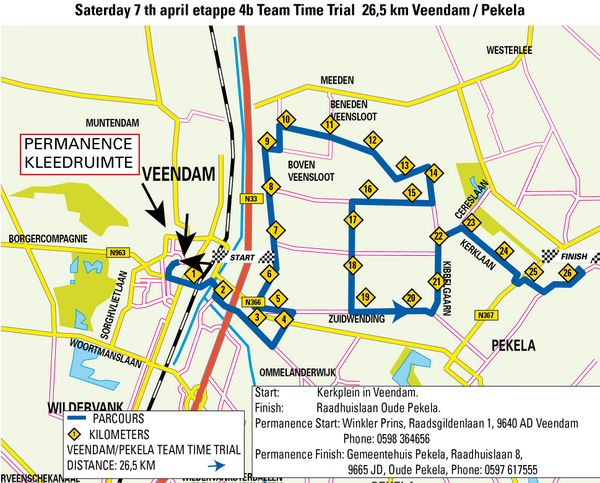
Stage 4b, the team time trial, takes place on Saturday afternoon and covers 26.5km, beginning at Veendam some way off to the south-east from 4a. After beginning in the centre of the town on JG Pinksterstraat (53° 6'19.91"N 6°52'27.74"E), the teams pass through the streets and cross the canal, then the N33 motorway as they head into the flat fields. A route made up of fast straights punctuated with 25 bends and corners will make for a fast stage, but one in which a slower rider could very easily be dropped off the back of the squad and never find her way back. When they arrive at Oude Pekela, they follow Feiko Clockstraat into town, then turn left to arrive at the finish on Raadhuislaan (53° 6'17.39"N 7° 0'24.65"E).

Stage 4b - click to enlarge
(image credit: Energiwacht Tour)
Marianne Vos has pointed out that Stage 4b is likely to prove the pivotal point in the campaign of any rider - including herself - who hopes to win this race, because a race leader's General Classification advantage can very rapidly be wiped out by a slow team. For fans and rivals, this is our first opportunity to see how well the Rabobank Women's team, which was formed with the express intention of supporting Vos, performs under team time trial race conditions; making this stage one of the most important races so far this season.


Cyclopunk's prediction: GreenEDGE take the stage, but with an insufficient advantage to knock Marianne off the top spot in the GC

Weather: The riders face a chilly start to the day - it's currently only 4C at Baflo, and with a northerly wind of 25kph it feels more like -2C, possibly -4C in exposed places. At present, it's raining lightly - it should dry up later, but further showers are likely. Veendam looks set to be similar, though afternoon temperatures of 7C will at least feel above freezing though not by much, perhaps 3C.

As ever, the best way to get information during the race is by following the official Twitter @ewacttour, hashtag #EWT12 and @richiesteege. Local TV RTL7 is broadcasting a short highlights show daily: Stage 4a will be shown at 14:45 BST (+1 hour for local time/CEST), Stage 4b will be shown along with Stage 5 tomorrow at the same time.

Stage 1 / 2 / 3 / 4a-4b / 5 / Guide / Video Vault