Showing posts with label teams. Show all posts

Monday, 19 August 2013

GP de Plouay Bretagne 2013

31.08.2013 Official Site
France, One-day Road Race,
UCI CDM

With the Women's World Cup consisting of only eight rounds this year (a loss of one third when compared to 2006, when there were twelve, but no different to 2012 and still an improvement on 1998, the first year the competition was held, when there were six), we've been left with a rather peculiar situation in which three rounds were held within a three week period in March, then there was another one in April and another in May before a three-month wait until the Vargarda team time trial and road race rounds, which take place on the same weekend. Two weeks after Vargarda it's the GP de Plouay-Bretagne and then, once that's over, so is the World Cup - and so we begin to approach the end of another cycling season.

Cup standings before the race
1 Marianne VOS (Rabobank-Liv/Giant) 354pts
2 Emma JOHANSSON (Orica-AIS) 252pts
3 Ellen VAN DIJK (Specialized-Lululemon) 224pts

With 75 points on offer to the winner, we're in a similar situation to 2012 when Marianne Vos started the race with an unassailable advantage of 84 points. This year, her advantage is even greater at 102 points; she is, therefore, guaranteed a fifth Cup victory (others: 2007, 2009, 2010, 2012). However, Ellen van Dijk trails Emma Johansson by only 28 points, meaning that she could still take second place - their Lululemon and Orica teams have proven many times that they are evenly-matched rivals, setting the scene for an epic battle. Fourth place Elisa Longo Borghini trails van Dijk by 68 points, meaning that she could take third place if she wins (for a breakdown of points awarded to each position, see the bottom of this article) and van Dijk does poorly, but cannot challenge for a higher place than that. Anna van der Breggen, in fifth, trails van Dijk by 101 points and thus cannot challenge for a podium position.

Don't take your eyes off Vos, though: she could stop off halfway round the parcours for a couple of beers if she felt like it, but that's not her style - she'll fight every bit as hard for a final first place over the finish line as she has at every other race she's taken part in. After all, she didn't need to win this race last year - but she still did, and by 35".

Previous Winners
2002 Regina Schleicher
2003 Nicole Cooke
2004 Edita Pucinskaite
2005 Noemi Cantele
2006 Nicole Brändli
2007 Noemi Cantele
2008 Fabiana Luperini
2009 Emma Pooley
2010 Emma Pooley
2011 Annemiek van Vleuten
2012 Marianne Vos

Since its inauguration, Plouay has earned a reputation as one of the most well-organised and fun events on the Elite Women's calendar and the committe makes sure there's plenty enough going on to keep the huge crowds that show up to watch happy even when no racing is taking place - with a selection of music, food, drink and all sorts of other entertainments also on offer, it attracts people with no interest in cycling and are simply looking for a good day out, which also makes it the ideal event to visit with your family if you've not yet persuaded them that cycling is something they ought to show some interest in. It all comes together to form a superb showcase for cycling, so who knows - it might be this race that finally gets them to see the light.

The Parcours
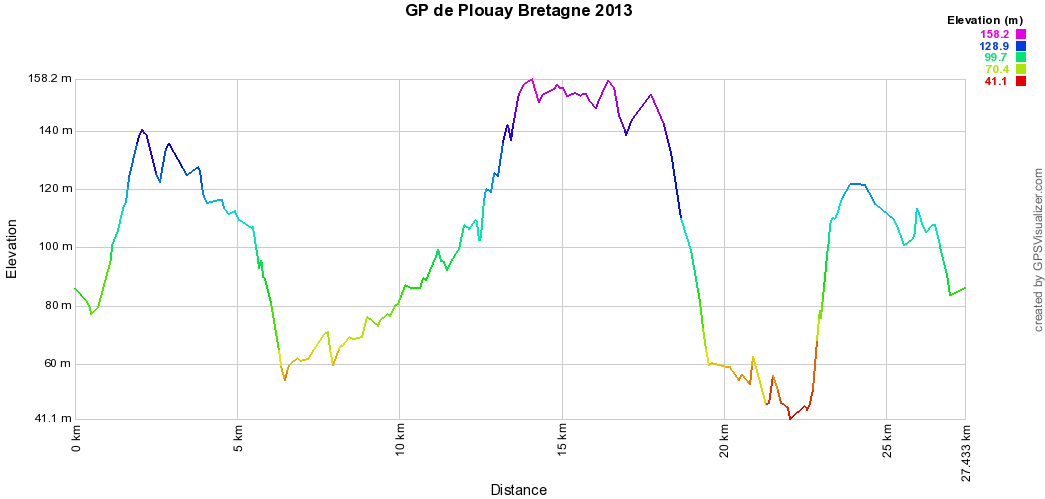
The race takes an almost identical route to the 2012 edition with only a few minor changes to the parcours leading through Plouay shortly after the start line. These changes do not alter the length of the circuit, which remains 27km; as was the case last year the riders will complete five laps (in red on the official maps, blue on the Les Déesses map; the shorter, blue circuit depicted on the official map is the parcours used by some of the other events taking place).

Back in 2000, Plouay hosted the World Championships and, just north of the velodrome on a road named the Boulevard des Championnats du Monde in honour of the event, a hard-surfaced area was created to host the event "village" with plenty of space for the team vehicles and race infrastructure. This area was preserved and is now used for the GP village; opposite it is a raised grassy area that, for those spectators who can find space among the vast crowds that pack onto it, offers excellent views of the spectacularly fast starts along the straight and slightly downhill initial 0.5km as the riders head into the first corner.


View GP de Plouay Bretagne 2013 in a larger map

Once past the unspeakably ugly Carrefour and Netto supermarkets just past the start line the riders head into the first corner, a tight left with a drain cover placed in the middle of the left-hand carriageway (potentially a hazard in the wet). Moments later, they pass a fuel station and then turn left again to join the D178 leading through the outskirts of Plouay to the first climb, Cote du Lezot. The summit is marked by a footbridge; just past it is another raised area alongside the road which forms another good point from which to watch the race. The route begins to climb again shortly afterwards and looks reasonably steep around the next bend, a non-technical left leading towards the village of Kerscoulic; beyond the village at Questenen Plaine is an easy right turn onto the D110.


The race follows the D110 for several kilometres through the Foret Domaniale de Pont-Calleck, an area of stunning natural beauty but one where the roads, as with all forests, can be treacherously slippery due to wet leaves after wind and rain. Soon they cross a bridge over the Le Scorff river and come to a roundabout, heading right to follow the course of the river north to Chateau de Pont-Calleck. The road rises and falls, but the route is primarily uphill. After bending left, the road starts to climb more steeply on the approach to Chapelle Ste Anne de Bois, a tiny church that looks like a miniaturised Baroque cathedral. Anne is the patron saint of lost objects; if hope is an object perhaps riders who suffered on the climb to reach her chapel will refind it on the fast, flat 5.1km that now takes them to the same roundabout they visited earlier. At the end of the road, the right turn to join the D204 is very tight and leads immediately into a fast descent.

The D204 ends at another roundabout, where the race turns left and then left again onto the D769, a wide and fast road with none of the charm of those running through the forest. Very soon, they leave the road by turning right and then immediately left, taking a road that is little more than a track running alongside the D769. It's not the more pleasant of the two routes, however, because it takes in the Minojenn du Calvaire climb which is as steep as 13% at points. Once over it, they rejoin the D769 and continue to the Cote de Ty-Marrec, the final climb of the circuit, and then enter the last 5km. A sharp left turn with a traffic island leads from the D769 to the D760BIS, which the riders will follow around a right-hand bend (and past more trees, hence more hazards if the weather is bad) and back toward Plouay. A road joining from the right marks 1km to go; the remainder is flat and straight all the way to the finish line and, if no rider manages to get away earlier on as Vos did in 2012, makes a fast bunch finish likely.

Start List
Click to enlarge. List is provisional.
How to follow the race
Regular updates are posted on the official website, with images at Plouay TV (turn the sound down if you're at work). Unfortunately, the organisers do not seem to have set up a Twitter account; however, Hitec-UCK manager Karl Lima, Boels-Dolmans mechanic Richie Steege and journalists Bart Hazen and Anton Vos all Tweet live from the races they attend.

Points awarded according to position: 1: 75 - 2: 50 - 3: 35 - 4: 30 - 5: 27 - 6: 24 - 7: 21 - 8: 18 - 9: 15 - 10: 11 - 11: 10 - 12: 9 - 13: 8 - 14: 7 - 15: 6 - 16: 5 - 17: 4 - 18: 3 - 19: 2 - 20: 1 

Wednesday, 31 July 2013

Lotto-Belisol Belgium Tour 2013

23-26.08.2013 Official Site
Belgium, 4-stage Road Race, 332.5km
UCI 2.2

If you want to be rich, women's cycling is not the place to go seeking your fortune - most of the teams operate on notoriously tiny budgets and riders can never be certain that their sponsors won't suddenly announce they're ending their links with the sport which, in all too many cases when the team is unable to find a new sponsor, means the end. Fortunately, there are a few companies out there that are willing to ignore the bean-counters and put in large amounts of money for returns that, as women's cycling doesn't receive anything like the exposure that men's cycling does, often seem not to make sound financial sense. Rabobank proved itself to be a company that genuinely cares when it elected to continue sponsoring a women's team after pulling out of men's cycling entirely; Boels, a plant machinery firm, is another example, one that sponsors a team and three races (the Boels Ronde van Drenthe, which took place in March, the Boels Hills Classic in May and Boels Ladies' Tour, previously known as the Holland Ladies' Tour and one of the most prestigious events on the Elite Women's calendar, which will take place early in September). There is also Lotto, the Belgian national lottery, and Belisol, a Belgian manufacturer of solar panels, doors and windows - together, they sponsor the Lotto-Belisol men's and women's teams and this race, the Tour of Belgium.

Unlike the Tour de France, which has stages that start in one town and end in another, the Belgium Tour is more like a rock band's tour - it visits a different town each day and the riders then compete on a circuit that starts and ends at the town. This has numerous advantages, chiefly that costs are cut by having each stage consist of several laps rather than one long parcours and fans get to see the race pass by several times, either by remaining at the same point or by moving around to see it from different places.

Parcours
Stage 1: Warquignies-Angreu (23.08.2013, 19.7km Team Time Trial)

View Tour of Belgium Stage 1 2013 in a larger map
The only non-circuit stage of the race, Stage 1 will see the teams putting their bike handling skills to the test with a series of very sharp corners in the first two kilometres, where it'd be very easy indeed to lose a couple of riders to unfortunate crashes and end up with insufficient numbers to even be awarded a time - which would mean race over. Once through, there's a forested section (which always increases the likelihood of punctures, which can be disastrous when racing against the clock) with a climb of around 70m in 2.5km, then a long and flat straight section running south-west along the Av. du Haut-Pays where the fastest squads will be able to get their heads down and find a serious time advantage against those who haven't been practicing their TTT tactics quite so much as they ought. Another very sharp bend then leads onto the remaining part of the parcours, finishing 19.7km (which is why it's a stage rather than a prologue; a prologue in an Elite Women's race cannot be longer than 4km according to UCI rule 2.6.006).
Altimetry
The route uses many open lanes running alongside flat, wide fields; although the parcours is in Wallonia, the region is subject to typically Flandrian wind and rain - with so little shelter along much of the route, the stage could become an ordeal if the weather is bad. There is also a cobbled section on the Rue des Juifs at Onnezies; however, the cobbles are flat, regularly-placed and in good condition, they will therefore not cause the riders serious problems.

Stage 2: Angreau (24.08.2013, 110.16km)

View Tour of Begium 2013 Stage 2 in a larger map
Stage 2 both begins and ends at the Place d'Angreu, where Stage 1 also finished. From the start line, the riders head into a 12.24km circuit taking them first south to Roisin; they then travel north-east to the first GPM climb of the race - the Cote du Autreppe (5.48km from the start, points awarded at 5.48km, 29.96km, 54.44km, 78.92km, 103.4km), where points will be awarded during the 1st, 3rd, 5th, 7th and final lap. There are also four intermediate sprints, each of which begins as the riders cross the finish line during the 2nd, 4th, 6th and 8th laps (24.48km, 48.96km, 73.33km, 97.92km).

A tight left-hand turn leads onto the narrow Rue d'Autreppe, at which point the parcours will be familiar to the riders as it now follows the same route via Onnezies (including the 300m Rue des Juifs cobbles), Angre, Honnelles and back to Angreau.

Riders must complete nine laps of the circuit; the Cote, though neither high nor steep, will have a considerable cumulative effect and there'll be some sore knees on the final passage.
Altimetry
Stage 3: Nijlen (25.08.2013, 115.12km)

View Lotto-Belisol Belgium Tour 2013 Stage 3 in a larger map
The place names reveal that the Tour has left Wallonia behind and is now in Flanders, perhaps the most cycling-obsessed region in the world. Many of the little towns that dot the flat landscape have produced famous riders, including Nijlen where the race begins - it was the birthplace of Victor van Schil, trusted lieutenant of Eddy Merckx and winner of the 1968 Brabantse Pijl (sadly, van Schil took his own life in 2009 at the age of 69), Bjorn Leukemans (who may have won far more had he not have crashed so often) and Nick Nuyens, winner of the 2011 Ronde van Vlaanderen and husband of Evy van Damme, Belgian Road Race Champion in 2000 and 2001.

Most of the great Flemish races have taken place in warm, dry conditions in recent years, but for many people racing in this part of the world will always be associated with cold winds and driving rain. The parcours is far enough from the coast to avoid the worst, but with the topography being as flat as it is any wind blowing in from the North Sea rips across the land and still has plenty of power by the time it reaches Nijlen - crosswinds on the section heading west between Herenthout and Kruiskenberg and headwinds on the section heading north between Heikant and Nijlen may create some problems. Riders must complete nine laps of the 14.49km circuit, making the stage

There are no GPM points on offer on this, the flattest stage of the 2013 edition; the feed zone passes through an area known as Kruiskenberg, which sounds dauntingly like one of the brutally steep climbs for which Flemish racing is infamous, but which is in fact an undemanding hillock rising no higher than 20m with an average gradient of around 1.5% (maximum 3.5%). There are, however, four intermediate sprints. Each begins at the Cafe de Max located at Bevel-Dorp 160 in Bevel and points will be awarded on the 1st, 3rd, 5th and 7th laps (10.59km, 39.57km, 68.55km, 97.53km).
Altimetry

Stage 4: Geraardsbergen (26.08.2013, 87.47km)

View Lotto-Belisol Belgium Tour 2013 Stage 4 in a larger map

Rather than several identical laps like the earlier stages, Stage 4 consists of a total of four laps around three circuits; the first is 29.16km in length with one GPM climb and will be completed once, the second is 19.17km with no GPM climbs and will be completed once and the third, which is 19.57km in length and features one GPM climb, will be completed twice. There are also intermediate sprints when the parcours crosses the finish line for the first, second and third times.

The first circuit begins at marketplace in Geraardsbergen, a town that will be familiar any riders who took part in Gooik-Geraardsbergen-Gooik back in May - it's also been a feature in many editions of the Ronde van Vlaanderen over the years. Very soon after heading out into the neutral zone they'll catch glimpses of what, to cyclists, is Geraardsbergen's most famous feature, Kapelmuur, but for the time being they can concentrate on other things. Racing gets underway 1.9km from the start on Verhaegenlaan and the parcours remains unchallenging until Parikeberg, a 0.6km climb offering GPM points, with an average gradient of 5.8 and maximum of 7%; it is 21.44km from the end of the neutral zone. The remainder of the circuit runs back into Geraardsbergen, with several tight and potentially risky corners leading into the town.  The riders will take the last (non-GPM) climb to arrive at the start line at the market place, then continue to the first T-junction where earlier they turned right; now they turn left and follow Vesten, passing the finish line and contesting the intermediate sprint for the first time.

Riders tackle the Muur van Geraardsbergen
during the 2006 Ronde van Vlaanderen voor
Vrouwen
A short while later they turn south onto Edingseweg, then west on Guilleminlaan and follow it through two sweeping curves until it joins Vesten heading south and the race then continues along the same route as earlier until reaching the T-junction at Priem. In Circuit 1, the riders turned left here to travel west; this time they turn east along Molenstraat, neatly avoiding Parikeberg. A few hundred metres ahead, they rejoin the Circuit 1 parcours and follow it back into Geraardbergen, taking the same route via the marketplace and back to the finish line where another intermediate sprint is contested.

To begin Circuit 3, the riders turn right before reaching the Oude Steenweg junction used in Circuit 2 and follow Oudebergstraat, a route that takes them directly to and over the notorious Kapelmuur - the reason that Geraardsbergen has featured in so many legendary races, Kapelmuur is, according to some, the toughest climb in East Flanders. With cobbles as large as steps and a maximum gradient of 19.8% (average is 9%), it's proved decisive many times and may well do so again today, even on the first lap of the circuit if one rider manages to get away and a crash in the peloton holds everyone else up - when that happens, many riders find it impossible to get going again on the steep slope and have to run up instead. Once over the top, the parcours takes Oudeberg and Dreipikkel for the short distance to Oude Steenweg and turns right, the remainder of the circuit following the route of Circuit 2. By the time the finish line approaches, those climbs will have taken their toll and there might not be any sprinters left in contention, in which case the race will be fought out by the climbers - unless, of course, one of them has built up a sufficient solo lead to win ahead of the pack.
Altimetry, Circuit 1 and Circuits 3/4


Starters

Specialized-Lululemon
Ellen van Dijk
Lisa Brannauer
Gillian Carleton
Trixi Worrack
Evelyn Stevens
Katie Colclough
Loren Rowney

Sengers
Kimberly Buyl
Joanne Hogan
Birgit Lavrijssen
Julia Soek
Evelyn Arys
Sofie de Vuyst
Vera Koedooder

Lotto-Belisol 
Marijn de Vries
Jolien d'Hoore
Ann Sophie Duyck
Kaat Hannes
Steffi Lodewijks
Kim Schoonbaert
Celine can Severen

CycleLive Plus-Zannata
Annelies van Doorslaer
Carla Ryan
Annelies Dom
Daisy Depoorter
Monique van der Ree
Latoya Brulee
Liz Hatch

TopSport Vlaanderen-Bioracer
Jessy Druyts
Kelly Druyts
Else Belmans
Tessa de Moyer
Gilke Croket
Nel de Crits

Tibco-To The Top
Shelley Olds
Claudia Hausler
Chantal Blaak
Melanie Spath
Jasmine Glaesser
Lauren Stevens

Boels-Dolmans
Lizzie Armitstead
Adrie Visser
Romy Kasper
Nina Kessler
Jessie Daams
Martine Bras

Orica-AIS
Emma Johansson
Loes Gunnewijk
Gracie Elvin
Jessie MacLean
Tiffany Cromwell
Melissa Hoskins

Hitec Products-UCK
Rossella Ratto
Emilie Moberg
Thea Thorsen
Elisa Longo Borghini
Siri Minge
Cecilie Gotaas Johnsen
Chloe Hosking

Futurumshop NL
Karen Elzing
Sarah Lena Hofmann
Anouska Helena Koster
Mieke Kroger
Janine van der Meer
Mascha Pijnenborg

Crano Go:Green
Madeleine Olsson
Jessica Kihlbom
Linnea Sjobom
Hanna Nilsson
Martina Thomasson
Alexandra Nessmar
Hanna Helamb

Argos-Shimano
Kirsten Wild
Fllortje Mackaij
Esra Tromp
Janneke Busser-Kanis
Willeke Knol
Kelly Markus
Amy Pieters

Wielerclub De Sprinters Malderen
Chantal Hoffmann
Sarah Ingelbrecht
Mieke Leeman
Lilianne Leenknegt
Steffy van den Haute
Laure Werner
Joyce Willems 

Mixed Team (Rabobank-Liv/Giant, Autoglass Wetteren, Group Solar, FCS)
Tamina Kate Oliver
Amy McGuire
Daniela Gass
Roxane Knetemann
Thalita de Jong
Marieke Blomme
Adeline de Vestele

Napoleon Games-St Martinus-Kerksken
Joyce Accoe
Evelien Deltombe
Nele Seghers
Helga Sibick
Janicke Gunvaldsen
Vittoria Bussi

Endura Lady Force
Ines Klok
Margriet Kloppenburg
Michelle Geoghegan
Natasja Nieuwenhuizen
iris van der Stelt
Marjolein Claessen
Elke Bolangier

Dura Vermeer
Kirsten Coppens
Rowena van de Klundert
Charlotte Peeters
Chantal Verstraten
Brigitta Roos
Natalie van Gogh
Demi de Jong

NWVG-Bike4Air
Geertje Hoeke
Olivia Koster
Mary Rose Postma
Danielle Lissenberg-Bekkering
Anne Peer
Nathalie van Katwijk
Femke van Kessel

Parkhotel Valkenburg
Aafke Eshuis
Bianca van den Hoek
Inge Klep
Riejanne Markus
Rozanne Slik
Lisanne Soemanta
Nathaly van Wesdonk

Water, Land en Dijken
Nike Beckering
Melissa Slewe
Bernadette Jeremiasse
Marleen de Kroon
Corrinne Smith
Sigird Jochem

SWABO
Sofie van Horik
Annemarie Pasveer
Domenique van Santen
Harriet Koorn
Nina van Tol
Yvonne van Dam
Stella Blom-Visser

Les Filles Racing Team
Lydia Boylan
Nicola Juniper
Alexie Shaw
Helen Ralston
Nicole Oh
Nikki Engelbach
Kate Hewett


Mixed Team (Boretti, Matrix, Vanderkitten)
Sara Olsson
Kate Chilcott
Tracy Best
Emma Grant
Christina Siggard
Gina Hofland
Jessica Smits

RC Jan van Arckel
Moniek Tenniglo
Kristen Peetoom
Silke Kogelman
Winanda Spoor
Roos Hoogeboom
Hester Wagenaar
Britt Jansen

GSD Gestion-Kallisto

Keukens Redant

Canada NT
Anika Todd
Shoshauna Laxson
Sarah Coney
Annie Foreman-Mackie
Veronique Fortin
Veronique Labonte

Australia NT
Emily McRedmond
Madeline Marshall
Alexandria Nicholls
Samantha de Riter
Miranda Griffiths

Belgium NT

Further details to be announced; check Women Cycling Fever for regular updates.

Following the race
As is the case with the majority of Belgian races, getting to the Tour is a simple process from anywhere in North-Western Europe - including from the United Kingdom: traveling by ferry from Dover to Dunkirk with a car costs as little as £74 return (check online for deals; Hull to Zeebrugge, a better choice for much of Britain's population, is for some reason far more expensive - around £200 with a bike rather than a car) and none of the Tour towns are more than 180km from the port. Better still, travel by bike - port to race is a day's ride for a fit cyclist, two at a more comfortable pace and, with the Belgians' legendary love for bicycles and cyclists, you'll be sure of a warm welcome. None of the towns are tourist traps, so accommodation will also be affordable.

If you can't get there, the choices for following the race are typically limited to Twitter feeds. Hitec Products-UCK manager Karl Lima provides regular updates on the progress of his team and the rest; Boels-Dolmans mechanic Richie Steege and photojournalists Bart Hazen and Anton Vos (who may attend regarless of whether or not his sister Marianne Vos is there with the Rabobank-Liv/Giant team) are also good choices.

Wednesday, 22 May 2013

Emakumeen Euskal Bira 2013

06-09.06.2013 Official Site
Euskadi/Spain, Four stages, 296.9km
UCI 2.1


Once upon a time there were three Grand Tours in women's cycling, just as there are three in men's cycling. They were the Grand Boucle (also known as the Tour de France Féminin, Grand Boucle also being a nickname for the men's Tour de France), the Tour de l'Aude Cycliste Féminin and the Giro d'Italia Femminile (better known as the Giro Donne and now renamed the Giro Rosa).

The Tour de France Féminin was last held in 2009, by which time a lack of sponsorship had left it a pale shadow of its former self - trimmed down to just four stages (in 1985, when Maria Canins won, there had been 17 and a prologue), only 66 riders started and winner Emma Pooley joked ruefully that it had become the Petite Boucle. The Tour de l'Aude Cycliste Féminin, which had grown from four stages to ten and developed into perhaps the most beautiful women's race of them all, went the same way for the same reason a year later. Then only the Giro Rosa was left (and it came close to disappearing in 2012, too; fortunately, new organisers and sponsors came onboard and the race has been saved).

Fans, riders and team officials are united in wanting more women's Grand Tours; either new versions of those that have vanished, completely new events or bigger, better versions of races that already take place. The third option is the most practical for three main reasons: an experienced organising committee is already in place, the race has an established name that fans already know and those same fans already look forward to the race. How would such a new Grand Tour be developed? Simple, really: as ever, it's down to money - money from the UCI (and all indicators suggest they could afford it), then even more money from sponsors once the sport gets that financial kickstart and begins to look more attractive to the bean-counting suits who get to decide whether a company is going to sponsor something or not (sadly, very few companies genuinely care about women's sports; one example is Boels - everything between this set of parantheses exists merely to give mention to them, simply because they deserve it for being as willing as they are to put money into women's cycling when so many other firms are not).

That leaves one question: which races would be a good choice for development? Why not copy men's cycling's example and have one in Italy (as is the case), one in France (La Route de France, which has massive unrealised potential) and one in Spain? The Emakumeen Bira would be a fantastic choice for the Spanish Grand Tour: imagine that it was given the funds to expand to ten stages with four in the autonomous Basque Country of Northern Spain, two in the stunningly gorgeous Haute Pyrenees, then four in the French Pyrénées-Atlantiques Basque region Iparralde - what a superb showcase not just for women's cycle but for professional cycling in general that would be.

One day, perhaps. In the meantime, the Bira is already a superb race with a unique character all of its own; so enough of that for now and let's have a look at the 2013 race. (Oh, and by the way - the organisers are superb, too. When I emailed them to ask for details of the race, they sent back large scale profiles and route guides from the race manual. Thanks, Roberto!)

Past Winners 
1988 Imma De Carlos, 1989 Maria Mora, 1990 Josune Gorostidi, 1991 Joane Somarriba, 1992 Lenka Ilavská, 1993 Elena Barillová, 1994 Elena Barillová, 1995 Jeannie Longo, 1996 Teodora Ruano, 1997 Hanka Kupfernagel, 1998 Hanka Kupfernagel, 1999 Hanka Kupfernagel, 2000 Leontien van Moorsel, 2001 Joane Somarriba, 2002 Edita Pučinskaitė, 2003 Mirjam Melchers, 2004 Joane Somarriba, 2005 Svetlana Bubnenkova, 2006 Fabiana Luperini, 2007 Susanne Ljungskog, 2008 Marianne Vos, 2009 Judith Arndt, 2010 Claudia Häusler, 2011 Marianne Vos, 2012 Judith Arndt.

The Parcours
Like mountains, do you? I'm guessing almost certainly so because all cycling fans like mountains, and for that reason you'll be pleased to know that this race has mountains. Proper ones in the Pyrenees, with the first categorised climb - a Cat 3 (and the Bira organisers don't tend to use quite so much poetic licence when categorising the climbs as organisers at some other races do) - comes in the first 60km of the first stage. Don't go thinking that an ace grimpeur such as Pooley, Vos or Moolman is a sure-fire winner though (on the other hand, any one of those three could very well win), because this parcours has been cleverly designed to include plenty of opportunities for other kinds of riders to push their names a few places up the General Classification listings each day.

Stage 1 (Iurreta-Iuretta, 06.06, 91.3km)
Click to enlarge
Many roads and locations in the Bira will be familiar from its sister race the Emakumeen Saria, which takes place two days earlier. Among them is Iurreta, where Stage 1 begins by the car park at 14 Maspe Kalea with 200 flat, straight metres to a tight right turn leading onto the N-634 heading east. The route climbs slightly to the next junction, where the riders turn right to head south over a level crossing to pass Matiena before continuing past a large industrial estate (where, as is always the case on any road regularly used by heavy trucks, there's a possibility of hazardous diesel spills on the road surface) and on to Abadino, where the terrains begins to climb more steeply - nevertheless, expect early attempts to break away from the peloton as those riders who aren't here to do battle on the mountains to come try to get into a position to bag the best points at the first intermediate sprint, 10.5km from the start on the San Fausto Kalea leading into Elorrio.

The race turns north and keeps climbing, reaching a point 250m above sea level some 13.8km from the start in the woods between Elorrio and Miota. At Olakueta, the road passes under the AP-8 motorway before leading into the village, then the riders immediately follow a bend to the left and travel back under the motorway to rejoin the N-634 which will take them downhill via Eitua and Matiena and back into Iurreta at 22.5km. It's downhill for the next 5.8km to Euba, then an easy climb gains 50m over 6.5km en route to Gumuzio where the race leaves the N-634 behind and heads north to Larrabetzu. Another climb, without GPM points, begins here and gains approximately 100m in 3.7km to Astoreka 44.9km from the start; the ascent isn't tough enough to give the climbers any serious advantage but the descent, which drops 150m in 4.9km to Fika and is considerably steeper than the average gradient of -3% in places, may put them at a disadvantage - something any heavier riders, who are able to maintain better control on a descent than the featherweight grimpeurs, will have noted.

Euskadi has many industrialised areas, some of which are
visited on this stage, which has enabled it to remain more
prosperous than Spain during the current recession.
However, modern and ancient sit comfortably side-by-side
and there is much to interest tourists, such as the medieval
buildings in Elorrio.
However, at the end of the less steep descent over the next 3.5km to Elgezabal, the tables are turned when the race arrives at the first categorised climb - a Cat. 3 ascent of 160m in 3.3km, average gradient 4.8km and steeper in places. This climb, being approximately two-thirds into the parcours with more climbs to go, might turn out to be decisive: if a good all-rounder (which could happen; the grimpeurs could decide to save energy for the bigger climbs in later stages, and this isn't a hugely taxing climb) or a climber who didn't lag behind on the descents earlier on (and doesn't do so on the one just ahead either) gets to the top at Arritugane, 57.7km from the start, first they may do so with a sufficient lead on the pack to stay away for the remainder of the stage. If not, the descent - 150m in 3.5km at -4.3% - is opportunity for the pack to reduce a leader's advantage.

There's a flat section of around 3.7km between Derio and Zamudio which will see some jostling for position because as the parcours starts to climb again at Lezama, 68.9km from the start, the riders arrive at the second intermediate sprint. The route passes through Larrabetzu again at 72km, then Gumuzio at 79.5km where it rejoins the N-634. The next 6.5km to Euba descend gently, then the final 5.3km climbs around 50m to carry the peloton back to Iurreta and the finish line at the same location as the start on Maspe Kalea.

Stage 2 (Aretxabaleta-Aretxabaleta, 07.06, 103.5km)

Yesterday, the riders faced climbs right from the start; today is entirely different with hardly any climbing at all in the first 39km. There's no reason to think this is a sprinters' stage, though: that long, flat section terminates with a Cat. 3 ascent and then, in the final 20km, there's a harsh Cat. 1 gaining 350m in 6km at an average gradient of 5.8% with several steeper bits on the way to the summit. If a climber can leave the pack behind on the way there, she'll only have to stay away 15.5km to win the stage - but the descent over the next 9.5km is steep too, and many climbers don't like descents. Add a far more gentle descent over the final 6km back into Aretxabala into the equation and the eventual outcome is far from certain.

Aretxabaleta is around 11km south (as the crow flies) from Elorrio, the southernmost point of Stage 1, and the race begins there at 32 Durana Kalea. The riders first take a complex route south-west via Errota Barri to Eskoriatza and then back to Aretxabaleta, north to Arrasate, back to Aretxabaleta (with the first intermediate sprint at 18.5km, hence probable breaks in the first section) and Erroto Barri again and north once more to return to Arrasate after 25km before heading north-east, then south-east to Onati.

View of Kurtzebarri from Aretxabalete across Apotzaga
Just east of Onati is the Cat. 3 climb, complete with four hairpin bends in the forest on the way up - if you're lucky enough to be able to visit the race, the second hairpin is a very good place to watch it go by due to a spectacular view of the mountains (the third bend is a better choice if you want to paint riders' names on the road, though). Following a descent likely to be too short for the pack to catch up with leading climbers, the race reaches Legazpi 50km from the start and begin a less taxing climb of 100m in 5km; the descent that comes after it loses 300m in a little under 7km on the way to Bergara and could see the climbers lose time, giving the others time to catch up on the far gentler incline over the next 20km via San Prudentzio, Arrasate (with the second intermediate sprint at 73km), Aretxabalete and Eskoriatza. After 81.5km, the parcours turns right at Aingeru Guarda and heads to Marulanda, beginning the Cat. 1 climb at 85km; the summit and GPM points are 3km ahead.

Although the climb is sufficiently challenging to make it entirely possible for a climber to get away and build up a lead, the descent has the potential to change everything - in parts, it's much steeper than the average gradient of -4.5%. After arriving back at Eskoriatza, there are 6km of far less steep descending via Aretxabaleta and Mugarri, then back to Aretxabaleta to reach the finish line located at the same point as the start on Durana Kalea.

Stage 3 (Orduna-Orduna, 08.06, 13.4km Time Trial)
Time trials are usually fairly flat - but there isn't much flat space in Euskadi and this is the Emakumeen Bira, so this time trial has around 300m of climbing along its 13.4km.

The stage gets underway at Orduna's grand Foru Enparantza, a civic square that looks as though it belongs to Bilbao, Paris, Rome or one of Europe's other great cities rather than to what is, despite its official city status, a town of only a little over 4,000 people; and it leaves by heading west out of the city along narrow streets and then turning north to join the Tras Santiago Bidea for a straight 0.7km section to the next turn - a good place for those riders who know they'll be slower than the climbers on the two hills later in the stage to get their heads down and bank a few seconds. The Arbieto Auzoa leads off to the right, continuing for 0.45km to a sweeping right-hand bend; as it passes the car park for the football ground on the left (football being another Basque passion), it begins to climb. Just around the bend the road becomes the Vista Alegre Auzoa and the riders stay on it for 0.5km, traveling south to a sharp left turn leading into a gently curving 0.3km section that begins to climb from 0.15km, bcoming steeper in the final third prior to a very tight right onto the Ibazura Auzoa. The following 0.7km section is straight but climbs steeply in the first half, giving the climbers a chance to gain time on their rivals; it descends gradually in the second half but riders will need to brake towards the end in order to take the extremely tight right turn leading into the next section, a steep 0.3km descent ending with a 90-degree left turn at a crossroads. They climb gradually for the next 0.3km to arrive at a junction between three roads where they turn left again, heading uphill along the Aloria Entitatea for half a kilometre to another crossroads where they turn right and continue south for 0.86km, crossing another crossroads on the way to a left onto the BI-4907. Climbing for the next 0.7km brings them to a tight right turn just north of the little village Artomana, followed by a 0.5km descent to a left at a crossroads and a straight 1.68km section along the Artomana Entitatea - it descends in the first half, then climbs slightly in the second and the view at the end, where Delika nestles among the mountains all around, is remarkable.

Delika Canyon
A surprisingly high percentage of cycling fans say they don't like time trials. Some of them say this is because a stage races can be all too easily won with a good trial time, which is a fair accusation - nobody wants to see a rider who hasn't performed well in other stages snatch victory from a rider who has on the back of one short stage (well, unless it's Fabian Cancellara, since we all love him) but the majority aren't able to give a reason, disliking them for some other reason that they perhaps don't know for themselves. I'm willing to hazard a guess that, for a good few of those in the latter category, it's because time trials aren't usually routed along roads chosen to show off an area's natural and architectural beauty, as other stages tend to be - and we all love professional cycling as much for the places as much as for the sport, hence the "chateau porn" at the Tour de France. This isn't going to be a problem in the Bira because this time trial goes past one of Europe's most incredible and surprisingly not very well-known landscapes - the vast Delika Canyon, carved out of the rock over millions of years by the Nervion River that plunges 300m into it, creating one of the world's most spectacular waterfalls. Just a pity the race won't be televised so we could see it, isn't it?

Turning left leads them along the BI-4906 into Delika and they follow the road as it curves through the town, then negotiate a left-left-right series of corners to lead onto a bridge crossing a railway on the way out of town. The road climbs for 0.2km en route to a right turn, beginning the 2.48km section to Tertango; the first kilometre is mostly downhill, but there's a short and steep climb through the woods over the next 0.25km before more downhill in the final kilometre. At a T-junction just east of Tertanga the riders turn right (they'll be glad they don't go left - there's a series of seven hairpin bends carrying the road 200m upwards 2km further south) and begin heading back to Orduna. The first part is o.63km in length and downhill, passing under a railway bridge on its way to a left turn at a roundabout that leads into a 0.3km flat section along a new road, ending at another roundabout and a right turn onto the Gama Erripdea - the first 0.26km is wide, but it becomes far narrower over the final 0.6km leading past the bull ring (the Basques, fine people that they are, unfortunately share the Spaniards' love of torturing cattle to death) and into the city. Just beyond the left turn at the bull ring is a 0.34km section along the straight and wide Barrio San Francisco; it ends at a junction of roads followed by a final 0.16km along very narrow streets leading back to the Foru Enparantza.

Stage 4 (Fruiz-Gatika, 09.06, 88.7km)
There are 24km at the start of this stage - with both intermediate sprints falling within it, at 10 and 23.2km - before the rest of the race is handed over to the climbers to decide the outcome of the stage and, unless anybody managed to build up an unbeatable lead earlier on, the final overall General Classification: there are five big climbs in the last 63km, including one Cat. 3 and two Cat. 2s, as well as an uphill approach to the finish, making it a stage that needs to be ridden intelligently - if a rider uses up too much energy on the first couple of climbs (an easy thing to do after the last three stages), she could very easily burn out on the Cat. 2s and fall several places down the GC list.

The first 5km is downhill, then the terrain rises gently over the next five to the beginning of the first intermediate sprint at the Cafe Lekuona in Maruri-Jatabe; a situation likely to encourage early breakaways with domestiques battling one another for valuable points while the climbers and GC contenders preserve themselves for later. The following 6.8km is flat, then another gentle leads 3.8km to take the riders for the first time to Gatika, where another downhill section of 2.6km will probably see more attempts to break away as the race approaches the second intermediate sprint 23.2km from the start at Mungia - and, so far as those riders who can't keep up with the real mountain goats are concerned, that's the end of the race: from this point onwards, it's mountains all the way. The first, an uncategorised ascent of approximately 110m over 5km, leads to Meñaka, more a collection of hillside micro-hamlets than a village. The descent isn't particularly challenging but provides an opportunity for climbers who don't fear descending to gain a lead over those that do on the way to the next climb, a Cat. 3 175m in 5.4km ascent with an average gradient of 3.2% but much steeper in parts. The descent, lasting for 14.1km, takes the race into Gernika, the Basque spelling of Guernica - the town that was bombed by the Luftwaffe in 1937, an event that inspired Picasso's most famous (and, by far, most disturbing) painting.

The next climb, beginning at Gernika, is one of the most difficult in the race and, in the right circumstances, may even prove to the pivotal point that decides the winner. Rising 275m in 5km at an average gradient of 5.5%, a rider able to make a solo break to the top might be able to build up enough of a lead to stay away on the next climbs and get to the finish line alone. There's a descent over the next 4.2km to Atxika, followed by another climb which, at 75m in 4.9km, doesn't look much on paper but the fact that it's rated at Cat.2 suggests some sections much steeper than the 1.5% average gradient and some very difficult road surfaces; the name of the village at the top of the climb, Arrieta, comes from the Basque word harrieta, meaning scree - extremely slippery and abrasive stuff when it collects on bends and corners. With that in mind the descent, 175m in 2.7km (average gradient -6.4%), begins to look rather like it might be the most dangerous section anywhere along the parcours since the race started in Iurreta and the riders will need to tackle it with very great care.

Butroeko Gaztelua
There is still one considerable, if uncategorised, climb to go. Beginning at the foot of the Arrieta descent at Ibarra some 71.1km from the start, it gains 100m in 5.2km; an average gradient less than 2% but sufficiently steep to potentially affect the leadership order so near to the end of a mountainous stage. It leads back to Meñaka, where a 7.4km route differing to the one taken earlier continues back to Maruri and to the last uphill 5km section to the finish line at Gatika, a town famous for Butroeko Gaztelua, Butron Castle - which looks so much like a medieval castle is romantically supposed to look (a grand palace for a benevolent lord and place of refuge for his subjects), as opposed to how they actually look (grim expressions of military power also intended to suppress any revolutionary ideas among the peasants) that it seems too good to be true. And in fact it is - although it really is a medieval castle, it was extensively and radically remodeled by a romantically-minded 19th Century architect and marquis Francisco de Cubas, who made it look like a Bavarian mountain castle (that it manages to do so despite being surrounded by distinctly non-Bavarian palm trees is evidence that the Marquis knew what he was doing).

Starters
Subject to change.


Orica-AIS
1 Emma Johansson
2 Tiffany Cromwell
3 Shara Gillow
4 Loes Gunnewijk
5 Annette Edmondson
6 Amanda Spratt

Lotto-Belisol
11 Ashleigh Moolman
12 Carlee Taylor
13 Marijn de Vries
14 Ann-Sophie Duyck
15 Kaat Hannes
16 Sharon Laws

Hitec Products-UCK
21 Elisa Longo Borghini
22 Emilia Fahlin
23 Mirian Bjornsrud
24 Rachel Neylan
25 Rossella Ratto
26 Cecilie Gotaas Johnsen

Faren-Let's Go Finland
31 Marta Bastianelli
32 Elena Cecchini
33 Christel Ferrier-Bruneau
34 Fabiana Luperini
35 Sara Mustonen
36 Patricia Schwager

Michela Fanini-ROX
41 Edwige Pitel
42 Liisi Rist
43 Katia Barazna
44 Mireia Epelde
45 Lara Viecel
46 Jutattip Maneephan

Lointek
51 Emma Crum
52 Belen Lopez
53 Yulia Ilinykh
54 Eider Merino
55 Elena Utrobina
56 Alexia Muffar

Cramo-Go:Green
61 Madelene Olsson
62 Jessica Kihlborn
63 Isabelle Soderberg
64 Hanna Nilsson
65 Martina Thomasson
66 Linnea Sjoblom

Cyclelive Plus-Zannata
71 Carla Ryan
72 Annelies van Doorslaer
73 Latoya Brulee
74 Annelies Dom
75 Monique van der Ree
76 Liz Hatch

Fassa Bortolo
81 Elena Berlato
82 Silvia Cecchini
83 Jennifer Fiori
84 Francesca Cauz
85 Chiara Pierobon
86 Francesca Stefani

Bizkaia-Durango
91 Anna Sanchis
92 Joane Hogan
93 Ane Santestaban
94 Dorleta Eskamendi
95 Mayalen Noriega
96 Lourdes Oyarbide

Specialized-Lululemon 
101 Evelyn Stevens
102 Ellen van Dijk
103 Trixi Worrack
104 Ina-Yoko Teutenberg
105 Lisa Brennauer
106 Katie Colclough

Futurumshop
111 Sarah-Lena Hofmann
112 Laura van der Kamp
113 Anouska Koster
114 Mieke Kroeger
115 Mascha Pijnenborg
116 Stephanie Pohl

Rabobank-Liv/Giant
121 Marianne Vos
122 Annemiek van Vleuten
123 Lucinda Brand
124 Megan Guarnier
125 Thalita de Jong
126 Pauline Ferrand-Prevot

Pasta Zara-Cogeas
131 Rosella Callovi
132 Inga Cilvinaite
133 Evelyn Garcia
134 Edita Janeliunate
135 Martina Ruzickova
136 Lorena Vargas

Boels-Dolmans
141 Lizzie Armsitstead
142 Martina Bras
143 Jessie Daams
144 Romy Kasper
145 Adrie Visser
146 Marieke Vanroij

BePink
151 Noemi Cantele
152 Simona Frapporti
153 Silvia Valsecchi
154 Alena Amialiusik
155 Daniela Levi
156 Alice Algisi

Argos-Shimano
161 Charlotte Becker
162 Janneke Busser
163 Willeke Knol
164 Elke Gebhardt
165 Amy Pieters
166 Kirsten Wild

Sengers
171 Anna van der Breggen
172 Julia Soek
173 Maaike Polspoel
174 Sofie de Vuyst
175 Christine Majerus
176 Evelyne Arijs


How To Follow The Race
The first point of call for race information is obviously the official race website - Bira organisers do a better job of keeping it all up-to-date than the organisers of, shall we say, some other races that took place over the last few weeks. Regular readers of this site will already be familiar with Karl Lima, the manager of the Hitec Products-UCK team - Karl somehow finds the time while following his riders at races to provide regular and detailed Tweets. Many fans rely on him to keep them informed as to what's going on in races and he's very much worth following. Anton Vos, brother of World Champion Marianne, also attends the big races in his capacity as a photographer, as does photographer and journalist Bart Hazen - both are also top-value Twitter follows.

Sunday, 24 March 2013

EPZ Omloop van Borsele 2013

20.04.2013 Official site
Netherlands, One-day Road Race, 120km
UCI 1.2

Large-scale map - click to enlarge
The Omloop van Borsele is the final event in one of those wonderful cycling festivals that take place in the Netherlands and Belgium - there is also a three-stage race for Junior women (time trial stage on Friday, stages 2 and 3 on Saturday and Sunday), a time trial for Elite women on Friday, time trials for Junior men and Promises on Saturday and a Junior men's race on Sunday.

Zeeland, in the far south of the Netherlands, consists largely of islands, many of them reclaimed from the sea; many points lie below sea level and the region is extremely flat. The parcours is also famous for the narrowness of the roads with at approximately half of the route being only wide enough for a single car which, combined with the winds that roar in from the North Sea, tends to keep the pack together and prevent the use of clever tactics - it's no surprise, then, that the Omloop has been dominated by sprinters with Kirsten Wild (racing with Argos-Shimano this year; 114) holding the record of four victories, won consecutively between 2008 and 2011.

The Race

With 2012 winner Ellen van Dijk away due to illness, Wild was a popular favourite this year - a string of sprint victories so far this season has proved that she has lost none of her skill. However, a crash shortly after the race got underway  in 's-Heerenhoek caused her to lose significant time; Orica-AIS rider Sungeun Gu also fell and had to leave the race (her team mates Annette Edmondsen and Gracie Elvin went down in the same spot later on; fortunately none received serious injury). The route, passing through typically flat Dutch countryside that leaves the riders at the mercy of the powerful winds that blow in off the North Sea at this time of year, is 24.311km from start to finish; riders needed to complete five laps to finish.


Kuipersdijk is wide, flat and smooth and encouraged a fast start as the riders headed south out of town, but there were plenty of technical sections to keep the riders paying attention: at Westeindsedijk, only 3km from the start, the road narrowed on a very tight turn and many of the riders found themselves suddenly at the back of the peloton as it poured itself into the limited space. A little further on on the Bandijk road, a nasty pavé-like rumblestrip running either side of the asphalt slowed down those riders who got forced onto it as they rounded the corner. A right followed immediately after, taking the race onto the Hooglandesdijk (with more rough verges) heading south-east again for 1.6km and a left onto Weldijk, soon passing through the tiny village Koekoek ("Cuckoo"), by which time a combination of parcours and the expected strong wind had split the pack into several smaller groups.

Kruiningenpolderweg is almost perfectly straight, another fast section where pressure could be put on rivals; it saw its fair share of tactical moves as the riders used it to test one another's strength. A few kilometres beyond Nisse, near a small lake called Schouwersweel on the left, the riders turned right and continued west on Nieuwekamerseweg, a narrower road that becomes Oudekamersedijk until reaching a fork where they kept right to follow Oude Zandijk north for 1.8km until arriving at a tight left onto Boomdijk, marking a point 20.121km from the start. Boomdijk is very narrow; with only 4km from here to the finish on the last lap, it left little room for chasers to get out of the peloton to bring back escapees - with her experienced eye, Vera Koedooder of the Sengers team knew it was the place to launch an attack and did so in the third lap with some 50km to go. With her went Loes Gunnewijk (Orica-AIS), Nina Kessler (Boels-Dolmans), Okzana Kozonchuk (RusVelo), Lucinda Brand (Rabobank) and Chloe Hosking, who seems to be determined to please team sponsors by getting her Hitec Products-UCK jersey into as many breaks and onto as many podiums as possible this year. The six stayed together as the race headed first west, then bent north for a short while and negotiented a pair of right-hand bends to get onto Oudelandseweg.

When Koedooder launched a second attack, only
Loes Gunnewijk was able to respond
0.6km further on, the riders arrived at a junction with the Heinkenszandseweg, the widest and most important road the race has seen for some time. Turning left led west and the road ran straight for 2.4km with plenty of width for the peloton to get into pursuit mode, stepping up the pace in the knowledge that they'd expend less energy than the six leaders. In the end, though, it was Koedooder that smashed the lead group apart: with 20km to go, she attacked so hard that only Gunnewijk was able to follow. The race was, against all expectations, going to end with a one-on-one sprint on the last 750m along the straight road to the finish line. Without Wild, who frequently seems utterly unbeatable in a finish such as this one, around to dominate proceedings this situation suited Koedooder perfectly - she powered up to full speed and simply kept going to her fourth win of the season so far, leaving Gunnewijk simply unable to find the little extra she'd have needed to get past. Lucinda Brand, who had led the chase group, took third place at +27" and Chloe Hosking was fourth at +53".

Kirsten Wild, the Argos-Shimano sprinter who crashed early on in the race, would eventually finish in 20th place 10'23" after Koedooder. Subsequent investigation revealed that she'd broken her shoulder - and anybody who has suffered a similar injury, as I have, will be thinking "Chapeau!" in wonderment that she could even get back on her bike, never mind finish the race. She'll now be forced to miss the upcoming Tour of Chongming Island, a race that would have suited her very well; get well soon Kirsten.

2013 victor Vera Koedooder
Result
Top Ten
1 Vera KOEDOODER (Sengers) 3h05'56"
2 Loes GUNNEWIJK (Orica-AIS) ST
3 Lucinda BRAND (Rabobank) +27"
4 Chloe HOSKING (Hitec Products-UCK) +53"
5 Nina KESSLER (Boels-Dolmans) +1'05"
6 Oksana KOZONCHUK (RusVelo) +2'16"
7 Amanda SPRATT, Amanda (Orica-AIS) +2'32"
8 Annemiek VAN VLEUTEN (Rabobank) +2'48"
9 Adrie VISSER(Boels-Dolmans) ST
10 Ilona HOEKSMA (Parkhotel Valkenberg) ST
Full result here


Saturday, 29 December 2012

2013 Ladies' Tour of Qatar

29.01.2013 Official Site (more info available from Velofocus)
Qatar, Road Race, 392km
UCI 2.1

Stop Press! According to a press release published on the 28th of January, live coverage of the Tour will be broadcast live and worldwide by Al Jazeera. Al Jazeera is available via satellite, cable and freeview.

Broadcasts will take place daily at 11:30 (14:30 East Africa Time, GMT+3 hours). For more details, see Al Jazeera's listing by clicking here.

Hurrah for the end of January! There's still at least a month of winter to go for those of us in much of North America, Asia and Europe, but the good news is that after several months of hibernation (and cyclo cross, so it's not all bad) the road racing calendar is coming back to life and heading south to the warmer climes of the Middle East for the Ladies' Tour of Qatar, promising three days of top quality racing and more roadside history than you could shake a stick at.

Oh, and wind. Lots of wind - Qatar is almost entirely flat and, being surrounded on three sides by the Persian Gulf, the wind blows straight in off the sea and continues over the land unabated, whipping up the sand as it goes. Imagine someone set fire to a huge pile of sandpaper and you had to ride through it - that's what the Tour of Qatar is like. It is not a race that eases the riders gently back into racing mode, as they found out just kilometres from the start of Stage 1 last year when they changing direction and a helpful tailwind that had seen them set off at high speed turned into a searing blast that fried them in their own sweat for the rest of the parcours. 2009/2010 overall winner Kirsten Wild, riding for the Dutch national team rather than her usual AA Drink-Leontien.nl (this year, she's riding for Argos-Shimano), won that day and became the first to wear the golden jersey after a group of eleven riders (whittled down to seven by the time they reached the final sprint to the line) broke away; later she would win Stage 3 in similar circumstances. However, finishing 2'20" behind Specialized-Lululemon's Trixi Worrack on Stage 2 meant Wild was never again in contention for a third General Classification victory - GreenEDGE leader Judith Arndt (now retired) was with Worrack at the Stage 2 finish and took the same time, thus gaining a 2" lead in the GC, and from that point onwards the battle was between those two teams. When Arndt managed to stay with Wild (and several others) for fourth place in a bunch sprint to finish Stage 3, her overall advantage increased to 6" and she had the race in the bag. A lot of racing had been packed into three days and Arndt was probably glad it was all over, as were the several riders who uploaded photographs showing what human legs look like after they've been sandblasted for 307km.

Kendall Ryan
For many fans, one of the highlights of the Tour is that due it being the first race of the season, young and less-well-known riders are out to show their stuff in an attempt to please their sponsors and prove to their directeurs sportif that signing them or keeping on the team was a wise move - Kendall Ryan (then 19 years old and racing for the USA national team rather than Tibco) lit up Stage 3 with a superb solo break that saw her increase her advantage over the peloton from 25" 15km into the route to 3'25" only 5km later, a truly remarkable achievement considering the strong headwind that day. Keep an eye on similar riders this year to see the stars of the future: they're the ones that make this race what it is.

One excellent piece of news is that, in these times when women's races are feeling the economic pinch and having to make cuts (or, in all too many cases, disappearing altogether), Qatar has actually grown - this year, there will be four stages rather than three as in previous years. Once again, the parcours concentrates on the north of the country.

This year, Qatar also offers us our first chance to see the all-new Wiggle Honda/DTPC Honda team in stage racing action. Owned and managed by women's cycling legend and Commonwealth gold medal winner Rochelle Gilmore, the British-based team is partly financed by Bradley Wiggins' Wiggo Foundation and boasts the sort of line-up that even well-established teams dream about: in addition to Gilmore, the squad is home to Laura Trott, Jo Rowsell, Dani King, Amy Roberts, Elinor Barker, twice World Champion Giorgia Bronzini (an ace sprinter and very much worth watching if she rides this race), Lauren Kitchen, Beatrice Bartellon, Emily Collins, Ana-Bianca Schnitzmeier and Mayuko Hagiwara- a talent pool that looks likely to do for British women's cycling what Sky has done for the men. They'll be wanting to make their mark; expect them to do precisely that.

Jerseys

Gold - overall race leader (General Classification)
Silver - points leader
White - leading young rider

Stages

Stage 1: Museum of Islamic Art - Mesaieed 97km 

Chloe Hosking gets things under way with a superb victory in the desert

Having set off from the Museum of Islamic Art in Doha (25°17'43.64"N 51°32'21.11") - among the most iconic modern buildings in a city full of iconic modern buildings and home to a world famous collection covering almost one and a half thousand years of artistic endeavour - Stage 1 headed south  past the airport out of the city for 11.5km to Al Wakra, then south-west for a further 14km before making a pass of the finish line at Mesaieed (Umm Sa'id) after 33km. Riders faced a strong headwind on this section, perhaps a contributing factor in the crash involving Charlotte Becker (Argos-Shimano), Anna-Bianca Schnitzmeier (Wiggle-Honda) and Jo Kiesanowksi (Tibco) at 14km; fortunately, none of the three suffered injury and were all back onboard within seconds.

The first pass of the finish line at 35.5km marked the beginning of the first sprint and 2009/2010 victor Kirsten Wilde took the top points closely followed by Rochelle Gilmore (Wiggle-Honda) and Marta Tagliaferro (Mcipollini-Giordana). Next, the riders turned north-west and headed out into the desert, heading across open country - a change of direction that turned the headwind into a tailwind with speeds increasing dramatically. Several teams took advantage of this, putting fast riders with useful domestiques out at the front; this rapidly led to the peloton breaking up into four groups with a lead group of fifty out in front.  29.5km later they arrived at Al Wukair for the second sprint, with Emma Johansson (Orica-AIS), Chloe Hosking (Hitec-UCK) and Tiffany Cromwell (Orica) first, second and third this time around.

Some 10km further on, now back at Al Wakra, the race followed the earlier route back toward the finish line - which brought an unwelcome return of the headwind, effectively finishing off any chance those riders who had failed to secure a place in the lead group had of winning the stage. Much of this final section was straight, culminating with a 1.8km along a wide road to the line, which always promised a high-speed bunch sprint. The leaders had an advantage of 2'30" going into the final 10km thanks largely to Trixi Worrack of Specialized-Lululemon taking control and driving it along at a high rate of knots. A little later, Gracie Elvin (Orica) launched an attack; a move that, had nobody have gone after her, might potentially have been a winning move. It was not to be, however - Lisa Brennauer (Specialized-Lululemon), Liebet de Vocht (Rabo-Liv-Giant) and, most crucially, Chloe Hosking (Hitec-UCK) went after her. Valentina Scandolara (Mcipollini-Giordana) broke away from the chase group for an impressive attempt at joining the leaders but, when nobody was willing to work with her, she faced the wind alone and was eventually reabsorbed by the second group.

Chloe Hosking
Elvin, Brennauer, de Vocht and Hosking had 45" with 2km to go. De Vocht was first to launch, but Elvin and Hosking overcame her rapidly and started their own private race; finally Hosking - an ex-rock climber who packs formidable ability in the mountains and the sprints into her 1.61m frame - got the upper hand, finding a last reserve of power that Elvin lacked to gain a fantastic start to the season for her team.

Stage 1 Top Ten
1 Chloe HOSKING HPU 2h23'51"
2 Gracie ELVIN GEW ST
3 Lisa BRENNAUER SLU ST
4 Liesbet DE VOCHT RBW ST
5 Marta TAGLIAFERRO MCG +10"
6 Kirsten WILD SKI +10"
7 Simona FRAPPORTI BPK +10"
8 Shelley OLDS TIB +10"
9 Emma JOHANSSON GEW +10"
10 Eleonora VAN DIJK SLU +10"
(Full result here)

Chloe Hosking is on Twitter - follow her here.
Chloe's team manager Karl Lima is also on Twitter and provides live updates from the races his team enter.


Stage 2: Camel Race Track - Al Khor Corniche 96km

Hey, who needs a team? Kirsten Wild overpowers with old-fashioned superior strength

Don't like cycling in strong wind? Then you'd probably best not book any cycle tours of Qatar - Stage 2 was a carbon copy of 2012's Stage 1, right down to a powerful headwind that strained the leg muscles throughout much of the parcours. Setting off from Ash Shahaniyah camel racing track (25°24'22.20"N 51°12'37.42"E) some 34km north-west of capital city Doha (25°24'20.66"N 51°12'39.51"E), the riders headed south-east for 2.87km on a flat road before arriving at a junction where they turned north into the desert and the wind, passing a zoo and game reserve at Lekhraib after 4km. Xiu-Jie Jiang (Chongming-Giant) and Audrey Cordon (France) got tactics off to a fine start with an attack at 8km but, both of them too far behind Chloe Hosking yesterday, the peloton showed little concern and only Malgorzata Jasinska (Mcipollini-Giordana) responded, waiting for the gap to half a minute before she successfully bridged. This initial section rises no more than a few metres but is very exposed, possibly once again leading to a hard time for the riders if it's windy.

Continuing north, the race reached a junction and turned left to follow an arrow-straight road north-west for 13.6km to a sub-station (25°43'31.04"N 51°10'15.93"E) marking the stage's first intermediate sprint, where Jiang took the top points with Jasinska and Cordon second and third. This led to a situation - with the gap now at a massive nine minutes, Jiang's bonus three seconds made her virtual race leader; Orica-AIS got on the case with every member of the team driving the pace ever higher to ensure the peloton made up time. Five of them - Tiffany Cromwell, Gracie Elvin, Amanda Spratt, Loes Gunnewijk and Emma Johansson - were joined by Chloe Hosking (Hitec-UCK), Lululemon riders Trixi Worrack and Ellen van Dijk and Kirsten Wild of Argos-Shimano to form a nine-rider break that took advantage of a change in direction, got away and reduced the gap to a more manageable three minutes - however, they couldn't catch the leaders in time to prevent them passing through the second intermediate sprint in the same order as earlier.

Then, 63km in, the three were caught; having worked so hard for so long in the wind, Jiang and Cordon could stay at the front no longer and dropped away, drifting back to the peloton. Now ten riders vied with one another, aware that - as tends to the way in this race - the stage was going to come down to a sprint finish. The peloton tried catch up so that the teams could decide who'd be in pole position, but Orica kept pushing hard and, at 10km to go, the gap had actually increased slightly - testament to Orica's tactical skills.

At Simsima, the riders continued straight ahead towards Al Khawr, the leaders attacking and counter-attacking one another all the way as they passed under the hundreds of pylons carry power cables away over the desert but, knowing now that the peloton was too far behind, they allowed their speed to fall off a little so as to save energy for the last dash to the line. Cromwell tried to take advantage, attacking with 5km to go, but was immediately caught by Wild; it was Wild who brought in Spratt when she tried her own attack a short while later. Interesting - Wild, with no team mates to support her and surrounded by a gang of strong Orica riders, was doing nothing less than taking control, bossing the race. She's enjoyed enormous success in this race with two General Classification victories to her name; was she going to go for an heroic stage win today?

Trixi Worrack made a splendid attempt at wresting victory
from an unstoppable Kirsten Wild
Worrack attacked next and, now that the finish was dangerously close, the entire group were on her instantly. Then Johansson tried, laying down sufficient power for Spratt to be jettisoned off the back and right out of the group, but the rest wasted no more time than they had in chasing Worrack and entered the final 300m en masse. Without the luxury of a lead-out - or indeed, any sort of team tactics - Wild opted instead for sheer brute strength, a technique not seen so often as it once was on this sort of parcours but one which, when it works, leads to spectacular victories. This time, it worked perfectly: Worrack tried to match her, but Wild was simply too strong and took the stage. Chloe Hosking, crossing in fourth place, recorded the same time and thus retains her 6" lead in the General Classification.

Stage 2 Top Ten
1 Kirsten WILD SKI 2h38'54"
2 Trixi WORRACK SLU ST
3 Ellen VAN DIJK SLU ST
4 Chloe HOSKING HPU ST
5 Emma JOHANSSON GEW ST
6 Gracie ELVIN GEW ST
7 Malgorzta JASINSKA MCG ST
8 Tiffany CROMWELL GEW ST
9 Loes GUNNEWIJK GEW +06"
10 Amanda SPRATT GEW +14"
(Full stage result)

General Classification after Stage 2
1 Chloe HOSKING HPU 5h02'33"
2 Gracie ELVIN GEW +06"
3 Kirsten WILD SKI +09"
4 Trixi WORRACK SLU +16"
5 Eleonora VAN DIJK SLU +18"
6 Emma JOHANSSON GEW +19"
7 Tiffany CROMWELL GEW +21"
8 Lisa BRENNAUER SLU +1'38"
9 Rochelle GILMORE WHT +1'50"
10 Marta TAGLIAFERRO MCG +1'51"
(Full General Classification)

Stage winner Kirsten Wild is on Twitter, send her your congratulations and follow her by clicking here.
Race leader Chloe Hosking is also on Twitter, she can be found here.


Stage 3: Al Thakhira - Madinat Al Shamal 112.5km

Wild does it again!

After setting off from Al Thakhira (Al Dhakira on some maps; 25°44'9.50"N 51°32'6.92"E) on the eastern coast, the riders faced 60km of desert road crossing the entire country to the western coast at Al Zubara - this first section also formed the first section of Stage 2 in 2012, but this year is being raced in the opposite direction. Al Zubara is home to a famous fort which looks medieval but was in fact constructed in 1938 on the foundations of an earlier fort. It remained in military use until the 1980s, also serving as a coastguard station, before being restored as a museum - visitors are asked to make a donation on entry. It also marks the beginning of the first sprint (25°58'31.90"N 51° 2'42.01"E).

As predicted, speeds were high with a tailwind blowing the peloton across the country from the south-east, driving the average speed during the first hour to a blistering 48kph and encouraging numerous riders to attempt to take advantage with attacks - however, with the peloton reaching top speeds of more than 60kph in places, nobody could get away. Several riders had punctures in the first stretch, including Kim de Baat (Netherlands) at 42km, Rochelle Gilmore at 40km and British rider Katie Colclough (Specialized-Lululemon) 5km before the first intermediate sprint, closely followed by riders from Be Pink and Chongming-Giant.

Argos-Shimano worked together to get their riders into an ideal position to grab points at the sprint and their efforts paid off: Stage 2 winner Kirsten Wild was the first one through, Charlotte Becker was third while Hitec-UCK's Chloe Hosking took second. Then, just as the race turned north a few kilometres up the road, a crash - a big one, splitting the peloton into pieces and allowing a group of 42 riders to get away on the 23.5km stretch to Abu Al Duloof. With this group counting numerous big-hitting favourites among its number, the pace stayed high and it wasn't long before some members found the going too tough and dropped away, reducing it down to 18 at the 75km point.

Wiggle-Honda rider/manager/owner Rochelle
Gilmore crashed hard and was disqualified
The leaders kept up a high pace, rapidly inserting a 35" gap between themselves and a second group that included devastatingly fast sprinter Giorgia Bronzini (Wiggle-Honda). Bronzini has spent a lot of time in second groups in this race; now she and team leader (and manager and owner) Rochelle Gilmore enlisted other riders to help them try to give chase; bizarrely, riders from rival teams with riders well-placed in the lead group seemed willing to chip in - a fine example of the unpredictability that makes women's professional cycling so fascinating.

At Madinat Al Shamal the riders entered a circuit and, 13km later, crossed the finish line for the first time, also beginning the second intermediate sprint - Lisa Brennauer (Specialized-Lululemon) took the top points at the second intermediate sprint with Chantal Blaak (Tibco) and Kirsten Wild right behind her for second and third. Several riders went down in another crash as they went through; Gilmore hit the road hard and reported after the race that she may have broken a collarbone. To add to her woe the judges, having apparently decided that she and Xiu-Jie Jiang's riding was to blame for the crash, disqualified both of them.

The chasers turned up the pressure and most of the lead group were caught, though eight riders remained out in front - a dangerous situation for the rest because, if that group could get into the final part of the race with a decent advantage, they'd almost certainly be able to choose from among themselves who would win. Because of that, the pressure was turned up even higher; the last of the lead group were caught with 4km to go and the riders approached the finish together.

Poor Chloe Hosking had awful luck with a front wheel puncture 500m from the finish - fortunately, since she was within the final 3km, she was awarded the same time as the lead group, mitigating the damage; unfortunately, due to time bonuses, she loses her General Classification lead and is now trailing by 3". Meanwhile, out at the front of the race Kirsten Wild, who set a new record for Tour of Qatar stage victories with a fourth yesterday (and also holds the record for most General Classification victories in this race), covered every attack and beat it with a fifth today - another superb effort by a rider who combines intelligence and strength and is one of the finest sprinters in the world today. Ellen van Dijk (Specialized-Lululemon), who had led until the Dutch superhero powered past her, was right behind her for second; Giorgia Bronzini (Wiggle-Honda) followed for third.

Stage 3 Top Ten
1 Kirsten Wild (Argos-Shimano) 2h28'15"
2 Ellan van Dijk (Specialized-Lululemon) ST
3 Giorgia Bronzini (Wiggle-Honda) +02"
4 Marta Tagliaferro (Mcipollini-Giordana) ST
5 Shelley Olds (Tibco-To The Top) +04"
6 Simona Frapporti (Be Pink) +05"
7 Trixi Worrack (Specialized-Lululemon) ST
8 Emma Johansson (Orica-AIS) ST
9 Gracie Elvin (Orica-AIS) ST
10 Tiffany Cromwell (Orica-AIS) ST
(Full stage result when available)

General Classification after Stage 3
1 Kirsten WILD (Argos-Shimano) 7h30'43"
2 Chloe HOSKING (Hitec-UCK) +03"
3 Gracie ELVIN (Orica-AIS) +16"
4 Ellen van Dijk (Specialized-Lululemon) +17"
5 Trixi WORRACK (Specialized-Lululemon) +26"
6 Emma JOHANSSON (Orica-AIS) +29"
7 Tiffany CROMWELL (Orica-AIS) +31"
8 Lisa BRENNAUER (Specialized-Lululemon) +1'52"
9 Marta TAGLIAFERRO (Mcipollini-Giordana) +1'58"
10 Lauren KITCHEN (Wiggle-Honda) +2'02"
(Full GC when available)
Kelly Druyts (TopSport-Vlaanderen) did not start; Xiu-Jie Jiang, Lina Shi (both Chongming-Giant), Rochelle Gilmore (Wiggle-Honda) and Liesbet de Vocht (Rabo-Liv-Giant) did not finish. Liesbet de Vocht's crash - image.


Stage 4: Sealine Beach Resort - Doha Corniche 86.5km

And the race goes Wild!

Stage 4 begans at the Sealine Beach Resort (24°51'37.76"N 51°30'53.00"E), a modern tourist site a few kilometres south-west of Mesaieed, then reversed the first section of Stage 1 to head through Al Wakra, location of the first sprint (25°10'43.96"N 51°36'12.82"E) and back into Doha for the grand finish at Doha Corniche. When the riders arrived at the Museum of Islamic Art roundabout, they continued straight ahead rather than turning right to return to the museum and crossed the finish line for the first time after 1km; this also marked the entry into a 6km circuit about which riders completed five laps. The second sprint began on the second passing of the finish line.

Unusually for Qatar at this time of year, the wind dropped considerably today, making the stage a different sort of race to the previous three - in an attempt to make the most of it, several riders and groups began their attacks within the first kilometres. Hitec-UCK put an enormous amount of effort into their attempt, hoping no doubt to help Chloe Hosking win back the three seconds she needed to retake the General Classification lead, but as the race left Mesiaeed behind and struck out across the desert for the coast the peloton was simply too fast and the riders remained together.

Kirsten Wild (Argos-Shimano) began the day with a 3" advantage over Hosking, but being a rider as wise as she is strong she knew that she should take any opportunity that came her way to win more time - and so a battle began on the way to the first sprint, with Hosking ducking into the Dutch rider's slipstream in the hope of slingshotting past for the points. Hosking has, on countless occasions, shown herself to be a remarkable sprinter; however, at 22 years of age, she doesn't yet have the experience or physical power of 30-year-old Wild and found herself simply unable to get past. Ellen van Dijk (Specialized-Lululemon) was on their tail and took third. With victory now looking more certain, Wild's Argos-Shimano team concentrated on providing protection rather than keeping breaks in check, showing no concern at all when a group of nine split off and headed away up the road - with best-placed rider Carmen Small (Specialized-Lululemon) setting off this morning with a disadvantage of almost four minutes to Wild, there was really no need to expend energy pulling them back at this point. Other teams followed suit; it was only when the gap reached 1'25" that Wiggle-Honda (presumably seeking to mitigate damages following the loss of team owner and leader Rochelle Gilmore yesterday) and the Italian national squad (presumably happy to grant a request for help from Wiggle's Italian superstar Giorgia Bronzini) combined forces and chased them down, chopping almost half a minute off the gap by the time the race entered the first of the five circuits.

By the beginning of the second lap, the gap was down to 45" and rapidly diminishing - though it still left Jasmin Glaesser (Tibco), Audrey Cordon (France) and Shelley Olds (Tibco), as the fastest in the break, to take the points on offer at the second intermediate sprint. The break's time out in front was almost over by the start of lap three with their advantage slashed to only 20"; when it fell to 15" Cordon launched a fine and picturesque solo attack, but was quickly caught by the super-fast Small. Jessie MacLean bridged and looked capable of overtaking, but as her Orica-AIS team mates were driving the peloton after Small and Cordon she then declined to go in case they went with her - probably a wise move, because Cordon had the strength to mount another attack towards the end of the third lap, though she couldn't fend off a counter attack by Lucinda Brand (Rabo-Liv-Giant).

As the penultimate lap loomed, Argos-Shimano decided the time was right to seize full control of the race - but Orica-AIS weren't about to let them have it all their own way and revealed themselves to have plans of domination too, as was seen when British rider Katie Colclough (Specialized-Lululemon) to have a go at a solo break of her own and found she had both Orica's Emma Johansson and Argos in its entirety on her back. Needless to say, she didn't get far. Lululemon now resorted to trickery, sending Small on another attack which then turned out to be a smokescreen intended to divert attention from an attack by her team mate Lauren Rowney over on the other side of the road. It didn't work: Argos and Orica were on Small the moment she made her move but were sufficiently alert to spot what was going on and stopped Rowney in her tracks too.

Kirsten Wild wins for a record third time
As the final lap began Kirsten Wild sat behind an Argos plalanx - and right behind her sat Hosking, whose Hitec-UCK sent Elisa Longo-Borghini on an attack in an attempt to tie up a few Argos riders, hoping to force them to expend energy they'd need to keep their leader safe as the finish approached. This tactic worked no better than Lululemon's tricks: Argos simply cranked up the pace and pulled the entire peloton with them as they chased and caught her, at which point her team mate Emilia Fahlin took over. This time it was Orica who responded, dealing with her as effortlessly as Argos had dealt with Longo-Borghini.

When the race entered the final 500m, the front of the peloton turned orange as riders from the Netherlands national team swarmed up, apparently wanting to assist Wild. This almost proved her undoing for, realising that the sudden increase in numbers would make it harder for any rider to get through, Hosking decided the time was right to begin what she hoped would be her winning move. Once again, however, Wild's greater experience and strength gave her the upper hand - while Hosking had needed to move to the other side of the road to select a clear path for her final sprint, Wild was able to muscle her way through along the centre of the road before fending off Brand and Marta Tagliaferro (Mcipollini-Giordana) as she sprinted away to a record third General Classification victory. Hosking took the same time in eighth place, but is second overall at +14".

Stage 4 Top Ten
1 Kirsten WILD (Argos-Shimano) 2h09'38"
2 Lucinda BRAND (Rabo-Liv-Giant) ST
3 Marta TAGLIAFERRO (Mcipollini-Giordana) ST
4 Giorgia BRONZINI (Wiggle-Honda) ST
5 Simona FRAPPORTI (Be Pink) ST
6 Maria Giulia CONFALONIERI (Italy) ST
7 Trixi WORRACK (Specialized-Lululemon) ST
8 Chloe HOSKING (Hitec-UCK) ST
9 Barbara GUARISCHI (Italy) ST
10 Pascale JEULAND (France) ST
(Full stage result)

Final General Classification
1 Kirsten WILD (Argos-Shimano) 9h40'08"
2 Chloe HOSKING (Hitec-UCK) +14"
3 Ellen VAN DIJK (Specialized-Lululemon) +29"
4 Gracie ELVIN (Orica-AIS) +29"
5 Trixi WORRACK (Specialized-Lululemon) +39"
6 Emma JOHANSSON (Orica-AIS) +42"
7 Tiffany CROMWELL (Orica-AIS) +44"
8 Lisa BRENNAUER GER (Specialized-Lululemon) +2'05"
9 Marta TAGLIAFERRO (Mcipollini-Giordana) +2'07"
10 Lauren KITCHEN (Wiggle-Honda) +2'15"
(Full General Classification)