Sunday, 17 February 2013

Cholet Payes de Loire 2013

17.03.2013 Official Site
France, One-day Road Race, 116km
Coupe de France Dames (French Women's Cup)
UCI 1.2

Cycling in the sport's heartlands - Belgium, the Netherlands, Italy - is now well under way, each nation having had at least one race to start off the new season. However, as far as many people are concerned cycling's spiritual home will always be France, and the season cannot truly be said to have begun until the French racing scene emerges from hibernation. That happens now, and the first race is the Cholet Payes de Loire.
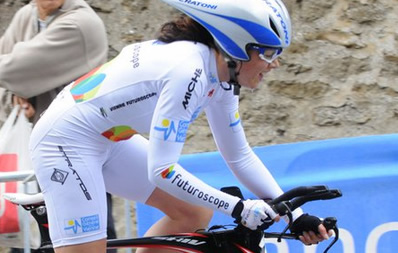
2012 winner Audrey Cordon returns with her
Vienne Futuroscope team
The race is given added importance by being the first round of the Coupe de France Dames (the others are the Prix de la Ville du Mont Pujols in April, the GP Feminin'Ain D'Yzernore and the GP de Plumelec-Morbihan in June and the Classic Feminine Vienne Poitou-Charentes in June) and, as such, is hotly contested by French riders who have won seven of the eight editions; though it's open to foreign riders too with Scandinavians doing especially well in recent years - in 2011, Swedish Emma Johansson (participating this year as part of a Swedish national team rather than with her trade team Orica-AIS) became the first foreigner to win while Sara Mustonen (also Swedish and also on the Swedish national team this year) was third, and Emilie Moberg of Norway was third behind French first and second Audrey Cordon and Pascale Jeuland in 2012.

Click to enlarge
The Parcours

The race uses a road circuit, a format that suits women's cycling as it offers fans a chance to see the peloton go by four times - men's cycling has a sufficiently devoted following for fans to wait along the parcours for only one glimpse; women's cycling unfortunately does not at present and so organisers use this format to attract more spectators, making the race better value for money as far as the all-important sponsors are concerned.

Cholet, an attractive city of around 55,000 people, has been inhabited for a very long time, as is made evident by the numerous Neolithic menhirs and megaliths (standing stones) to be found nearby, one of which - the Menhir de la Garde, taking its name from La Garde where it originally stood - now stands in the Jardin du Mail where it can easily be visited. Like other megaliths in Brittany, Great Britain and elsewhere, nobody yet knows what it was for, with archaelogists' theories ranging from cattle-scratching posts to tribal territory markers to ceremonial objects and non-academic theories ranging from sensible to the bizarre. The city grew rich due to its weaving industry from the 16th century onwards and thus has a large number of grand monuments from that time onwards. It would experience tough times as a result of the textile industry's decline and from geographical isolation in the 1950s, causing many young people to move away in search of employment and the population remains older than average to this day; fortunately tourism and other new industries have begun to bring back wealth and Cholet is in better shape today than it has been for some time. It was declared French City of Sport in 1972 and 2007 and several roads have been named after prominent athletes, among them 1947 Tour de France winner Jean Robic and tragic local hero Jacques Champion, killed in an accident just as he began to attract the attention of professional teams.

The race begins at the Pont De Lattre De Tassigny with a 0.5km neutralised start ending at the where the route crosses the Bd. de la Victoire and becomes the Av. Anatole Manceau, a wide and straight road likely to encourage a fast start; it then continues south to a large roundabout and straight on to become the Av. de la Toussalle/D258 leading out of the city and over the A87 motorway to Les Loges. Once out of the city, the riders are immediately at the mercy of wind and rain blowing in from the Atlantic - the region experiences around 170 days of rain every year, and the wind can be harsh. If so, the peloton may split up, in which case riders may try to take advantage of the disarray by launching early attacks.

Altimetry profile - click to enlarge
At Les Loges, the D258 continues south-west through the rolling countryside towards La Tessoualle. o.5km from Les Loges, the roads begins to climb, imperceptibly at first but then more steeply once La Tessoualle is reached. Just past the first houses on the right, the riders turn right onto the Rue du Côteau where the road becomes much steeper for the first 0.5km past the little bungalows on the left. The average gradient before the crossing with the Rue Saint-Joseph, where the road becomes the Rue du Président Pompidou, is around 4% but for a very short section it rises to 14% - just enough for an attack and, perhaps, a break. The terrain continues to rise, less steeply, to a right turn opposite a sports field. This turn leads onto the D157 heading west, meaning that any side winds from the right experienced thus far now become head winds - the unsheltered road continues to climb through open countryside for 2.55km and precisely the sort of route that many cyclists hate most in wind and rain. It ends, after another right turn, at Le Puy-St-Bonnet; just before the final stretch into the village stands a little chapel, Notre-Dame du Chêne-Rond, on the right of the road, then the last few hundred metres turn steeply downhill. Any riders who dropped off the back of the peloton on the climb or in the wind have an opportunity to build up speed and reduce their disadvantage here, but the road is smooth enough to become slippery in rain - not a good place at all to lose control due to a puncture.

The race enters le Puy along the Rue Notre-Dame through a residential area; large numbers of parked cars mean that oil and fuel spillages are an extra hazard especially on the bends. Having now ridden 9.5km from the start, the riders turn right at a roundabout onto the Rue Nationale/D752 and head north for 0.44km to a tight left onto the much narrower Rue Jeanne d'Arc, passing between two little roadside shrines on the corner. The one on the left is heavily influenced by those menhirs, being made of rather pagan-looking slabs of granite with a little bit of more church-like carving stuck on top - it makes for an attractive effect, but the riders won't be looking at it because they'll need to give their full attention to readjusting positions as the peloton squeezes itself into the narrower road.

Rue Jeanne d'Arc carries the race to the western edge of Le Puy, then becomes first the Imp. du Bosquet and then the Rue des Ruisseaux as it heads downhill over the A87 motorway and on through open country to La Renardiere, where it crosses the D160 just before arriving at St-Christophe-du-Bois 14.4km from the start. Just before reaching the town itself, the route reaches an industrial area on the south-east, where the riders turn right onto the Rue du Parc. This is another hazardous spot, being a wider road into a narrower road as well as being susceptible to oil and diesel spillages from trucks and vans entering and exiting the industrial area. After 0.63km, the road ends at a left turn onto the wider Rue de la Liberation/D202, leading almost immediately to a level crossing over railway tracks prior to a right turn onto the Rue de la Promenade. This is rapidly followed by a right onto the Rue Saint Maurille, another difficult corner with a poor-quality road surface, then the road heads north into the countryside.

Cholet
The route immediately after St-Christophe climbs gently until 18km from the start, then begins to descend on the approach to La Senguiniere where, at a roundabout, the race turns left onto the Rue du Bocage and passes one small roundabout, then a large one before turning right onto the Av. de Nantes/D753 which continues for 0.66km to a tight left turn by a bar onto the Rue de la Paix. After passing round a right-hand bend, the road becomes the Rue de Paradis; then, after a fork, the Rue Louis et Alcine Brouillet which climbs north-east past a sports ground to a roundabout, maximum gradient approximately 5.7%. At the roundabout the riders continue straight ahead on a bridge over the E62 motorway to join the Rue Eiffel. They pass one roundabout, then turn right at the next to head east through countryside on the D158, turning right again onto a much narrower country road 1.6km from the last roundabout. This road leads south to a left turn onto the wide Av. des Trois Provinces which, after 25.1km from the beginning of the race, arrives back at Cholet.

At another roundabout on the western edge of Cholet, the race continues straight ahead onto the Av. de Nantes, then turns right after 0.5km for the Rue Saint-Rémy. 0.12km later they turn right again onto the Rue Saint-Eloi, a corner made technical by the down hill slope and poor road surface, followed by a left onto the Rue Saint-Roch 0.32km later - this should be less hazardous than the last corner but, being in a residential area, there's a risk of oily patches left on the road by parked cars. It leads almost immediately to a roundabout; riders continue ahead on the Rue de Saint-Melanie for 0.77km, then turn right onto the Av. Francis Bouet and arrive seconds later at a much larger roundabout known as the Place Mauriac. They go straight ahead once more, finding themselves on the Av. des Cordeliers as it leads east along the northern bank of the river to the Av. de l'Abreuvoir for a short distance before the road forks. The riders keep right, now heading south on the Av. Maudet (called the Place du 8 May 1945 on the organisers' map) to arrive 0.32km later at the start line, where the begin a new lap.

During the final three laps, there will be GPM points on offer for the first riders to the top of the Rue du Côteau climb in la Toussalle and the Rue Louis et Alcine Brouillet climb in La Senguiniere; these points will be awarded according to the standard UCI procedure with five points for the first rider, three for the second and one for the third. There will also be intermediate sprints on the Rue Nationale at Le Puy-Saint-Bonnet and on the Rue du Parc at Saint-Christophe-du-Bois; points will again be awarded according to standard procedure with five points for the winner, three points for second and one for third. Points in both categories will be added up at the end of the race to decide the Climbing and Sprint Classification winners, with General Classification position being taken into account in the event of a tie.


Start List

Subject to change


VIENNE FUTUROSCOPE
1 Karol-Ann CANUEL
2 Audrey CORDON
3 Jessica ALLEN
4 Sandrine BIDEAU
5 Pascale JEULAND
6 Manon SOUYRIS

HITEC PRODUCTS-UCK
8 Emilie MOBERG
9 Miriam BJORNSRUD
10 Elisa LONGO-BORGHINI
11 Tone Hatteland LIME
12 Chloe HOSKING
13 Thea THORSEN
14 Siri MINGE

RUSVELO
15 Elana KUCHINSKAYA
16 Aleksandra BURCHENKOVA
17 Maria MISHINA
18 Elena BOCHARNIKOVA
19 Hanka KUPFERNAGEL
20 Oksana KOZONCHUK
21 Yulia BLINDUK

LOTTO-BELISOL
22 Marijn DE VRIES
23 Jolien D'HOORE
24 Sophie-Ann DUYCK
25 Kaat HANNES
26 Marion ROUSSE
27 Kim SCHOONBAERT
28 Celine VAN SEVEREN

TIBCO-TO THE TOP
29 Chantal BLAAK
30 Rushlee BUCHANAN
31 Jasmin GLAESSER
32 Claudia HAUSSLER
33 Shelley OLDS
34 Samantha SCHEIDER

SENGERS
36 Inge ROGGEMAN
37 Vera KOEDOODER
38 Kimberly BUYL
39 Birgit LAVRIJSSEN
40 Gabriele JANKUTE
41 Geerike SCHREURS

TOPSPORT VLAANDEREN-BIORACER
43 Nel DE CRITS
44 Jessy DRUYTS
45 Kelly DRUYTS
46 Anisha VEKEMANS
47 Eline DE ROOVER
48 Else BELMANS
49 Gilke CROKET

BISKAIA-DURANGO
50 Lilibeth CHACON
51 DorletA ESKAMENDI 
52 Joanne HOGAN
53 Elena LIORET
54 Amaia MARTIODA
55 Mayalen NORIEGA
56 Lourdes OYARBIDE

SWEDEN
57 Emma JOHANSSON
58 Hanna HELAMB
59 Sara MUSTONEN
60 Alexandra NESSMAR
61 Madelene OLSSON
62 Isabelle SODERBERG
63 Martina THOMASSON

LOINTEK
71 Emma CRUM
72 Sheyla RUIZ GUTIERREZ
73 Julya ILINYKH
74 Alexia MUFFAT
75 Anna POTOKINA
76 Fanny RIBEROT
77 Ana BALERDI USABIAGA

French Teams

BIGMAT AUBER 93
78 Alna BURATO
79 Noeline DELBOVE
80 Roxane FOURNIER
81 Elodie HEGOBURU
82 Steffi JAMONEAU
83 Melodie LESUEUR

COMITE BRETAGNE
Not yet announced

CSM EPINAY
92 Pauline ABAUTRET
93 Audrey ARTAUD
94 Alessia BUGEIA
95 Isabel CAETANO
96 Joy DELAPORTE
97 Veronique LABONTE
98 Amelie VIVION

CSM VILLENEUVE LA GARENNE
99 Kelly GAMBIER
100 Camille ROBERT
101 Ophelie FENARD
102 Harmony LESOILLE
103 Tifany GOUPY
104 Ludivine CARRE
105 Audrey ARNOUX

CSM PUTEAUX
Not yet announced

TEAM REGION CENTRE
113 Segolene LEBERON
114 Berengere STAELENS
115 Marie TONDEREAU
116 Daniele PAROT
117 Julie BOUCHER
118 Melanie GUEDON

COMITE DE NORMANDIE
120 Marine LEMARIE
121 Eugenie DUVAL
122 Tatiana BLIN
123 Justine HAVE
124 Elise RAULLINE

COMITE PAYS DE LOIRE
Not yet announced

CHAMBERY CYCLISME COMPETITION
148 Sophie CREUX
149 Eva MOTTET
150 Celin SCHULLER
151 Marjolaine BAZIN
152 Christelle CHAPUT

Weather

More information nearer to the race


Saturday, 16 February 2013

Classica Citta di Padova 2013

16.03.2013 Official Site
Italy, One-day road race, 126km
UCI 1.1

Warmer nations - Qatar, Costa Rica, El Salvador - got the women's professional cycling season off to a fine start before the first European races in Belgium and the Netherlands; then we had the Asian and Oceania Championships in India and Australia respectively. Now another one of cycling's homelands, a nation where cycling grew to become almost a religion for the legendarily passionate local fans, is ready to join in: the Classica Citta di Padova is Italy's first UCI Elite Women event of the year.

Carmen Small  became the first foreigner
to win the race in 2012 and earned a
place on the Specialized-Lululemon
team by doing so.
Now in its fifth year, Italian riders won the first three editions: Annalisa Cucinotta in 2008, then Monia Baccaille (who gave birth to a daughter, Aurora, a little over one month before the 2013 race) and Noemi Cantele in 2009 and 2010 respectively; the race was not held in 2011 but returned in 2012 when American Carmen Small became the first non-Italian rider to win when she took the honour in 2012, her first European victory. However, foreign riders have tended to do well with Lithuanians, Australians and Canadians all getting their feet on the podium and, with the race enjoying increasing popularity, this is likely to continue as it attracts more and more foreign teams and riders.

The season-opening races in the flat Low Countries tend to favour climbers because although the hills are small, they're very steep; meanwhile Italy, which has some of the most beautiful and challenging mountain roads to be found in Europe, gets things under way with a sprinter's race - the Classica features just three easy climbs of which the highest rises only 33m to 45m above sea level in 2.9km, creating an average gradient of only a little more than 4%. What's more, all three climbs fall within the 26.8km that make up the first part of the race; the remaining 99.2km (consisting of eight laps around a 12.4km circuit) are as flat as flat can be with only 9m of climbing split between three almost imperceptible hills on each lap.

The Parcours

The race begins on the wide and flat Via Roma in Noventa Padovana, approximately 8km from the centre of Padua, and an area noted for the many large, lavish villas that reveal it to be the second richest place in the province of Padua after Padua itself. After 1km the road forks; the riders follow it to the left to take the Via Camin onto a bridge crossing the Canale Piovego, which is the first potential hazard - although the bridge is not narrow, it's not wide enough for the entire peloton to get through en masse which, with the Via Roma encouraging a fast start, may happen. If so, some riders are going to have to give way; there may be an early crash here.

Riders complete the entire route (red and green) once, then
eight laps of the red circuit. Click to enlarge.
Having turned right once over the bridge, the riders follow the Via Camin as it bends left around a wooded area and then becomes the Via Corsica 1.8km from the start. The Via Corsica becomes the Via delle Granze; simple left, right and left turns lead onto the Via Lisbona and then Via Belgio, the latter ending in a left turn onto the Via della Regione Veneta leading to the Via Vignovese - also known as the SP40d, it leads the race into Tombelle before becoming the SP17 and presenting the riders with the first climb at 6.7km from the start. Climbing 33m in 0.8km gives it an average gradient of 4.1%, unchallenging but perhaps just sufficient for the all-rounders to get away from the specialist sprinters; something that's unlikely to make much difference so early in the race, but as it provides a chance to show off jerseys out at the head of the race (thus making sponsors happy) a chance that some riders may choose to grab.

Following the road to the right as it forks on the eastern side of Tombelle continues along the SP17, now known as the Via Padova and heading through open countryside (with potential sidewinds) to a bridge. On the opposite bank is Vigonovo; the SP17 leads into the centre of the town and turns right at a roundabout before curving left to another bridge. This forms the second climb at 9.5km - rising 29m in 0.9km gives it an average gradient of 3.2%; even less of a challenge but another opportunity for a break to form or for all-rounders who failed to get into an earlier break to attack and bridge to it. The road leads into Fosso, becoming the Via Roma after a left turn at a roundabout, riders follow it into the centre of the town and turn left onto the SP12, heading north to the third climb at 12.1km - this one ascends 28m in 1.9km, giving an average gradient of only around 1.5%.

The SP12 continues north through open countryside and past villages, then over a bridge at Brigo-Paluello. 400m from the bridge, the route turns right onto the much smaller Via Piove leading to the SR11, upon which the riders turn west to head back towards Novento Padovana, passing through Fiesso d'Artico before continuing all the way to the Via Noventana and on to the start line, where they begin the first of the 12.4km laps.

The Classica Citta di Padova is not a race for the
climbers. Click to enlarge.
For the initial 4.9km into Tombelle, the lap parcours follows the same route as the first section; however, where the first section followed the SP17 to the right into Vignovo, the riders now keep left, following a straight road for 0.69km to a sharp left turn, then continue for 0.19km to a roundabout and the Via Cristoforo Colombo. This leads into Casa Gottero, where a left turn finds the Via Dante which, after 0.22km, reaches a bridge; riders turn right onto it and then left onto the Via Noventana, following it back the same way as earlier to the start line for the beginning of a new lap. There will be intermediate sprints on the second, fourth, sixth and eighth laps offering 5, 4, 3, 2 and 1 point for the first five riders.

The laps route resembles a criterium race and is characterised by numerous tight corners, a combination that provides many opportunities for attacks and breakaway attempts by groups or individuals. If a group formed of strong riders early on, they might simply pull further and further away from the peloton, thus whittling down contenders to just those sprinters in the group and able to keep up the pace for however much of the race is left; alternatively, there is plenty of scope for the peloton to send chasers after breaks, either keeping the bunch together all the way or bringing it back together as the finish line draws near - the Classica Citta di Padova, being two races in one, can keep us guessing right to the very end.

Prizes

1° € 379,00
2° € 326,00
3° € 272,00
4° € 164,00
5° € 152,00
6° € 141,00
7° € 130,00
8° € 119,00
9° € 109,00
10° € 97,00
11° € 87,00                
12° € 76,00
13° € 66,00
14° € 53,00
15° € 42,00
16° € 28,00
17° € 28,00
18° € 28,00
19° € 28,00
20° € 28,00

Intermediate Sprint prizes (decided by accumulated points)

1° € 200,00              
2° € 150,00              
3° € 120,00
4° € 100,00
5° € 80,00

Start List

Not yet available

Weather

More information nearer to the race


Novilon Euregio Cup 2013

10.03.2013 Official Site
Netherlands, One-day Road Race
UCI 1.2


No Vos this year - but there'll be
plenty of other worthy adversaries
for Armitstead
The third of the big UCI women's races at the Drenthe Wielerweekend (though not the last race, as the Rabobank Toertocht van Coevorden takes place later on the same day), the Novilon Euregio Cup (named after sponsors Novilon, a flooring manufacturer, and Euregio - more on that below) has - like the Drentse 8 and Ronde van Drenthe that took place over the last few days - been dominated by Dutch riders in most years: German Viola Paulitz-Müller won the first edition in 1998, then Dutchwoman Leontien van Moorsel won in 1999 followed by the Swedish Madeleine Lindberg in 2000. The race couldn't be held in 2000 due to an outbreak of foot-and-mouth disease in the agricultural province; then van Moorsel won again in 2001 followed by fellow Dutch riders Mirjam Melchers, Sissy van Alebeek, Suzanne de Goede and Loes Markerink over the subsequent four years. Giorgia Bronzini, an Italian, took the honours for 2007 before Kristin Armstrong became the first and to date only American to stand on the podium when she won in 2008, then the Dutch took over once again with a win by Marianne Vos is 2009, Annemiek van Vleuten in 2010, de Goede again in 2011 and then Vos again in 2012. British riders have done well too, perhaps because Drenthe is so similar to much of England, with three third places - Ceris Gillfillan in 2000, Rachel Heal in 2003 and Lizzie Armitstead in 2012. Armitstead, of course, was the only rider to challenge Vos in the Olympics road race later that year; Vos, who won the Ronde van Drenthe on the 9th of March, isn't taking part in the Novilon Cup this year but there are plenty of her nation's finest - on her Rabo team and in other squads - mean that Armitstead has plenty of competition of she fancies a chance to returning the favour of winning on a rival's home soil. Expect a battle..

The Ronde, with its three ascents of VAM berg, suits the climbers; in the past the Novilon has featured four climbs but became more of a sprinters' race from 2012 - it now takes in VAM berg only once relatively early in the race before taking flat roads to the final flat, straight sprint finish. The schedule can be downloaded here.

Click to enlarge

The Parcours

Coevorden is a municipality in the south of Drenthe; the city from which it takes its name is just metres from the German border in Euregio, a cross-border region in which Dutch and German authorities, enterprises and other entities have agreed to work together without regard to their different nationalities for the good of the region (Euregio was the first such area, established in 1958, and has been enormously successful; there are now a total of 74 similar Euroregions). Although it has the feel of a market town, Coevorden has held city status since 1408, at which point it was the largest and most important in the area. Since eclipsed by Emmen, its illustrious past is made evident by the large star-shaped fortifications in the centre of the city, designed by Menno van Coehoorn - the design will look familiar to anyone who has been to Besançon to see the Tour de France, though in fact Besançon's star-shaped fort was designed by Sébastien Le Prestre de Vauban. Right in the centre is the marketplace - not, it has to be admitted, the most attractive in the Netherlands, but it's from here that the race begins before heading north out of the city to De Loo, arriving there after ten minutes, then through the flat countryside - where the riders get their first taste of the wind that often characterises races at this time of year - to Dalen, birthplace of professional cyclist Karsten Kroon and home to several windmills. The N854 then carries the race toward Gees and, at 14.7km when they're on roads familiar from the previous day's Ronde van Drenthe, to the first cobbles. Situated in a damp forested region, these cobbles are made especially dangerous by slippery moss and may easily finish off any early breakaways - or, if a small group finds its lower density offers an advantage, serve to increase their advantage if the peloton is held up by a crash.

Once they're through Nieuw-Balinge (also familiar from the Ronde), the riders come to Drijber, a village that would fit several times over into the land occupied by its neighbour - the Essent-Attero waste disposal plant better known to cyclists and fans as VAM, site of the VAM berg climb. VAM berg, which climbs to 56m above sea level in 0.4km at an average gradient of 9.7% with one section as steep as 16%, is an attractive hill that appears far higher than it really is due to the flat surroundings but isn't a natural hill: under the grass and soil that was placed over it when it came to the end of its operational life is a vast rubbish dump (VAM was the name of the company that operated the site). It's another point at which a break might be reeled in and caught by climbers, though at this early stage in the race the peloton is unlikely to show much concern unless the break includes riders who might be able to stay out in front until the next ascent.

After VAM berg, the race turns back to Drijber and then to Mantinge, another village, before arriving at Meppen 44.8km into the race. The parcours now leads via Oosterhesselen and Wachtum back to Dalen, then to Dalerveen at 61.6km, Schoonebeek at 73.5km, Twist at 89.5km and Emmlicheim at 106.9km; at 108.3km the riders come to an intermediate sprint and begin to make their way back to Coevorden, 129.5km into the race. At 131.8km they pass over the finish line, beginning a second intermediate sprint and a final 9.3km section through the city then back out to Achterloo, returning on the Daler Allee road that ends at a roundabout where the riders continue straight ahead onto Stationstraat, marking 1.5km to the finish. Stationstraat ends at another roundabout; the riders again continue straight ahead onto Friesestraat, which takes them back to the marketplace in the centre of the city prior to the last 400m along the straight Kasteel (and past the kasteel, a pink fortified manor house now occupied by a restaurant).

Start List

Click to enlarge

Weather

Like your bike races tough, just like the Dutch do? Well, here's some good news - in addition to "high" temperatures of just 3C (and lows of -5C), the riders are likely to experience some flurries of snow en route. It's not predicted to settle, but with conditions throughout north-western Europe becoming colder as next week begins it'll feel bitingly cold as they ride into it.

Friday, 15 February 2013

Boels Rental Ronde van Drenthe

09.03.2013 Official Site
Netherlands, One-day World Cup Road Race, 132.8km
UCI CDM

The second race of the four-day Drentse Week, the Ronde van Drenthe comes two days after the Drentse 8 and is a completely different sort of race: while the 8 is flat and favours sprinters, the Ronde features three climbs of VAM berg - the highest point in Drenthe and a climb that in true Northern Classics style makes up for its lack of altitude with knee-busting steepness, rising to 56m above sea level in just 0.4km at an average gradient of 9.7% with steeper sections up to 16% on the way. Think it doesn't sound too bad? Even Marianne Vos has to put serious effort into getting up it...


In addition to the three ascents and because a 16% gradient isn't enough to satisfy Dutch cycling fans' idea of what a hard race should be, there are also plenty of cobbles, numerous tight corners, narrow bridges, slippery moss-covered roads and - always a potential issue in this part of the world at this time of year - the weather: there's a very good chance that riders will face rain (and perhaps snow), freezing temperatures and strong winds blowing in from the North Sea. Sounds like fun, doesn't it?

The women's race has been running under various names since 2007 and has been dominated by Dutch riders: Adrie Visser won the first edition, followed by Chantal Beltman in 2008, Swedish Emma Johansson in 2009, Loes Gunnewijk in 2010 and then Vos in 2011 and 2012. After a typically excellent cyclo cross season and a swathe of triumphs last year, Vos is the easy favourite; however, her enormous talent and success has forced rivals to respond and she won't win again without serious challenges from other teams.

The Parcours

Drenthe is located in the north-eastern corner of the Netherlands, just south of Groningen. Densely populated during the Bronze Age, it's now a rural province with a far lower population density that most of the rest of the country. In the Netherlands, it's nicknamed "The Cycling Province" due to the large numbers of cyclists from across Europe who come to ride on the quiet, excellent roads. At the beginning of the Second World War, Drenthe was home to a camp housing German Jewish refugees who had fled the Nazis; after the Netherlands was invaded the camp was taken over and became a transit camp from which Jews, Gypsies and others were sent to the concentration camps (among them, Anne Frank, who was placed on the last train to leave the camp for Auschwitz where she died early in March 1945). Today, the province frequently plays host to historical re-enactments of the conflict, as Australian star Bridie O'Donnell discovered when she took a wrong turn on her way to the race in 2010 and ended up right in the middle of one. 

VAM berg
VAM berg's unusual name comes from the fact that it's not a natural feature - it used to be a rubbish dump maintained by the Vuijl Afvoer Maatshappij ("Waste Disposal Company") who covered it in soil and turned it into a hill once it reached the end of its operational life. The riders climb it for the first time 9.4km after reaching the end of the neutralised zone at Hoogeveen - with the surrounding landscape being so flat, the views from the top are superb; however, since it's such a crucial factor in deciding the eventual outcome of the race the riders won't take much notice even at this early stage. There are the first GPM points of the race on offer for the first riders to the top and there is plenty of opportunity for a breakaway on the way down - if a rider or group does manage to get away here she or it is unlikely to stay away for the remaining 122km (although it might not be particularly surprising if Vos managed to pull that one off), but it's a chance for those riders who don't have much chance of winning to get some time out in front where the press can notice them. The first third of the climb is steepest with an average gradient of 14%; it becomes progressively less steep over the last two thirds to the summit.

Once through Nieuw-Balinge, the riders enter an area with many ponds and small lakes formed by the peat cutting industry that brought much of the region's income and shaped the landscape. At 20.2km, now in forest, they come to the first cobbles - a 500m section made especially treacherous by the moss and algae that grow in the damp forest and a real challenge for riders in any break that got away earlier now that they'll be wanting to extend their advantage in preparation for the intermediate sprint at Emmen, 41.8km into the parcours. There are more cobbles, albeit far less dangerous ones, on the way through Exloo from 50.1 to 53.8km, then some more at Borger-Odoorn from 57.2 to 60.7km and again at 67.1 to 69.1km before the race enters a 14km section featuring several tight corners and narrow stretches en route towards the second ascent of VAM berg at 93.1km, where there are again points for the first riders up and scope for the race to change dramatically - a break could be caught on the way up or might extend its lead if it includes climbers, or a new one might form.

Marianne Vos won in
2011 and 2012. Can she
be stopped this year?
Recent performances
suggest not.
Heading back along some of the same roads they used earlier, the riders make their way back to Hoogeveen and begin the third part of the race. At 106.5km they pass over the finish line for the first time, beginning the second intermediate sprint. They then head back out of town in the direction of Stuifzand, negotiating some hazardous sharp bends after around 111km before entering the VAM industrial site once more for the third and final climb of VAM berg at 119.9km. Now, the order in which the riders climb it is important: there are insufficient kilometres to the finish line for the peloton to risk allowing a strong break to get away and, should one form, expect the teams to work together to bring them back rapidly; if it's a superstrong break, made up of some race favourites and their most able domestiques, the eventual winner will be among them. This last section will probably see an increasing number of attacks as riders test one another, finding out who has a the strength left for a last push and who won't be able to hold their own. After passing through Stuifzand for the final time, the race returns to Hoogeveen where the riders head into town along the Griendtsveenweg, then turn the last corner, left at a roundabout onto Rembrandstraat - not an easy corner as the wide road is split into two narrow carriageways by a central island for much of its length, creating a potential bottleneck if a large number of riders fighting for good positions to begin the final sprint are compressed into a tight area. The width of the road doesn't change from now on, meaning that if a bunch is leading the race sprinters may have difficulty in forcing their way through to the front in time for the final 300m to the finish line on Prinses Beatrixstraat.

Start List

Not yet available

Weather

More information nearer to the race


Tuesday, 12 February 2013

Drentse 8 van Dwingeloo 2013

07.03.2013 Official Site
Netherlands, 1-day Road Race, 141.2km
UCI 1.2

2012 winner Chloe Hosking
There have been several races in exotic, warmer climes such as Qatar, Costa Rica and El Salvador already this season and even three in the somewhat less warm at this time of year Belgium; now the fantastically-named Drentse 8 van Dwingeloo marks women's cycling's return to the home of its greatest star (that's Marianne Vos, of course) - the Netherlands.

Drentse 8 began in 2007 with Regina Sleicher taking first place, then Ina-Yoko Teutenberg dominated with three consecutive victories before Vos won in 2011. Vos, who by 2012 had left little doubt that she's the most successful cyclist in the world today (some would say ever), was favourite for the World Championship in 2012 but ultimately lost out to Giorgia Bronzini, another rider who has done well in this race with third place in 2007; when they faced each other at the Drentse 8 early in 2012 many fans expected the outcome of the race to be decided between the two riders and were therefore surprised when the then-little-known 21-year-old Australian Chloe Hosking (now riding with Hitec-UCK) proved herself their equal when she got the better of them both in an 11-woman final bunch sprint - a glorious and entirely unexpected finish.

Chloe Hosking beats Bronzini and Vos, 2012

The Parcours
If you're wondering where the "8" in the race's name comes from, it's due to the shape of the route - a great big 47km figure of eight (well, sort of - it's a straggly 8 with an extra loop on top) around which the riders race three times. Dwingeloo, home some 2,500 people, has a claim to fame that few villages can match - two galaxies, Dwingeloo 1 and 2, both of which are approximately 10 million lightyears from Earth - are named after it; the connection being that they were discovered using the 25m radio telescope (the largest in the world when it was built in 1956) just south of the village.

Having started on Brink, a street in the village, the riders head north-west and into the first loop, then south and back to Dwingeloo before turning east and passing through the Nationaal Park Dwingeldvelde, at 37 square kilometres the largest area of wet heathland in Western Europe. The telescope, restored during 2012 and now a national monument, can be seen over the trees from various points along the road. The route then heads south before turning west to skirt a plain dotted with circular lakes, thermokaarsts created by retreating glaciers in the last ice age.

Drentse 8 is the flattest of the three Drentse Week races (the others are the Boels Rental Ronde van Drenthe, taking place on the 9th, and the Novilon Euregio World Cup race one day later) but the numerous technical sections along the parcours, including numerous tight corners and cobbles interspersed with long straights, makes this an ideal race for attacks - last year, they came in waves and continued throughout the event. It's very likely that this year's race will see more of the same; whether any one of those attacks will lead to a break getting away and staying away from the peloton in order to avoid another bunch sprint finish will be decided on the day.

Start List

Not yet available

Weather

More information closer to the date

Friday, 8 February 2013

Grand Prix GSB and Grand Prix El Salvador 2013

Grand Prix GSB

07.03.2013 Official Site
El Salvador, 1-day Road Race, 97km
UCI 1.1

Click to enlarge
El Salvador has not been listed among the great cycling nations in years gone by - though they do take sport very seriously, having had a war with neighbouring Honduras after a football match - but they've certainly got a taste for women's cycling: already this season the tiny Central American country has played host to the Grand Prix de Oriente and Vuelta El Salvador, now it's time for the Grand Prix Grand Saint Bernard and tomorrow the Grand Prix El Salvador. It's a very fine place for bike racing too, with 65% of the nation being mountainous (including volcanoes) and most of the rest being beautiful tropical rainforest - thanks to environmental programmes El Salvador is one of the very few nations where rainforest is actually increasing.

Some of the European riders might feel rather at home at the end of the race due to the finish line being located at the Grand St. Bernard Swiss Resort and Spa. This hotel, high in the mountains at Juayúa and owned by the main sponsor (hence the name of the race) is modeled on a typically Alpine chalet, while the rest of the town is characterised by its well-preserved Spanish colonial architecture. To get there, they'll pass through unmistakably tropical rainforest landscape and climb some tough mountains.

Note that the altimetry profile on the official race website seems not to correspond with altitude
figures given in the race schedule - click to enlarge
The race begins at capital city San Salvador before heading first north and then east around the El Boquerón volcano, a familiar sight to those who took part in the Vuelta El Salvador which climbed it in Stage 4 - they don't need to repeat that climb today and, having started at an altitude of 744m, face only a small and gradual climb over the first couple of kilometres before a long descent - gradual at first, then steeper - leads into a flat section approximately 30km in length. It's likely that several riders, probably in groups, will attempt to use the descent to get ahead of the climbers and then try to extend any lead they can find in the flat section, thus giving themselves a greater chance of staying within reasonable distance on the big climbs lurking towards the end of the race. Many climbers, being too light to keep a comfortable level of control over their machines on fast downhill sections, don't like descents and may prefer to allow a break to get away; their teams will respond to a break by sending out chasers to try to bring back escapees on the flat section in order to get climbers where they need to be for the second half.

Final 3km
The terrain starts heading upward at Ciudad Arce, 44km along the parcours, where the altitude is 470m above sea level. 8km later, having climbed 380m, they arrive at El Congo and an altitude of 850m. A short descent of around 4km follows and precedes another flat section some 12km in length, potentially the scene of more breaks as riders try to get ahead in preparation for the big climb up to 1,471m at 82km. This is where the climbers get their own chance to take the lead: with the road turning downhill for the next 12km, they'll need it because they're going to be chased all the way to the final 3km where the race begins a 40m climb to the finish line - while that's an average gradient of only 1.3%, note that the parcours becomes steeper on the approach to the final flat 500m.


Start List

Not yet available


Grand Prix El Salvador

08.03.2013 Official Site
El Salvador, 1-day road race, 93.2km
UCI 1.1


Click to enlarge
Taking place the day after the Grand Prix GSB, the Grand Prix El Salvador is the final UCI Elite women's race of the season and gives those riders that don't specialise in mountains a chance to turn the tables on the climbers. Possibly, at any rate - El Salvador, being situated on a tectonic rift, has many volcanoes and mountains; a race organiser would be hard pushed to set out a parcours that didn't feature at least a bit of climbing.

Once again the riders start their day in the capital San Salvador, but this time they head south out of the city before turning east towards the nation's second biggest lake, Lago de Ilopango, situated in a 72 square kilometre volcano crater. This volcano was subject to a huge eruption some time in the 5th or 6th Century CE, which destroyed several Mayan cities and made agriculture impossible in the region for many years; it last erupted - on a much smaller scale - in 1879-80. Before reaching the lake, the riders turn south again and head towards Comalapa, descending from the race's highest point at 779m above sea level 2.1km from the start to 154m at 28.1km; since many climbers are not good descenders, this gives the rest of the peloton - especially the less well-known riders, eager to please sponsors by showing off their jerseys at the head of the race - the opportunity to leave the climbers far behind. With a climb of 600m in the final 13.6km, average gradient 4.4%, they'll want to do precisely that to prevent a climber getting away as the finish draws near.
Click to enlarge
At the airport 29.6km in, the altitude drops to 59m and then remains relatively flat, climbing only two small hills before a long, gradual descent to 79.6km where the riders will be only 9m above sea level - 50km in which a breakaway group could extend its lead or the peloton could draw them back in, sending chasers out to catch them while the teams cluster around their climbers to keep them up to speed and get them into position for the final climb. The final 3km, running into Zaragoza, climb at an average gradient of around 5% all the way to a straight section leading to the finish; a challenge after 90km, but not steep enough to automatically give the climbers a winning advantage - the eventual winner of this race might not be a dedicated climber, as was the case in 2012 when all-rounder Noemi Cantele won days after taking sixth place overall in the Vuelta El Salvador.

Start List

Not yet available

Wednesday, 6 February 2013

Omloop van het Hageland - Tielt-Winge 2013

03.03.2013 Official Site (race schedule)
Belgium, 1-day Road Race, 122.3km
UCI 1.2

Although we've had a number of events outside Europe (Qatar, Costa Rica, El Salvador) by this point in the year, as far as many fans are concerned the season hasn't really got going until the European - and specifically in the case of women's cycling Belgian, and in the case of Belgian cycling specifically Flemish - season is underway. The Omloop Het Nieuwsblad took place in February, now the Omloop van het Hageland is the second big Flanders race: the racing season has well and truly begun.

55.3km parcours - click to enlarge
The race, now in its fifth edition, consists of one main section of 55.3km and five laps around a 13.4km circuit for a total of 122.3km, offering all the usual features of a Flemish race - tough and narrow roads, knee-busting climbs, bone-and-bike-breaking cobbles and, because it's early March and this is Flanders, potentially horrible weather. Cycling is a cruel and brutal sport; all its cruelty and brutality can be found in the Flemish races, combining to make for spectacular racing.

Last year, Lizzie Armitstead became the first British rider to win when she completed the parcours in 3h17'49", beating Pauline Ferrand-Prévot by 2" and Elisa Longo-Borghini by 4" while the tough Dutch sprinter Kirsten Wild led a group that came in 43" later. No start list has been published at the time of writing but, having gone on to enjoy enormous success throughout last year, we can expect to see Lizzie going for a second victory if she takes part this year.

As is usually the case, there will be three competitions taking place in the race. The first is the General Classification, for which the winner will be awarded €326 and 40 UCI points, second €217 and 30 points, third €164 and 16 points (4th-8th will receive 12, 10, 8, 7 and 3 points respectively) and the next  17 across the line various sums down to €22 for 16th-20th - rather paltry amounts, reflecting the realities of professional women's cycling. There will also be a GPM or hill climbing competition with hill sprints on Kerkstraat in the 55.3km route and on Roeselberg during the first, second, third and fourth laps of the circuit - the first rider to the top receives 5 points, second 3 points and third 1 point; at the end of the race the rider with the most climbing points wins €75, second €50, third €25. Intermediate sprints will be contested at 55.3km as the riders enter the circuit and then at 68.7km, 82.1km and 95.5km as they begin the second, third and fourth laps. The intermediate sprint points system and prizes are the same as the GPM.

13.4km circuit - click to enlarge
The race starts and ends at Tielt, a town of just under 20,000 people that became a German headquarters during the First World War and suffered heavy Allied bombing as a result - almost all of the buildings, many of which look as though they've stood for hundreds of years, had to be rebuilt after the conflict. It is the birthplace of Gianni Meersman, who currently rides for Omega Pharma-Quickstep, and was once the home of the legendary Flandrien (some say the only Flandrien) Briek Schotte.

Climbs

Kerkstraat

Kerkstraat, beginning 50.7km into the race (highest point: 57.2km), is a mere 697m in length and has an average gradient of 4%, which doesn't sound difficult - even the maximum 10.5%, for approximately 20m starting 300m from the start of the road, isn't particularly hard compared to the insane gradients of Paterberg and the infamous Koppenberg. However, conditions on the road are extremely tricky - there is ample opportunity for an unfortunate rider to lose significant time here.


Kerkstraat View Larger Map

It doesn't look like much at the beginning - just a left turn between a grey barn and some modern red-brick houses, leading through some trees toward the church that gives it its name, and despite the cobbles and a low wall on the right during the first hundred metres or so it's straightforward, though too narrow to allow riders to change position much. Then, suddenly, a hazard: on the left, there's a deep, stone-lined ditch running  right along the side of the road for 45m - unless they're near the back of the peloton, any rider who gets in there is going to have a long wait for the mechanic to get through with the spare bike at best and at worst will be out of the race with fractured bones.
Kerkstraat altimetry profile - click to enlarge
The first bend lies 167m from the start of the road - with stone walls either side, all the riders are squeezed tightly together as they attempt to get round and, just to make matters worse, there are steep banks behind the walls meaning that the road is likely to be covered in a slippery layer of mud after rain. Just around the bend the road becomes narrower and steeper; a ditch now runs along the right side and forms another potentially race-ending trap for any rider that runs out of space and rides into it. More banks on both sides mean more slippery cobbles, and the brambles growing on the banks threaten punctures. 47m after the bend the road opens up to the left but becomes even narrower; a short way ahead, where the hedge starts again on the left, the steepest part begins. There's another bend 437m from the start, not as sharp as the first but tighter due to the narrowness of the road and with more banks; then 84m a right bend as the race leaves the trees behind and heads into a final straight 197m past an orchard where any rider that has managed to stay ahead of the pack and find an advantage might - provided the cobbles aren't too wet - be able to step up her speed and extend it before turning left onto the very welcome smooth asphalt of Driesstraat 51.8km from the start of the race. If she can, that rider will then have a good chance of being first through the intermediate sprint at the beginning of the circuit 3.5km away.

Roeselberg

Located 7.6km into the circuit, Roeselberg is shorter at 200m and, despite being steeper (the average gradient is 7.5%) would be a far less daunting prospect than Kerkstraat due to the wider and smoother road - if the riders didn't have to climb it five times, of course.


Roeselberg View Larger Map

The climb begins from a left turn out of Kriebekestraat; there's a bank on the right for the entire climb (and for 100m after it), but it looks stable and is unlikely to cause slippery conditions unless rain has been exceptionally heavy. As the bank ends, the road becomes Motbroekstraat and there are 4.1km to the beginning of the next lap.

Start List

Not yet available

Weather

More details nearer to the date