Showing posts with label Ronde. Show all posts

Friday, 22 March 2013

Ronde van Gelderland 2013

14.04.2013 Official Site
Netherlands, One-day Road Race, 139km
UCI 1.2

The Ronde van Gelderland is perhaps unique in that it started as a race for men in 1957 and was then held almost annually (except 1975-1981 and 2001) until 2003 when a women's race was added, then continued from that date to the present as a women's race only. For the first five years of the women's competition it was dominated by Dutch riders - Yvonne Troost-Brunens won in 2003, Leontien van Moorsel in 2004, Suzanne de Goede in 2005, Bertine Spijkerman in 2006 and then Marianne Vos in her second professional year in 2007. Canadian Anne Samplonius became the first (and so far the only) non-European rider to win with her 2008 victory, then German Ina-Yoko Teutenberg won in 2009 before Kirsten Wild took the honours back for the Netherlands a year later. Teutenberg became the first rider to have won twice with another victory in 2011 and de Goede repeated her feat 2012. In the last few years, the Australian flag has also been a regular on the podium lists courtesy of Rochelle Gilmore; the owner, manager and rider of the British-registered Wiggle-Honda team was second in 2009 and 2010 and third in 2011.

The Parcours
Click to enlarge
The race always starts and finishes at Apeldoorn, home to the famous Omnisport Velodrome that hosted the 2011 World Track Cycling Championships. Each year, it also hosts the Six Days of Apeldoorn.

Very much a race of two halves, the first 41km in the forested Veluwe features several climbs whereas the remaining 98km are almost entirely flat. The altimetry profile as printed in the official race book is somewhat unintentionally misleading, being "squashed up" so that the climbs appear far steeper than they in fact are: the first climb is Terlet, gaining some 75m in 4km to reach 90m above sea level 9km after the start line, has an average gradient of only 1.8%, but the first half climbs more rapidly before it levels out approaching the top; Kemperbergweg reaches 80m at 20.4km and features 40m of climbing in 2km, an average gradient of 2%; Moonikensteeg rises to 75m at 28.1km, doing so in 0.9km gives an average gradient of 4.4%; the pleasingly-named Emmapyramide reaches 82m at 32.8km with 40m of climbing in 1.4km for an average of 2.9%; Zijpenberg is the highest hill in the race, climbing to 107m at 34.8km with an average gradient of 2.3% on the 3.3km ascent; final climb Posbank tops out at 95m 40.9km from the start, the 75m gained in 2.2km giving it an average gradient of 3.1% - the highest in the race.

Even coming within the same 41km, those are not altitudes and gradients that would be especially taxing to a professional cyclist. However, Gelderland has further trials for them: the remainder of the race following the IJssel river valley may be flat but it's subject to strong winds that blow in off the North Sea from the north-west - the direction in which the riders will be traveling for most of the way back to Apeldoorn. The sprinters will have used up more energy than the climbers in the Veluwe, whereas the climbers don't have the strength to fight the wind - if it's windy, therefore, nobody has an obvious advantage as the finish line draws near.

Click to enlarge
Setting out from the Omnisport Velodrome, the riders complete a 7km neutralised zone ending on Arnhemseweg, where the official start is located 100m south from the roundabout at the end of Laan van Malkenschoten. The road narrows after 1.7km, riders then continie south via Beekbergen for 5.5km to Woeste Hoeve where, after a wide left-hand bend, the road crosses a bridge over the A50 motorway and becomes the Groenendaalseweg; 107m after the bridge a right turn takes them onto the Oude Arnhemseweg, a forest road much narrower than those that come before and a potential hazard if the entire peloton tries to get onto it at the same time - and, if any riders who don't have much chance of winning have successfully formed a break by this point, for them to increase their advantage for some sponsor-pleasing time out in front before chasers from rival teams can find a way through the pack to bring them back. Following the road south leads to Groenendaal and then, after 9km, to Terlet.

Having completed the climb, there are 7.2km to the right turn onto Koningsweg and then 4.2km past Noordoostelijk van Schaarsbergen to a left at a roundabout onto Kempberweg for the second climb leading to Arnhem at 23.7km. At the end of the road they turn left onto Schelmeseweg and proceed for 1.4km to a right turn onto the wide Cattepoelseweg, taking it for 1.2km until they reach a left and progress along Wagnerlaan - the junction is complicated, but the "lane" is a wide, smooth dual carriageway road and can be taken at high speed. After passing underneath Apeldoornweg, the road becomes the Bosweg; 1.27km the route turns left onto Rosendaalseweg, then left again 156m later to begin the third climb on Monnikensteeg. After passing a sportsground on the right, a right turn at traffic lights carries the race back onto the Schelmeseweg leading into Rosendaal. A bridge over the E45 motorway takes the road into forest, then left at a roundabout 32.3km from the start takes the riders onto Kerklaan. 0.5km later, at a pretty cottage surrounded by trees, they continue straight ahead on Beekhuizenweg and ride through the forest to a junction with Boerenallee, which climbs for 0.5km to the top of Emmapyramide at a right/left S-bend (with trees growing right on the edges of the road, conditions may be slippery and punctures are likely) after which the road becomes known as the Bovenallee. A short way ahead, the riders reach a T-junction and turn left to rejoin Beekhuizenweg which climbs to the top of Zijpenberg.

2.5km further on, a right turn follows the edge of the forest along Snippendaalseweg; the road surface along this section is formed of regular, flat, brick-like cobbles, smooth enough not to slow things down as the riders battle to find places on the much narrower road. The route soon heads back into the forest, leading for 2.5km to Rheden, a fast and potentially dangerous descent to a left turn at 39.8km onto Arnhemsestraatweg and, 1.1km later, another left at another roundabout for Schietbergseweg and the Posbank climb. At 43.1km, with all the climbing over, a right turn by a picnic area with a viewpoint takes the race to the Beekhuizenweg, along the forest edge to another right at 44.4km for the Holleweg. The Holleweg becomes the Rozenbos, then a right followed by a left at a T-junction leads onto the Hoofdstraat at De Steeg. A short way ahead, the IJssel can be seen to the right, marking the change in the character of the race - from now on, with all the climbs over, the race passes through stereotypically flat Dutch countryside.

Final circuit - click to enlarge
After 122.km, the race reaches a road called De Voorwarts at Apeldoorn and enters the final circuit of 16.7km. A right turn leads onto the Laan van Erica, then a left 0.1km later finds De Groene Voorwarts leading for a flat and straight 1.1km to a T-junction and right turn onto Barnewinkel. 0.3km later, riders turn left onto Woudheizermark, then crosses Zutphensestraat to become the much narrower Grote Woudhuis - arriving at high speed, there may be clashes at the front of the pack as it squeezes into the reduced space. If any riders are still out in front, chasers will be setting out here to catch them and bring them back so that team leaders can get into good positions for the final sections leading to the finish. A left at Ecofactorij is followed by a right onto Energiweg, then a left at a T-junction leads onto the Ijsseldijk before a right onto Zutphensistraat; at De Kaar the road forks and the riders take the Oude Apeldoornseweg at a point marking 10km to the finish. 0.4km further on, a left finds the Ardeweg, then another left leads onto the very narrow Leemsteeg heading south-west until it reaches a sharp right-hand bend, then it travels north to a left turn onto Heeringstraat.

Heeringstraat travels south before turning sharply right onto Nieuw Schuilenberg, then a left leads back to Ecofactorij where the riders reverse the route taken earlier along Grote Woodhuis and Woudhuizermark into the final 3km, then back along Barnewinkel, De Groene Voorwarts and Laan van Erica to reach the final left turn onto De Voorwarts. The route encircles the Omnisport Velodrome, then enters the last 800m along De Voorwarts. With this section being flat and straight,  the race looks set to finish with a high-speed bunch sprint unless a break has succeeded in staying away.

The Race
Willeke Knol
As expected, the sprinters took control of the race as soon as the climbs were over and done. Shara Gillow (Orica-AIS) had been out in front for some time until, 30km before the finish line, the teams decided it was time to bring her back. Annemiek van Vleuten (Rabobank) managed to bridge the gap once it'd been reduced to 30"; a potentially dangerous situation as the two riders working together might have been able to maintain, even increase, their lead and finish the race with a duel.

Argos-Shimano weren't having any of it and understandably so because in Kirsten Wild they have a sprinter who, if there was any justice in the cycling world, would be as much a household name as Mark Cavendish; if they could bring the two leaders back and thus make sure the race ended in a bunch sprint, they'd virtually guarantee themselves a victory. Two of Wild's team mates,  Under-23 European Pursuit Champion Amy Pieters and Most Aggressive rider from the 2012 Holland Ladies' Tour Willeke Knol, laid down a fine example of what domestiques are employed to do when they found new reserves of strength to bring down the two more experienced leaders, ensuring that the rest of the Argos team could put Wild where she needed to be. The plan worked splendidly - 38 riders approached the finish together, but none of them was able to overpower Dutch powerhouse Wild.
Amy Pieters

Top Ten

1. Kirsten WILD (Argos-Shimano) 3h31'04"
2. Giorgia BRONZINI (Wiggle Honda) ST
3. Chloe HOSKING (Hitek Products-UCK) ST
4. Carmen SMALL (Specialized-Lululemon) ST
5. Katarzyna PAWLOWSKA (GSD Gestion-Kallisto) ST
6. Elisa LONGO BORGHINI (Hitek Products-UCK) ST
7. Lisa BRENNAUER (Specialized-Lululemon) ST
8. Emma JOHANSSON (Orica-AIS) ST
9. Jolien D’HOORE (Lotto-Belisol) ST
10. Annemiek VAN VLEUTEN (Rabobank) ST
Full results

Tuesday, 19 March 2013

Ronde van Vlaanderen 2013

31.03.2013 Official Site
Belgium, One-day Monument/World Cup Road Race, 128.8km
UCI CDM

The Ronde is finally added to Vos' palmares
With fifteen UCI Elite Women's events and four continental championships already raced, the Ronde van Vlaanderen was the first Monument of the year in men's and women's racing. It's a race with a long history: the men's race was first held in 1913 and, over the years, it's become considered the joint most prestigious alongside next weekend's legendary Paris-Roubaix, for which reason it's contested by the best riders - a list of winning men reads like a list of the most famous cyclists of all time: Schotte, van Steenbergen, Magni, Simpson, Merckx, de Vlaeminck, Museeuw, Boonen, Cancellara. The women's race is of far more recent vintage, having first been held in 2004, but already the roll call of winners is a list of the greatest riders in the sport: Zabirova (2004), Melchers-van Poppel (2005/2006), Cooke (2007), Arndt (2008/2012), Teutenberg (2009), Verbeke (2010), van Vleuten (2011).

One name surprisingly wasn't on that list until 2013. Marianne Vos was a favourite to win in 2012 but had to be replaced at the last moment by Sarah Düster due to catching the 'flu; she was, predictably and entirely justifiably, delighted after winning in thrilling style despite feeling ill before the race again this year. She'll no doubt be pleased that she had to fight for it, too: two years ago, the Dutch rider seemed without equal, now there are several riders who have trained long and hard to be able to rival her and women's cycling has become more competitive as a result. Marianne, who loves only her sport more than she loves winning, probably takes as much satisfaction from knowing that she caused that as she does from being able to say that she has now won all the major competitions in women's road cycling.

The Race
Click to enlarge
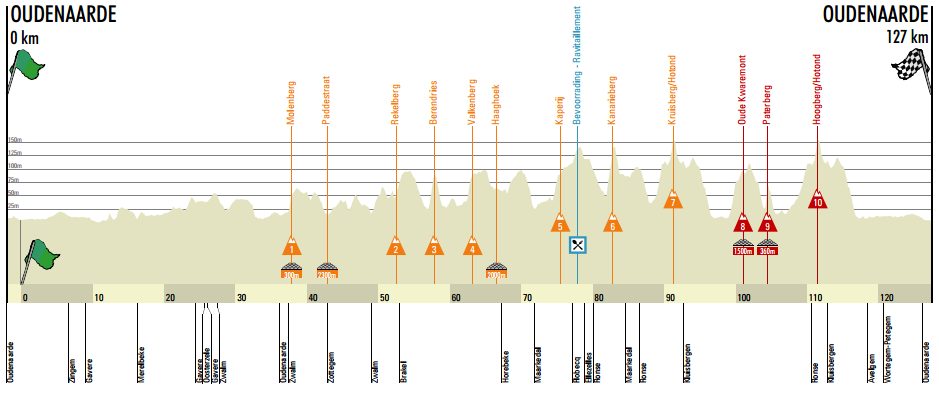
Some races retain the same route year after year - and understandably so, as sending route finders out on reconnaissance missions costs money that could be spent on other aspects of the event (this is especially true in women's cycling as many races are run on shoestring budgets). The Ronde, meanwhile, tends to change with each edition as organisers add new sections and alter the order in which the hills are climbed, making them more or less decisive than in years past - but not this year, when the route was almost identical to 2012 with only a small alteration near Gavere some 11.5km in while Molenberg, missed out last year, became the first climb and Rekelberg, first last year, was second.

It remained  as classically a Flandrian race as can be, featuring a hard and challenging parcours with several cobbled sections that, despite lack of rain, were made especially dangerous by the potential for icy patches in sheltered areas due temperatures not much above freezing point - a nasty crash en route to Molenberg forced Jessie Maclean (Orica-AIS) out of the race when she hit her head, though she escaped injury. The Ronde, like many of the other races in Flanders, is also famous for the numerous short but very steep climbs - Rekelberg, for example: the average gradient over its 0.8km is 4% which doesn't sound too bad, but the steepest part at a painful 9% would be more than enough to persuade many non-professional cyclists to get off and push. Oh - and it was the easiest climb in the race. Paterberg, the toughest, has an average gradient of 12.9% and a maximum 20.3% - in Flemish, that's known as brutaal.

Click to enlarge

The climbs were Molenberg, 37.8km, average 7%, maximum 14.2% (a few riders had to dismount and run up); Rekelberg, 52.4km, av. 4%, max. 9%; Berendries, 57.8km, av. 7%, max. 12.3%; Valkenberg, 63.1km, av. 8.1%, max. 12.8%; Kaperij, 75.4km, 5.5%, max. 9%; Kanarieberg, 82.8km, av. 7.7%, max. 14%; Kruisberg/Hotond, 91.2km, av. 5%, max. 9%; Oude Kwaremont, 101km, av. 4%, max. 11.6% and Paterberg, 104.4km, av. 12.9%, max. 20.3%; Hoogberg/Hotond, 111.4km, av. 3.5%, max. 8%. Few riders troubled themselves with trying to break away, perhaps preferring to stay with the pack to keep warm; special mention must go to Suzanne Zorzi (Faren-Let's Go Finland) for managing to put a gap of two minutes between herself and the peloton before she was brought back. Lucinda Brand (Rabobank) and Amanda Spratt (Orica-AIS) had a go between Kruisberg and Oude Kwaremont but were not permitted to get any further than a few seconds ahead.

Paterberg, 23km from the finish line, was expected to prove decisive with any group or individual that could get to the climb at the front of the peloton, remain ahead as the pack began to break up and then maintain their lead over Hoogberg would be in with a very good chance of staying in front to the end; as indeed was the case - Vos, Emma Johansson (Orica-AIS) and Elisa Longo Borghini (Hitec Products-UCK) escaped on Oude Kwaremont and worked together to build up a comfortable lead, which makes Ellen van Dijk's successful efforts to bridge and join them all the more impressive. Johansson tried to attack Vos at the top of the climb but found Longo Borghini and van Dijk unable to assist; then more attacks came as Oudenaarde approached, driving the pace so high that the Orica rider found herself temporarily dropped until she made an effort every bit as superhuman as van Dijk's and managed to rejoin, setting the scene for a classic sprint finish.

Vos, showing exactly why she's so frequently compared to Eddy Merckx (except by the ever-increasing number of fans who argue she's the better rider), launched her sprint early and silenced those who wondered if sixth place at last week's Trofeo Alfredo Binda might be a sign that the current World Champion was devoting too much time and attention to her newly-rekindled mountain biking career, holding off the other three all the way to the line before a final, forceful attack powered her to victory. She knew she'd finally added the Ronde to her palmares with 25m still to go, letting out a whoop of joy that was answered with a roar of support from the fans while van Dijk found the strength to battle past Johansson for second place.

"We tried everything we could to get away from Marianne. She just has that little kick that makes it impossible to escape from her,” van Dijk told reporters after the race. Vos now has 174 following three rounds of the World Cup, with van Dijk second in the standings on 135 points and Johansson third with 120.

Top Ten
Start list - lick to enlarge
1 Marianne VOS (Rabobank-Liv/Giant) 3h33'21"
2 Eleonora VAN DIJK (Specialized-Lululemon) ST
3 Emma JOHANSSON (Orica-AIS) ST
4 Elisa LONGO BORGHINI (Hitec Products-UCK) ST
5 Annemiek VAN VLEUTEN (Rabobank-Liv/Giant) +2'37"
6 Adrie VISSER (Boels-Dolmans) ST
7 Anna VAN DER BREGGEN (Sengers) ST
8 Loes GUNNEWIJK (Orica-AIS) ST
9 Elizabeth ARMITSTEAD (Boels-Dolmans) +2'39"
10 Kirsten WILD (Argos-Shimano) +4'33"
Full result here

Video
As ever, the coverage given to the women's race was woeful when compared to that the men's event received - as bemoaned by fans and riders alike on Twitter and elsewhere. Fortunately, encouraged by the enormous popularity of the women's road race at the 2012 Olympics and the constant badgering by fans (keep it up, folks!), the UCI has finally come to realise that, provided it's made available and accessible to the public, there is a considerable audience for women's cycling and, as a result, it's started to provide highlights on its official YouTube channel. It's a long was from the sort of coverage the sport deserves and needs, and tends to be irritatingly brief, but it's a start - and there'll be a more in-depth half-hour highlights programme available soon.


Friday, 15 February 2013

Boels Rental Ronde van Drenthe

09.03.2013 Official Site
Netherlands, One-day World Cup Road Race, 132.8km
UCI CDM

The second race of the four-day Drentse Week, the Ronde van Drenthe comes two days after the Drentse 8 and is a completely different sort of race: while the 8 is flat and favours sprinters, the Ronde features three climbs of VAM berg - the highest point in Drenthe and a climb that in true Northern Classics style makes up for its lack of altitude with knee-busting steepness, rising to 56m above sea level in just 0.4km at an average gradient of 9.7% with steeper sections up to 16% on the way. Think it doesn't sound too bad? Even Marianne Vos has to put serious effort into getting up it...


In addition to the three ascents and because a 16% gradient isn't enough to satisfy Dutch cycling fans' idea of what a hard race should be, there are also plenty of cobbles, numerous tight corners, narrow bridges, slippery moss-covered roads and - always a potential issue in this part of the world at this time of year - the weather: there's a very good chance that riders will face rain (and perhaps snow), freezing temperatures and strong winds blowing in from the North Sea. Sounds like fun, doesn't it?

The women's race has been running under various names since 2007 and has been dominated by Dutch riders: Adrie Visser won the first edition, followed by Chantal Beltman in 2008, Swedish Emma Johansson in 2009, Loes Gunnewijk in 2010 and then Vos in 2011 and 2012. After a typically excellent cyclo cross season and a swathe of triumphs last year, Vos is the easy favourite; however, her enormous talent and success has forced rivals to respond and she won't win again without serious challenges from other teams.

The Parcours

Drenthe is located in the north-eastern corner of the Netherlands, just south of Groningen. Densely populated during the Bronze Age, it's now a rural province with a far lower population density that most of the rest of the country. In the Netherlands, it's nicknamed "The Cycling Province" due to the large numbers of cyclists from across Europe who come to ride on the quiet, excellent roads. At the beginning of the Second World War, Drenthe was home to a camp housing German Jewish refugees who had fled the Nazis; after the Netherlands was invaded the camp was taken over and became a transit camp from which Jews, Gypsies and others were sent to the concentration camps (among them, Anne Frank, who was placed on the last train to leave the camp for Auschwitz where she died early in March 1945). Today, the province frequently plays host to historical re-enactments of the conflict, as Australian star Bridie O'Donnell discovered when she took a wrong turn on her way to the race in 2010 and ended up right in the middle of one. 

VAM berg
VAM berg's unusual name comes from the fact that it's not a natural feature - it used to be a rubbish dump maintained by the Vuijl Afvoer Maatshappij ("Waste Disposal Company") who covered it in soil and turned it into a hill once it reached the end of its operational life. The riders climb it for the first time 9.4km after reaching the end of the neutralised zone at Hoogeveen - with the surrounding landscape being so flat, the views from the top are superb; however, since it's such a crucial factor in deciding the eventual outcome of the race the riders won't take much notice even at this early stage. There are the first GPM points of the race on offer for the first riders to the top and there is plenty of opportunity for a breakaway on the way down - if a rider or group does manage to get away here she or it is unlikely to stay away for the remaining 122km (although it might not be particularly surprising if Vos managed to pull that one off), but it's a chance for those riders who don't have much chance of winning to get some time out in front where the press can notice them. The first third of the climb is steepest with an average gradient of 14%; it becomes progressively less steep over the last two thirds to the summit.

Once through Nieuw-Balinge, the riders enter an area with many ponds and small lakes formed by the peat cutting industry that brought much of the region's income and shaped the landscape. At 20.2km, now in forest, they come to the first cobbles - a 500m section made especially treacherous by the moss and algae that grow in the damp forest and a real challenge for riders in any break that got away earlier now that they'll be wanting to extend their advantage in preparation for the intermediate sprint at Emmen, 41.8km into the parcours. There are more cobbles, albeit far less dangerous ones, on the way through Exloo from 50.1 to 53.8km, then some more at Borger-Odoorn from 57.2 to 60.7km and again at 67.1 to 69.1km before the race enters a 14km section featuring several tight corners and narrow stretches en route towards the second ascent of VAM berg at 93.1km, where there are again points for the first riders up and scope for the race to change dramatically - a break could be caught on the way up or might extend its lead if it includes climbers, or a new one might form.

Marianne Vos won in
2011 and 2012. Can she
be stopped this year?
Recent performances
suggest not.
Heading back along some of the same roads they used earlier, the riders make their way back to Hoogeveen and begin the third part of the race. At 106.5km they pass over the finish line for the first time, beginning the second intermediate sprint. They then head back out of town in the direction of Stuifzand, negotiating some hazardous sharp bends after around 111km before entering the VAM industrial site once more for the third and final climb of VAM berg at 119.9km. Now, the order in which the riders climb it is important: there are insufficient kilometres to the finish line for the peloton to risk allowing a strong break to get away and, should one form, expect the teams to work together to bring them back rapidly; if it's a superstrong break, made up of some race favourites and their most able domestiques, the eventual winner will be among them. This last section will probably see an increasing number of attacks as riders test one another, finding out who has a the strength left for a last push and who won't be able to hold their own. After passing through Stuifzand for the final time, the race returns to Hoogeveen where the riders head into town along the Griendtsveenweg, then turn the last corner, left at a roundabout onto Rembrandstraat - not an easy corner as the wide road is split into two narrow carriageways by a central island for much of its length, creating a potential bottleneck if a large number of riders fighting for good positions to begin the final sprint are compressed into a tight area. The width of the road doesn't change from now on, meaning that if a bunch is leading the race sprinters may have difficulty in forcing their way through to the front in time for the final 300m to the finish line on Prinses Beatrixstraat.

Start List

Not yet available

Weather

More information nearer to the race